
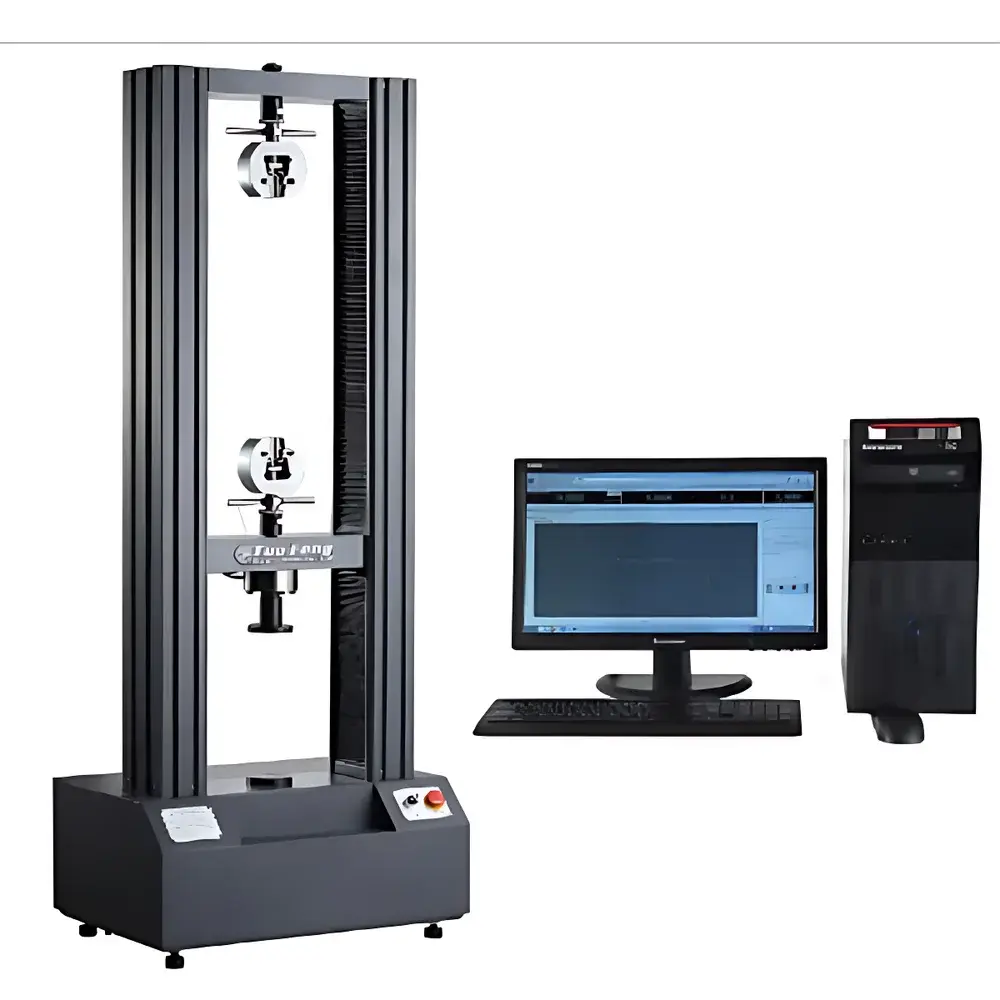
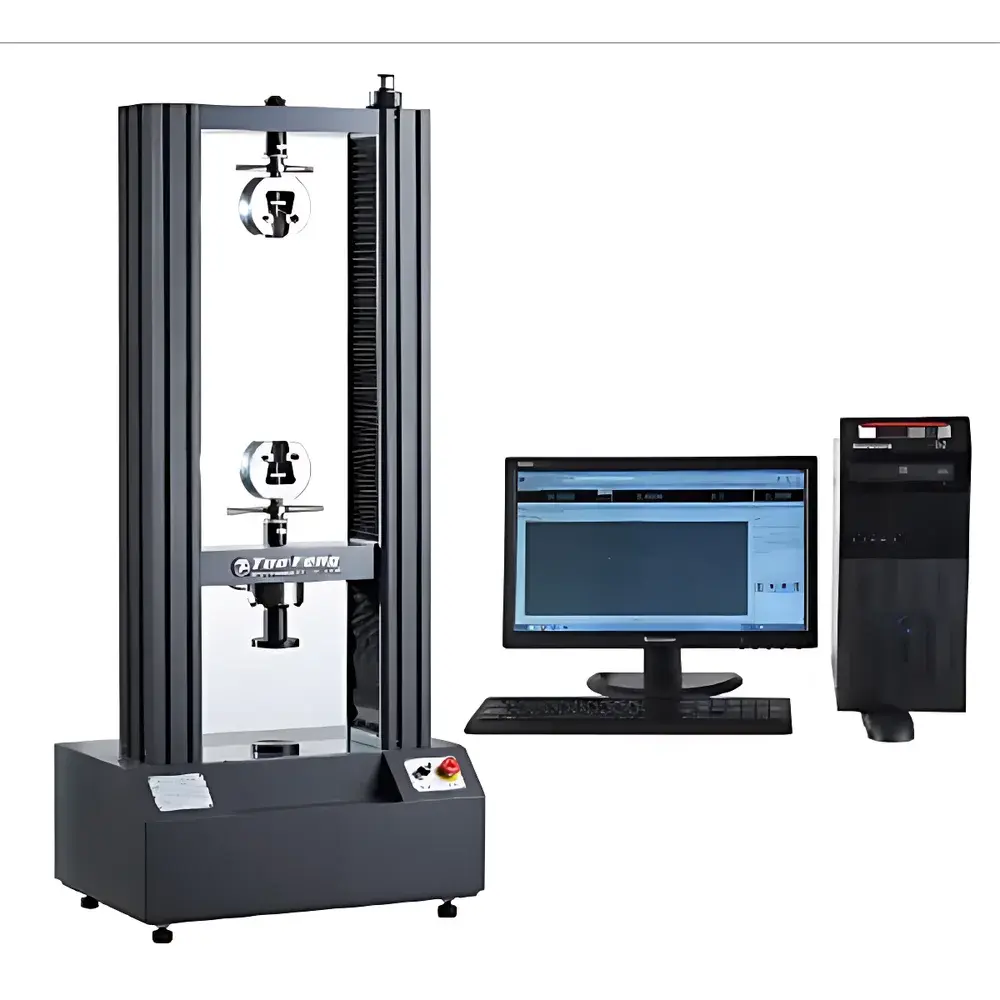
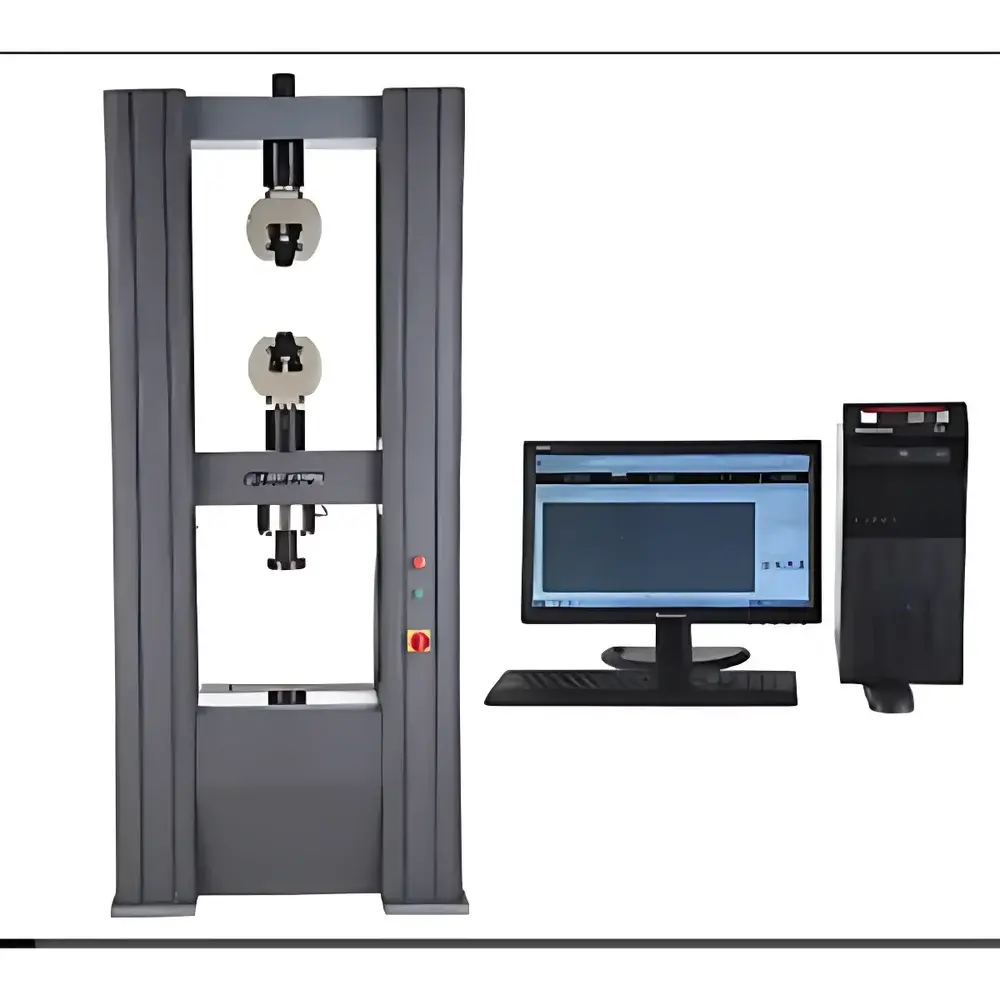
Tuofeng TFW-311 Microcomputer-Controlled Universal Testing Machine
| Brand | Tuofeng |
|---|---|
| Origin | Shanghai, China |
| Manufacturer Type | Direct Manufacturer |
| Product Category | Domestic |
| Model | TFW-311 |
| Price Range | USD 1,400 – 14,000 |
| Instrument Type | Electromechanical Universal Testing Machine |
| Load Capacity | 300 kN |
| Load Accuracy | ±0.5% |
| Accuracy Class | 0.5 |
| Effective Force Measurement Range | 0.2%–100% of Full Scale |
| Force Resolution | 1 part in 500,000 (full-scale, single-range, constant resolution) |
| Drive System | Imported Servo Motor with Worm Gear Reducer |
| Lead Screw | High-Precision Ball Screw |
| Effective Test Width | 400 mm (customizable up to 600 mm) |
| Maximum Stroke | 800 mm (extendable) |
| Speed Range | 0.001–500 mm/min (infinitely variable) |
| Displacement Measurement | Optical Encoder |
| Displacement Accuracy | ±0.005% of reading |
| Strain Measurement | Optional Extensometer or Large-Deformation Gauge |
| Strain Accuracy | ±0.005% of reading |
| Safety Protection | Electronic Limit Switches, Emergency Stop Button, Overload Protection (10% above rated capacity) |
| Crosshead Adjustment | Dual-Speed Motorized (Fast/Slow), Point-to-Point Control |
| Return Function | Automatic or Manual High-Speed Return to Initial Position |
| Fixture Customization | Application-Specific Grips Available |
| Power Supply | 220 V AC, 3.0 kW |
| Approx. Weight | 1,500 kg |
| Compliance | GB/T 16491–2008, JJG 475–2008, ASTM E4, ASTM E8, ASTM D638, ISO 6892-1, ISO 7500-1, DIN 51221, JIS Z2241, BS EN 10002-1 |
Overview
The Tuofeng TFW-311 Microcomputer-Controlled Universal Testing Machine is an electromechanical force-testing platform engineered for precision mechanical property characterization of metallic, polymeric, ceramic, composite, and elastomeric materials. Based on closed-loop servo control architecture and high-fidelity load-cell transduction, it implements standardized uniaxial tensile, compressive, flexural, shear, tear, peel, and puncture testing per international mechanical testing protocols. Its dual-range load cell design—calibrated to a maximum capacity of 300 kN—and integrated high-resolution displacement and strain acquisition systems enable traceable, repeatable measurement of yield strength, ultimate tensile strength (UTS), fracture elongation, Young’s modulus, compressive strength, Poisson’s ratio, and proof stress. The system complies with metrological requirements defined in ISO 7500-1 (Class 0.5 accuracy), ASTM E4 (verification of force-measuring instruments), and JJG 475–2008 (Chinese verification regulation for electronic universal testers), supporting GLP-compliant data integrity when paired with audit-trail-enabled software configurations.
Key Features
- High-stiffness, single-column or dual-column frame architecture (model-dependent) with preloaded ball screws and low-backlash gear reduction for minimal compliance and thermal drift.
- Imported industrial-grade servo motor delivering smooth, noiseless motion across the full speed range (0.001–500 mm/min), enabling quasi-static to dynamic-rate testing without mode switching.
- Full-scale force resolution of 1:500,000 with no internal range switching—ensuring consistent sensitivity from 0.2% to 100% of 300 kN capacity.
- Dual-mode position control: programmable crosshead movement with independent fast/slow speeds and precise point-to-point positioning for fixture alignment and specimen preloading.
- Comprehensive hardware safety layer: redundant protection including electronic travel limits, emergency stop circuitry, and automatic overload cutoff at 110% of rated load.
- Modular grip interface accommodating wedge-action, pneumatic, hydraulic, and custom-designed fixtures for flat, round, threaded, or irregular specimens.
Sample Compatibility & Compliance
The TFW-311 accommodates specimens ranging from thin films (<0.1 mm thickness) to structural steel coupons (up to 60 mm diameter or 40 mm thickness), provided within its 400–600 mm test width and 800 mm stroke envelope. Standardized test methods supported include ASTM D638 (tensile plastics), ASTM E8/E21 (metals), ISO 6892-1 (metallic materials—tensile testing), ISO 527 (plastics), ISO 178 (flexural properties), and GB/T 228.1 (Chinese metallic tensile standard). All calibration and verification procedures adhere to ISO/IEC 17025 requirements for testing laboratories. The machine meets the mechanical construction and performance criteria specified in GB/T 16491–2008 and is supplied with factory calibration certificates traceable to NIM (National Institute of Metrology, China).
Software & Data Management
The embedded Windows-based testing software provides multi-language UI (English, Simplified/Traditional Chinese), unit-system flexibility (N/kN/lbf, mm/in, MPa/psi), and real-time visualization of up to four synchronized curves: load–time, load–displacement, stress–strain, and displacement–time. It supports ASTM/ISO-defined control modes—including constant rate of extension (CRE), constant load ramping, hold-at-load, and displacement-controlled cycling—as well as user-defined step sequences. Raw data is stored in ASCII-compatible .csv format with timestamped metadata; all test parameters, operator ID, environmental conditions (if sensor-integrated), and instrument configuration are automatically logged. Audit-trail functionality—including user login history, parameter change logs, and report generation timestamps—can be enabled to satisfy FDA 21 CFR Part 11 and ISO 13485 documentation requirements. Software updates are delivered remotely with version-controlled release notes and backward-compatible data file handling.
Applications
This system serves as a primary mechanical characterization tool across quality control, R&D, and certification workflows. In aerospace manufacturing, it validates tensile ductility and yield consistency of aluminum alloys and titanium fasteners. In polymer R&D labs, it quantifies creep resistance under sustained load and measures tear propagation in elastomeric seals. Automotive suppliers use it for validating weld joint strength in sheet metal assemblies and evaluating peel adhesion of laminated composites. Within building materials testing, it determines compressive strength of concrete cores and flexural modulus of fiber-reinforced cement boards. Academic institutions deploy it for fundamental studies of viscoelastic behavior in hydrogels and fracture mechanics in brittle ceramics. Its modular design allows integration with environmental chambers (−70°C to +300°C), video extensometry, and acoustic emission sensors for advanced multimodal analysis.
FAQ
What standards does the TFW-311 comply with for force calibration and verification?
It conforms to ISO 7500-1 (Class 0.5), ASTM E4, JJG 475–2008, and GB/T 16491–2008, with factory calibration traceable to national metrology institutes.
Can the system perform cyclic loading or fatigue tests?
Yes—the software supports programmable load/displacement waveforms (sine, triangle, trapezoidal) with dwell periods; however, dedicated high-cycle fatigue testing requires optional servo-hydraulic actuation modules.
Is third-party certification available for ISO/IEC 17025 accreditation?
Tuofeng provides documentation packages—including uncertainty budgets, calibration records, and installation qualification (IQ) templates—to support laboratory accreditation processes.
How is data integrity ensured during long-duration tests (e.g., creep or relaxation)?
Continuous sampling at ≥100 Hz, non-volatile memory buffering, and automatic power-fail recovery prevent data loss; all raw acquisitions are time-stamped and checksum-verified.
Are extensometers included as standard equipment?
Electronic axial extensometers and clip-on large-deformation gauges are optional accessories—selected based on gauge length, strain range, and material surface compatibility.



