
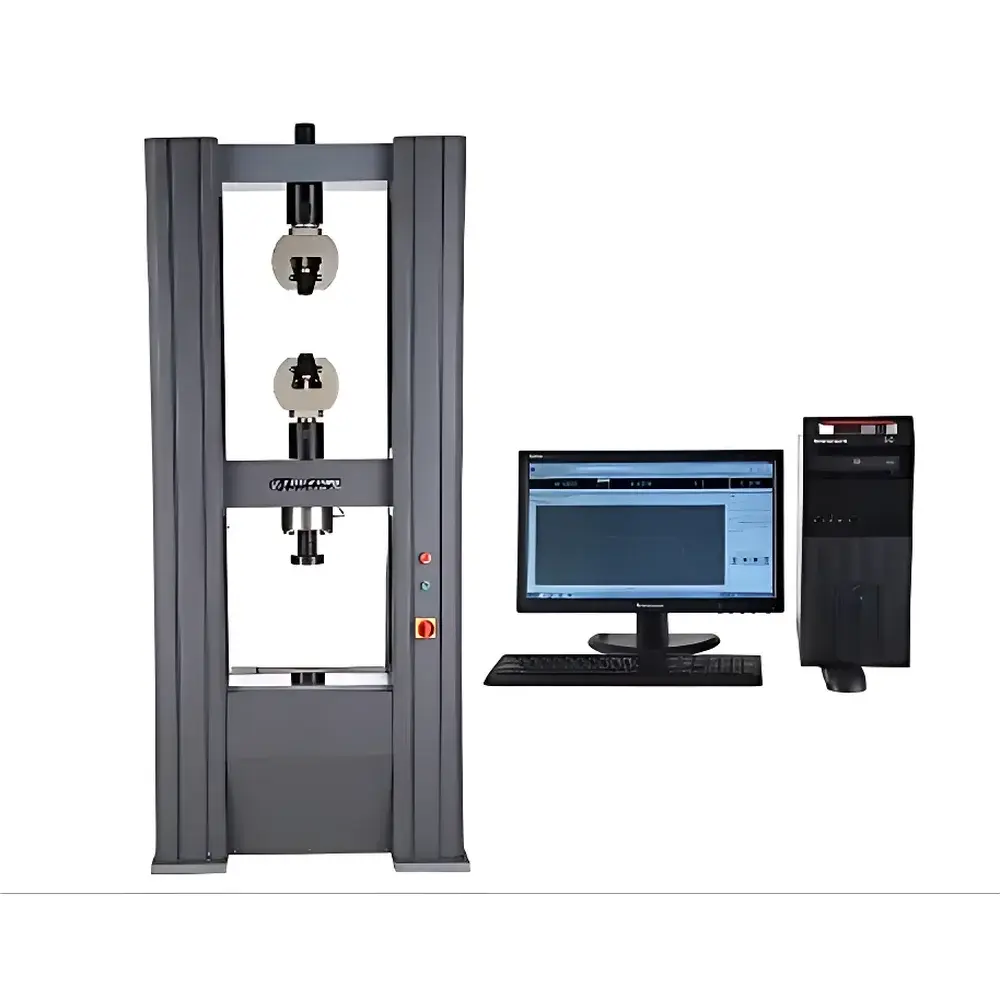
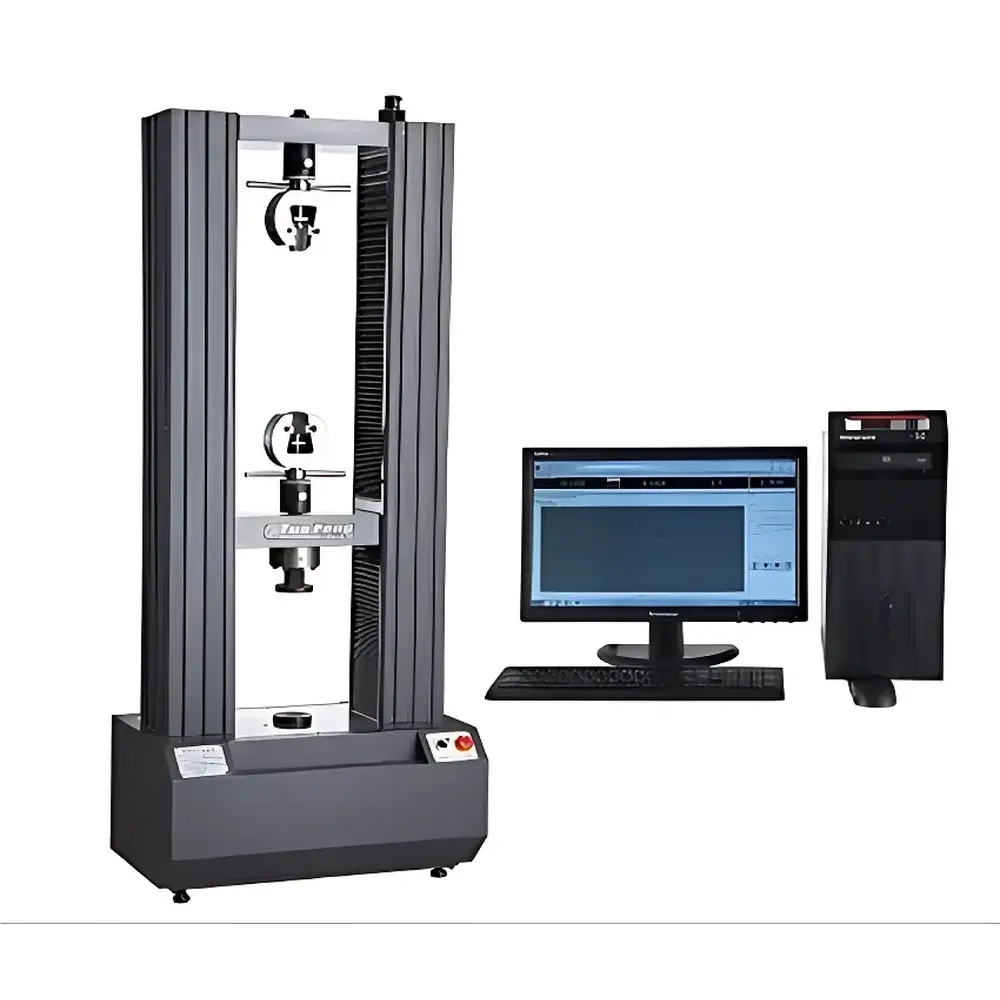
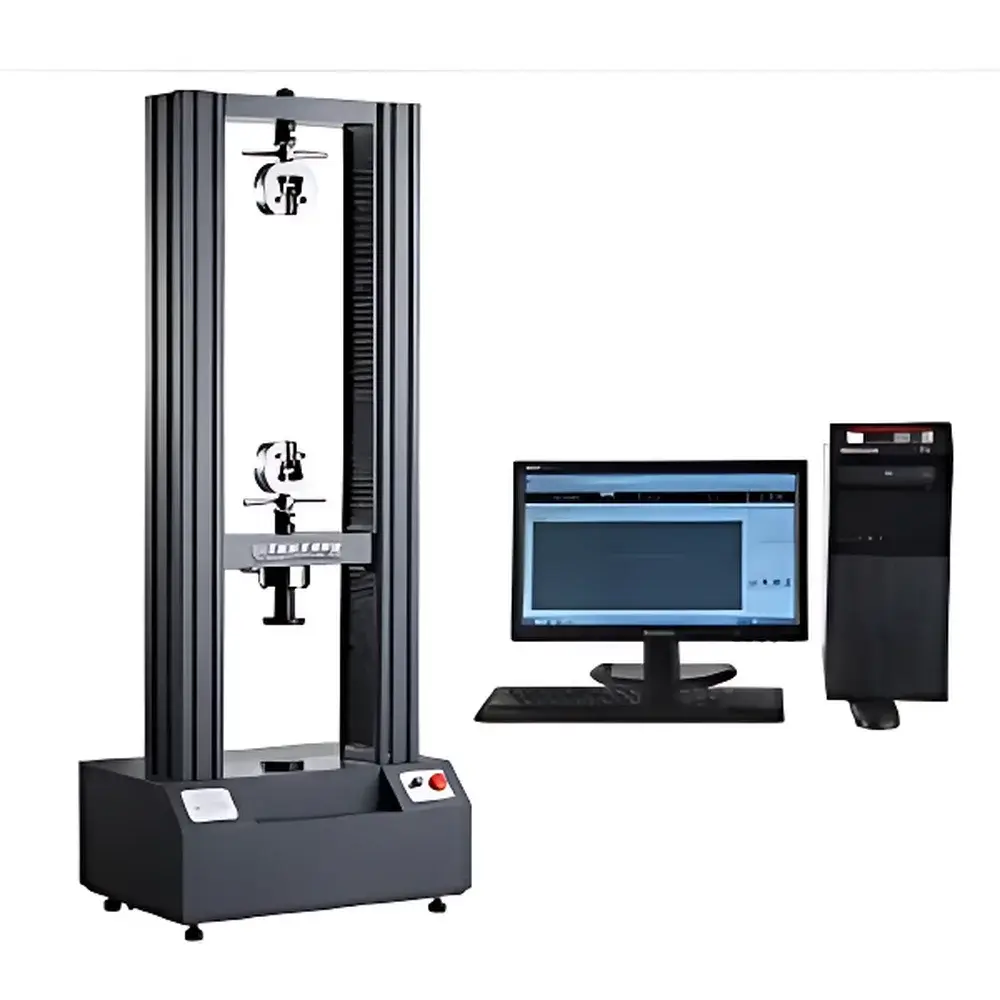
Tuofeng TFW-37 Microcomputer-Controlled Electromechanical Universal Testing Machine
| Brand | Tuofeng |
|---|---|
| Origin | Shanghai, China |
| Manufacturer Type | Direct Manufacturer |
| Equipment Type | Electromechanical Universal Testing Machine |
| Model | TFW-37 |
| Force Capacity | 37 kN (typical configuration within TFW series) |
| Accuracy Class | ISO 7500-1 / ASTM E4 Class 0.5 |
| Compliance | GB/T 16491–2008, JJG 475–2008, ISO 6892-1, ASTM E8/E9/E21/E292, DIN 50125, JIS Z2241 |
Overview
The Tuofeng TFW-37 is a dual-column, microprocessor-controlled electromechanical universal testing machine engineered for high-fidelity static mechanical characterization of engineering materials. It operates on the principle of controlled displacement actuation via precision ball-screw-driven crosshead movement, coupled with closed-loop load and displacement feedback using high-stability load cells and optical encoder-based position sensing. Designed in accordance with ISO 7500-1:2018 (static calibration of force-proving instruments) and ASTM E4-23 (practices for force verification of testing machines), the system delivers traceable, reproducible mechanical data across tension, compression, bending, shear, peel, tear, and puncture test modes. Its modular architecture supports seamless integration of extensometry—including clip-on electronic extensometers and video-based digital image correlation (DIC) systems—for strain measurement compliant with ISO 9513 and ASTM E83. The TFW-37 serves as a core platform for R&D laboratories, quality control departments, and third-party certification bodies requiring metrologically sound mechanical property evaluation under standardized conditions.
Key Features
- Dual-column rigid frame with high-rigidity welded steel construction and precision-machined guide surfaces, minimizing deflection during high-load testing.
- Imported servo motor coupled with worm-gear reduction gearbox and preloaded recirculating ball screw—ensuring smooth, backlash-free motion and long-term positional stability.
- Force measurement system calibrated to ±0.005% of reading (full scale), with resolution up to 1 part in 500,000 codes—maintaining consistent resolution across the entire 0.2%–100% effective force range.
- Adjustable crosshead travel (standard 800 mm, extendable upon request) and wide test width (400 mm base, expandable to 600 mm) accommodate diverse specimen geometries and fixture configurations.
- Programmable speed control from 0.001 to 500 mm/min (infinitely variable, no gear shifting), enabling quasi-static creep, relaxation, and rate-dependent dynamic tests per ISO 6892-1 Annex D.
- Integrated safety subsystems: electronic limit switches, emergency stop circuitry, overload protection (auto-shutdown at >110% FS), and dual-speed motorized crosshead return with manual override.
- Real-time dual-channel acquisition of load, displacement, and optional strain signals—synchronized at ≥1 kHz sampling rate for transient event capture.
Sample Compatibility & Compliance
The TFW-37 accommodates metallic alloys (ferrous/non-ferrous), polymers, elastomers, composites, ceramics, textiles, adhesives, and thin films—provided specimens conform to standard gauge lengths and cross-sectional dimensions defined in applicable test methods. Standard fixtures include wedge-action tensile grips, compression platens, three- and four-point bending assemblies, and pneumatic peel/tear fixtures. All mechanical tests comply with international regulatory and industrial standards including: ASTM E8/E8M (tension), E9 (compression), E292 (fracture toughness), ISO 6892-1 (metallic tensile), ISO 178 (flexural), ISO 527 (plastics tensile), ISO 1133 (melt flow index correlation), DIN 53455 (rubber tear), and JIS Z2241 (Japanese tensile standards). System validation documentation satisfies GLP audit requirements and supports FDA 21 CFR Part 11-compliant electronic records when paired with validated software modules.
Software & Data Management
The Windows-based Tuofeng TestSuite™ v5.x provides full IEC 62304-compliant test control and analysis functionality. It supports multiple test modes—load-controlled, displacement-controlled, strain-controlled, hold (load/position), and ramp-hold sequences—with customizable PID tuning parameters. Real-time plotting includes selectable axes: Load vs. Time, Load vs. Displacement, Stress vs. Strain, Displacement vs. Time, and custom user-defined curves. All raw data are stored in encrypted binary format with embedded metadata (operator ID, timestamp, environmental conditions, calibration IDs). Software features include automatic calculation of tensile strength, yield point (0.2% offset), modulus of elasticity, elongation at break, compressive strength, flexural modulus, tear strength, peel adhesion, and Poisson’s ratio—based on user-input specimen geometry and gauge length. Data export options include CSV, XML, PDF reports, and direct SQL database logging. Audit trail functionality logs all parameter changes, test executions, and result modifications—meeting ALCOA+ principles for data integrity.
Applications
The TFW-37 is routinely deployed in aerospace component qualification (e.g., composite layup tensile shear, fastener pull-out), automotive material validation (seat belt webbing tensile, gasket compression set), medical device testing (suture tensile strength, catheter kink resistance), battery electrode mechanical integrity assessment, additive manufacturing post-process characterization (LPBF Ti-6Al-4V tensile anisotropy), and construction material certification (rebar yield behavior, geotextile grab strength). Its adaptability to specialized fixtures enables advanced protocols such as ISO 14129 interlaminar shear testing, ASTM D638 dog-bone tensile mapping, and ASTM D1876 T-peel adhesion evaluation of structural adhesives.
FAQ
What international standards does the TFW-37 support out-of-the-box?
The system is pre-configured with test templates and calculation routines aligned with ASTM E8, ISO 6892-1, ISO 178, GB/T 228.1, and JIS Z2241. Custom method development is supported via scripting interface.
Can the TFW-37 be integrated into a factory MES or LIMS environment?
Yes—via OPC UA or TCP/IP API, enabling bidirectional communication with enterprise systems for automated job dispatch, result ingestion, and calibration status synchronization.
Is third-party calibration and IQ/OQ/PQ documentation available?
Tuofeng provides ISO/IEC 17025-accredited calibration certificates and offers GMP-aligned installation qualification (IQ), operational qualification (OQ), and performance qualification (PQ) packages upon request.
What extensometry options are compatible with this model?
Standard support includes ASTM E83-compliant clip-on extensometers (10–50 mm gauge length, ±0.5 µm resolution) and non-contact video extensometry systems for high-strain or elevated-temperature applications.
Does the software meet FDA 21 CFR Part 11 requirements?
When deployed with role-based access control, electronic signatures, and audit trail activation enabled, the validated version of TestSuite™ satisfies 21 CFR Part 11 Subpart B for electronic records and signatures.



