
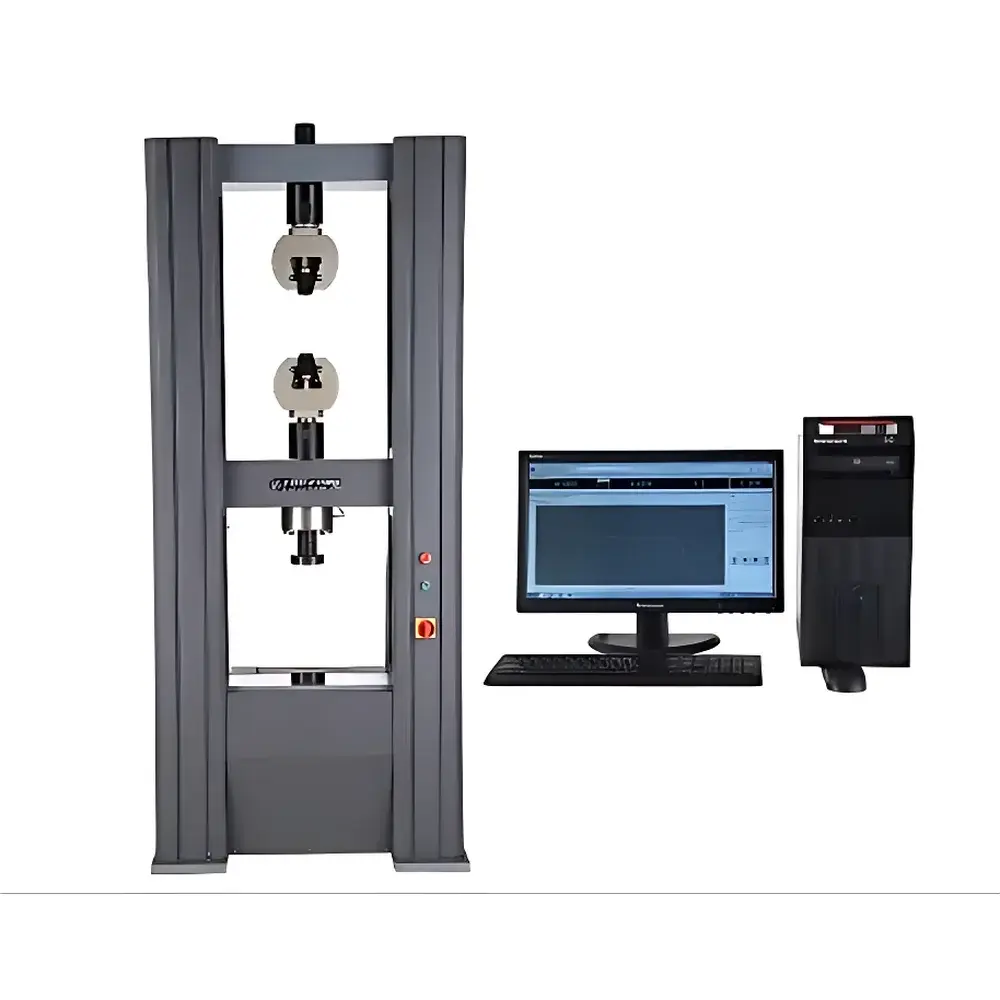
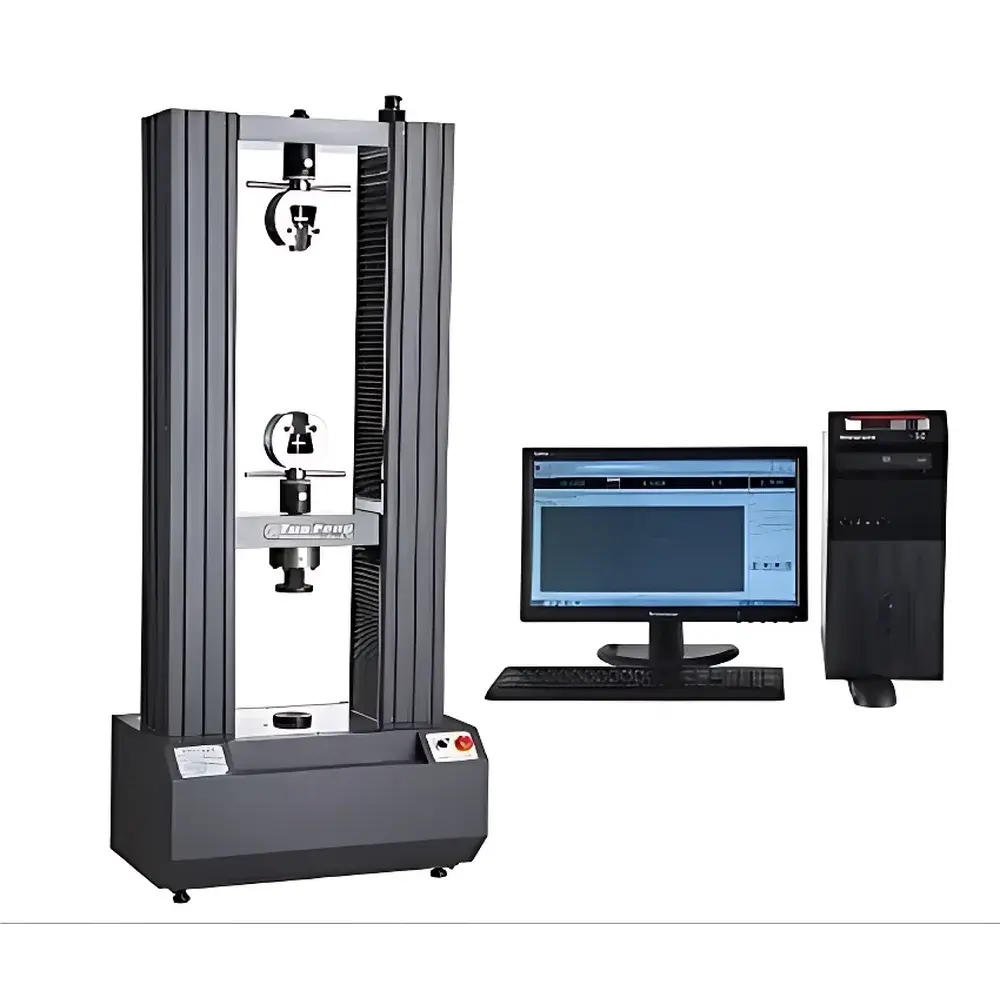
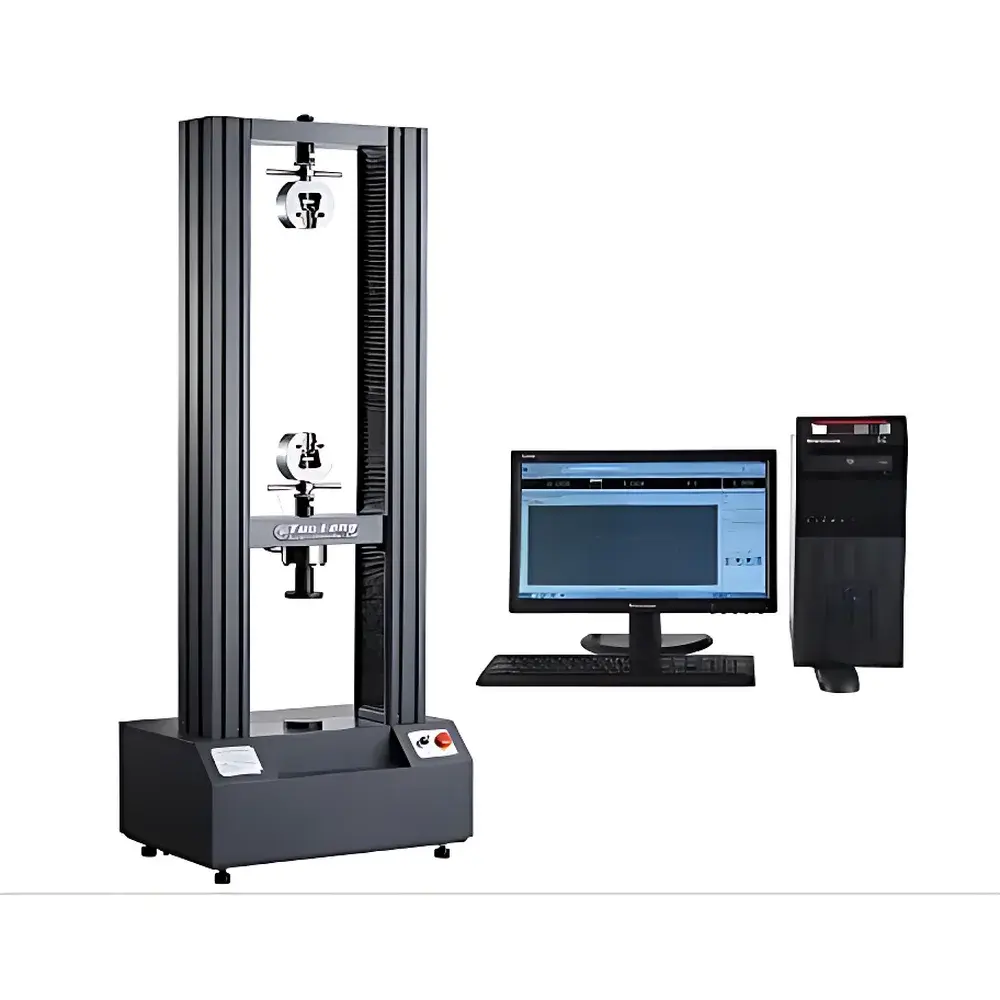
Tuofeng TFW-81 Microcomputer-Controlled Electronic Universal Tensile Testing Machine
| Brand | Tuofeng |
|---|---|
| Origin | Shanghai, China |
| Manufacturer Type | Direct Manufacturer |
| Instrument Type | Electronic Universal Testing Machine |
| Model | TFW-81 |
| Max Test Load | 200 kN |
| Force Measurement Range | 0.2%–100% of Full Scale |
| Force Accuracy | ±0.5% of reading |
| Test Stroke | 1000 mm |
| Displacement Resolution | 0.001 mm |
Overview
The Tuofeng TFW-81 is a microcomputer-controlled electronic universal tensile testing machine engineered for high-precision mechanical property evaluation of metallic, non-metallic, and composite materials. Based on servo-motor-driven electromechanical actuation and high-accuracy load cell transduction, the system adheres to fundamental principles of uniaxial static mechanical testing per ISO 6892-1, ASTM E8/E21, and GB/T 228.1. Its modular architecture supports standardized tensile, compression, bending, shear, tear, peel, and puncture tests—enabling full characterization of strength, stiffness, ductility, and deformation behavior under controlled displacement or load conditions. Designed for industrial R&D labs and quality control environments, the TFW-81 delivers traceable, repeatable, and auditable test data in compliance with GLP and GMP-aligned workflows.
Key Features
- Precision force measurement via calibrated load cell with ±0.5% accuracy across 0.2–100% FS range, eliminating range-switching artifacts
- High-resolution displacement sensing using optical encoder system (0.001 mm resolution) and optional extensometer integration for strain measurement
- Imported servo motor coupled with precision ground ball-screw transmission ensures smooth, low-noise motion control and minimal backlash
- Dual-speed automatic crosshead adjustment (fast/slow modes) with programmable return-to-start functionality post-test
- Comprehensive safety suite including electronic limit switches, emergency stop circuitry, and over-load protection (auto-shutdown at >110% FS)
- Robust structural frame with reinforced upright columns and adjustable test width (standard 400 mm, extendable to 600 mm)
- Wide speed range: 0.001–500 mm/min, continuously variable and programmable for quasi-static and slow-rate testing protocols
Sample Compatibility & Compliance
The TFW-81 accommodates specimens ranging from thin foils and polymer films to structural steel sections and power hardware components—including suspension clamps, tension grips, and connector assemblies used in overhead transmission lines. Standardized fixtures (tensile grips, compression platens, 3-/4-point bend jigs, peel fixtures) are available per ISO 1974, ASTM D638/D790/D882/D3330, and GB/T 2317.1–2317.4 for electrical fittings. The system conforms to national and international metrological and manufacturing standards, including GB/T 16491–2008 (Electronic Universal Testing Machines), JJG 475–2008 (Verification Regulation), ISO 7500-1 (Static Calibration), and ASTM E4 (Force Verification). It supports audit-ready documentation required for ISO/IEC 17025-accredited laboratories.
Software & Data Management
The Windows-based TFW-TestSuite software provides full test configuration, real-time monitoring, and post-processing capabilities. It supports multiple control modes—including constant rate of extension (CRE), constant load ramping, hold-to-stress/strain, and cyclic loading profiles. Real-time plotting includes load–time, load–displacement, stress–strain, and displacement–time curves, with on-screen display of peak values, yield points, modulus calculations, and user-defined analysis markers. Data units (N/kN/MPa, mm/inch, %) are freely convertible; language interface supports English, Simplified Chinese, and Traditional Chinese. All test records include timestamped metadata (operator ID, sample ID, environmental notes), support auto-save and manual archive, and generate compliant PDF reports with embedded signature fields. Software architecture enables future expansion via API-accessible modules for custom test sequences or LIMS integration. Firmware and application updates are provided free-of-charge for the lifetime of the instrument.
Applications
The TFW-81 serves as a primary mechanical characterization platform across sectors requiring rigorous material validation:
- Power transmission infrastructure: tensile strength and elongation testing of aluminum alloy fittings, galvanized steel clevises, and insulator hardware per IEC 61299 and DL/T 759
- Aerospace and automotive: fatigue-critical fasteners, composite laminates, and elastomeric bushings under ASTM D3479 and SAE J211
- Wire & cable manufacturing: conductor breaking strength, jacket tensile integrity, and insulation peel adhesion per ICEA T-28-520 and UL 1581
- Rubber and plastic processing: modulus determination, tear resistance (ASTM D624), and peel strength (ASTM D903) for gaskets, seals, and insulating tapes
- Academic and metrology institutes: method development, inter-laboratory comparison studies, and reference material certification under ISO/IEC 17043 guidelines
FAQ
Does the TFW-81 comply with FDA 21 CFR Part 11 requirements for electronic records and signatures?
The base software does not include Part 11-compliant audit trails or electronic signature modules by default; however, an optional validated version with role-based access control, electronic signature capture, and immutable audit logs is available upon request for regulated pharmaceutical or medical device applications.
Can the system be integrated into an existing laboratory information management system (LIMS)?
Yes—TFW-TestSuite supports CSV/Excel export and offers optional OPC UA or RESTful API interfaces for bidirectional data exchange with major LIMS platforms.
What calibration certificates are supplied with the instrument?
Each unit ships with a factory calibration certificate traceable to NIM (National Institute of Metrology, China) for force and displacement axes, valid for 12 months. Third-party ISO/IEC 17025 calibration services are available pre-delivery.
Is thermal compensation available for high-precision modulus measurements?
Ambient temperature monitoring is standard; for ASTM E111-compliant Young’s modulus testing, optional environmental chamber integration (−40°C to +150°C) and digital extensometer synchronization are supported.
How is mechanical overload protection implemented?
Hardware-level protection includes dual-channel load cell saturation detection, motor current limiting, and independent electronic limit switch circuits—ensuring immediate drive shutdown before mechanical damage occurs.



