
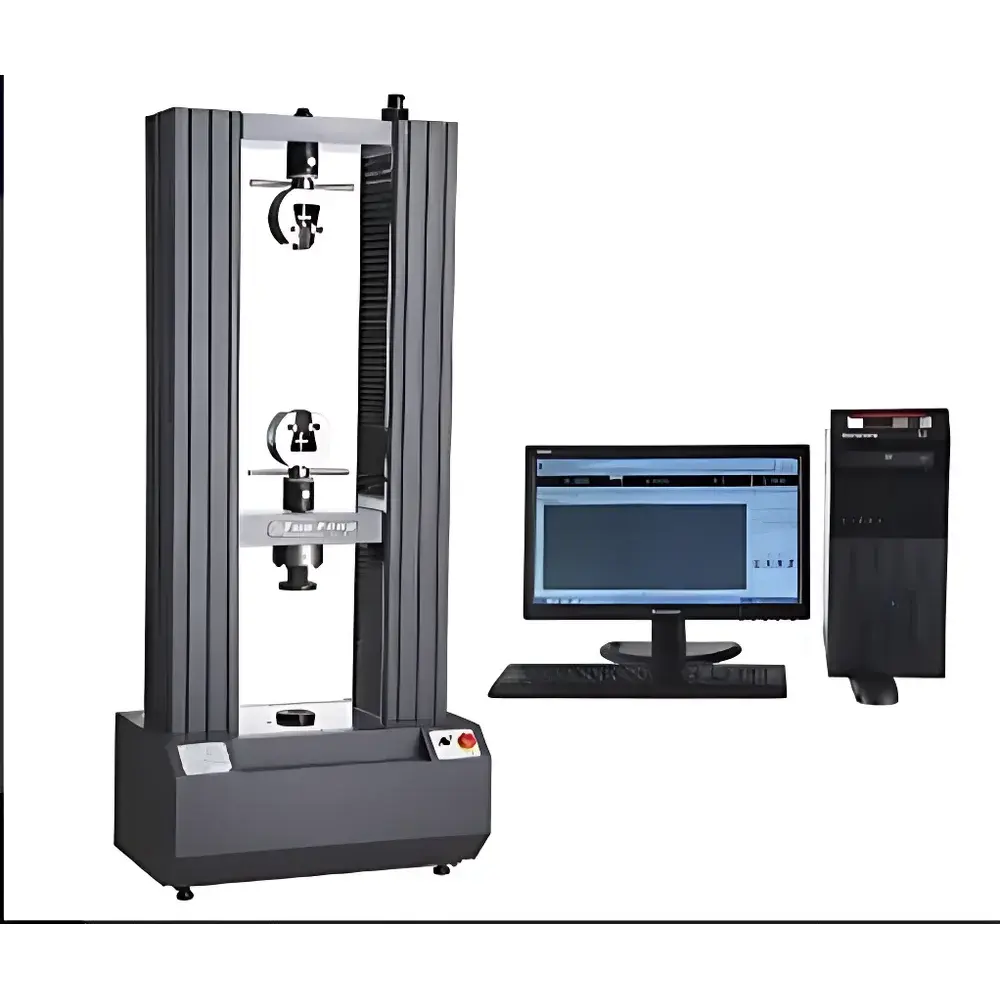
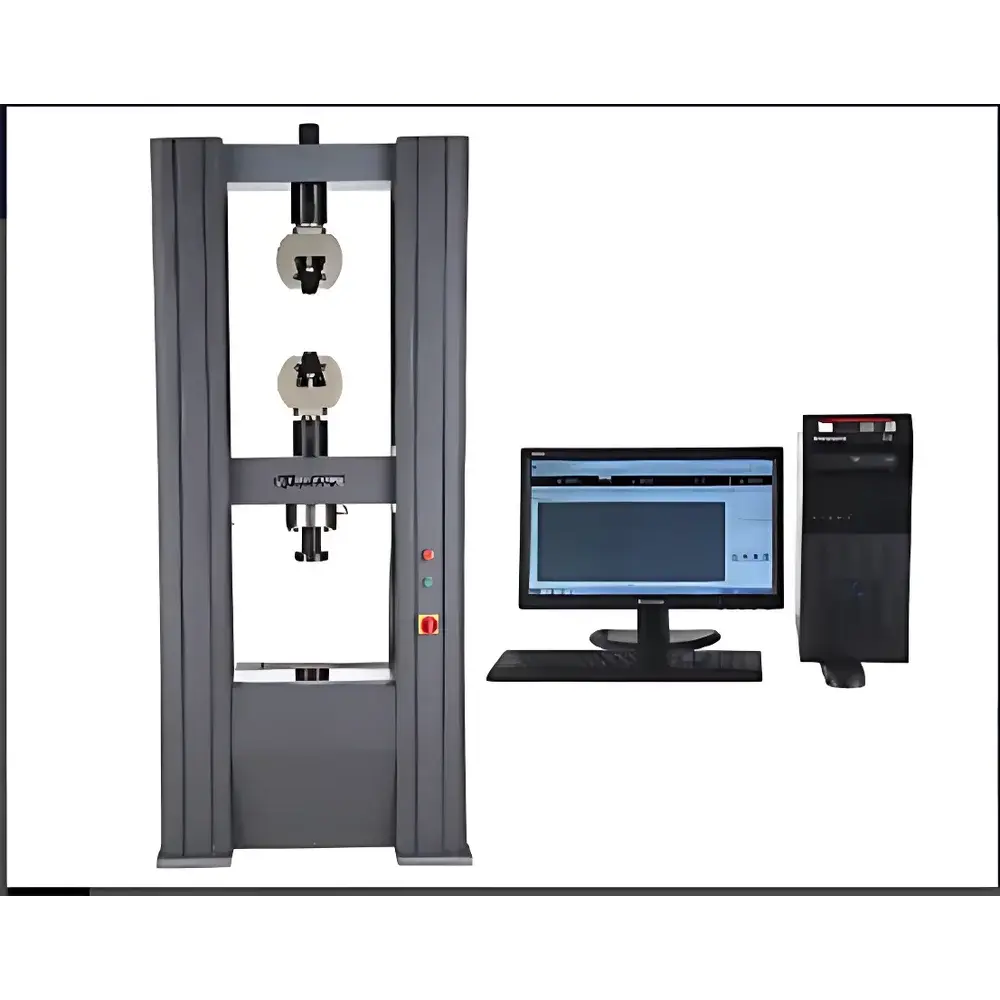
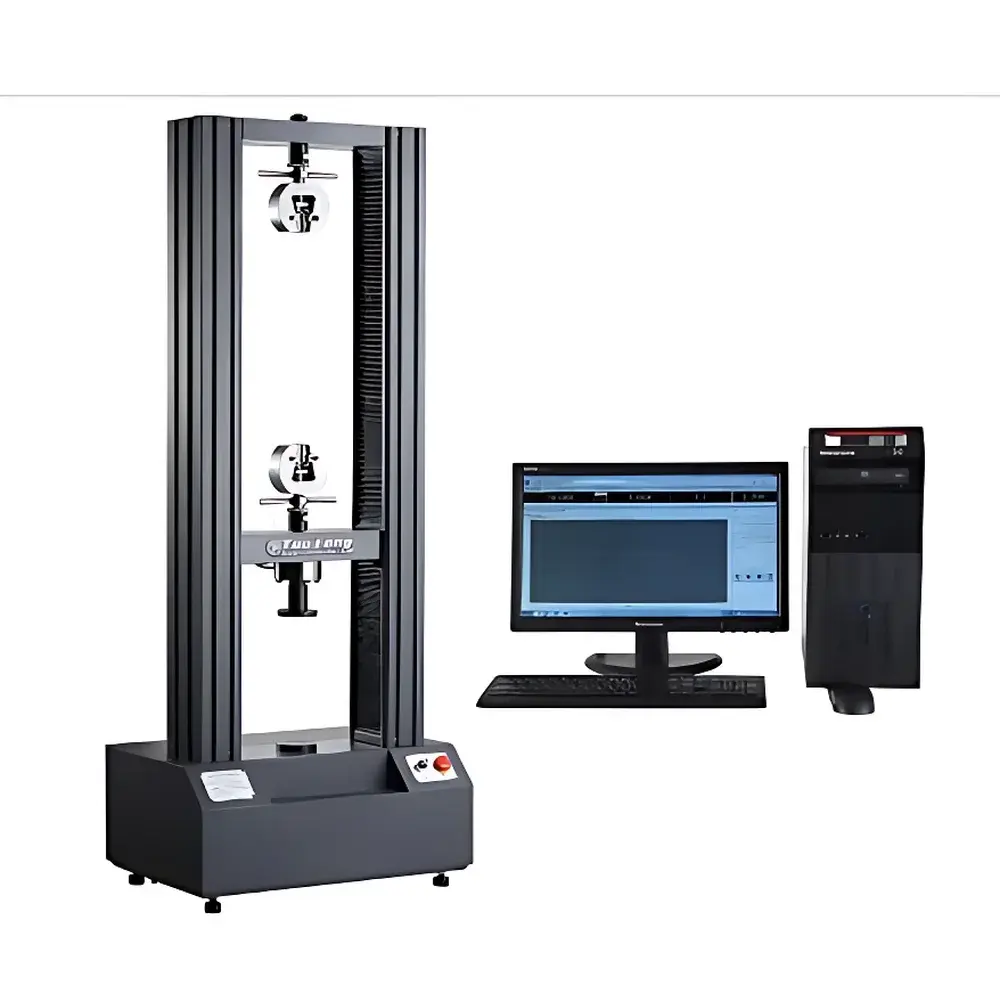
Tuofeng TFW-88 Microcomputer-Controlled Universal Testing Machine
| Brand | Tuofeng |
|---|---|
| Origin | Shanghai, China |
| Manufacturer Type | Direct Manufacturer |
| Product Category | Domestic |
| Model | TFW-88 |
| Instrument Type | Electromechanical Universal Testing Machine |
| Load Capacity Options | 5–200 kN (configurable) |
| Accuracy Class | ISO 7500-1 / ASTM E4 Class 0.5 |
| Force Range | 0.2–100% of full scale |
| Force Resolution | 1/500,000 FS (dual-range free) |
| Speed Range | 0.001–500 mm/min (infinitely variable) |
| Crosshead Travel | Up to 800 mm (extendable) |
| Effective Test Width | 400–600 mm (customizable) |
| Displacement & Strain Accuracy | ±0.005% of reading |
| Drive System | Imported servo motor + precision worm gear reducer |
| Lead Screw | High-precision preloaded ball screw |
| Safety Protection | Dual-limit electronic sensors, emergency stop, overload cutoff (>110% FS) |
| Software Compliance | Supports ASTM D638, ISO 527, GB/T 16491, JJG 475, EN 10002, JIS Z2241, BS EN ISO 6892-1 |
| Data Management | Audit-trail enabled, 21 CFR Part 11-ready configuration available |
Overview
The Tuofeng TFW-88 Microcomputer-Controlled Universal Testing Machine is an electromechanical force-testing platform engineered for high-fidelity mechanical property characterization of metallic, polymeric, ceramic, composite, and elastomeric materials. Based on the fundamental principle of controlled uniaxial loading—applying precisely regulated tensile, compressive, flexural, shear, peel, tear, or puncture forces—the system measures real-time load-displacement response to derive standardized mechanical parameters including ultimate tensile strength (UTS), yield strength (0.2% offset), Young’s modulus, fracture elongation, compressive yield stress, flexural modulus, peel adhesion, and tear resistance. Its dual-column rigid frame architecture ensures minimal deflection under load, enabling reproducible results across multi-kilonewton test ranges (5–200 kN variants). Designed and manufactured in Shanghai per GB/T 16491–2008 and calibrated to JJG 475–2008, the TFW-88 meets international metrological traceability requirements and serves as a primary reference instrument in GLP-compliant laboratories and ISO/IEC 17025-accredited testing facilities.
Key Features
- Rigid dual-column structural design with high-stiffness welded base and crosshead assembly, minimizing parasitic bending moments during high-load testing.
- Precision preloaded ball screw transmission system coupled with imported servo motor and worm gear reducer, delivering smooth motion control and zero backlash across the full speed range (0.001–500 mm/min).
- Force measurement system certified to ISO 7500-1 Class 0.5, featuring digital load cell with 1/500,000 internal resolution, no range switching required, and thermal drift compensation.
- Integrated displacement sensing via high-resolution optical encoder (±0.005% accuracy) and optional extensometer support (contact or non-contact) for strain-controlled tests per ASTM E83 or ISO 9513.
- Intelligent safety architecture: programmable electronic limit switches, hardware-based emergency stop circuit, mechanical overload protection at 110% FS, and automatic return-to-start function post-test.
- Modular fixture interface compatible with standardized wedge-action grips, compression platens, bend fixtures, peel jigs, and custom-engineered tooling per ASTM D1876, ISO 11339, or user-defined geometries.
Sample Compatibility & Compliance
The TFW-88 accommodates specimens ranging from thin polymer films (≥0.05 mm thick) to structural steel coupons (up to 50 mm diameter), including wire, rod, sheet, tube, and molded parts. Its configurable test width (400–600 mm) and extendable stroke (up to 800 mm) enable evaluation of both standard ISO/ASTM specimens and large-format composites or civil engineering samples. The system fully supports test protocols defined in GB/T 228.1, ASTM E8/E9/E21, ISO 6892-1, ISO 178, ISO 148-1, EN 10002-1, JIS Z2241, and BS EN ISO 6892-1. Calibration certificates are traceable to NIM (National Institute of Metrology, China) and compatible with external accreditation bodies requiring documented uncertainty budgets per ISO/IEC 17025 Clause 6.5.
Software & Data Management
The Windows-based Tuofeng TestSuite v4.2 software provides full compliance-ready operation. It supports multiple control modes—including load-controlled, displacement-controlled, strain-controlled, and hold-step sequences—as required by ASTM D638 Annex A2 or ISO 527-2. Real-time plotting includes synchronized load-time, load-displacement, stress-strain, and extension-time curves, with overlay capability for comparative analysis of up to 16 datasets. All measurements adhere to SI unit conventions; users may toggle between MPa/kPa, N/kN, mm/in, %/mm/mm, etc., without recalibration. Raw data export is supported in CSV, XML, and PDF formats. Audit trail logging (user ID, timestamp, parameter changes, test initiation/termination) satisfies FDA 21 CFR Part 11 requirements when configured with electronic signature modules. Software updates are provided free of charge for the instrument’s operational lifetime.
Applications
The TFW-88 serves as a core mechanical characterization tool across diverse sectors: aerospace (titanium alloy tensile testing per AMS 2300), automotive (composite bumper impact simulation, rubber bushing compression hysteresis), construction (rebar yield verification per GB/T 1499.2), medical device R&D (suture tensile strength per ISO 10555-1), packaging (peel strength of laminated pouches per ASTM F904), and academic research (nanocomposite modulus mapping, hydrogel viscoelastic recovery). Its modularity allows rapid reconfiguration for QC labs performing daily batch verification or R&D teams executing complex multi-cycle fatigue pre-conditioning protocols.
FAQ
What standards does the TFW-88 comply with for calibration and verification?
It conforms to GB/T 16491–2008 (Chinese national standard for UTM design), JJG 475–2008 (verification regulation), ISO 7500-1:2018 (static force calibration), and ASTM E4–22 (load verification procedures).
Can the system perform closed-loop strain control using an extensometer?
Yes—when equipped with a Class 1 or Class 2 extensometer (e.g., clip-on or video-based), the controller executes real-time strain feedback loops compliant with ASTM E83 and ISO 9513.
Is remote diagnostics and firmware update supported?
Yes—via secure Ethernet connection, authorized service engineers can initiate remote diagnostic sessions and deploy validated firmware patches without onsite intervention.
Does the software generate reports compliant with ISO/IEC 17025 documentation requirements?
Yes—test reports include instrument ID, operator ID, environmental conditions (optional sensor input), raw data timestamps, uncertainty statements, and digital signature fields.
What is the warranty coverage and service response time?
Standard warranty is 24 months parts-and-labor; extended service plans include annual calibration verification, preventive maintenance, and 48-hour priority response for critical failures.



