
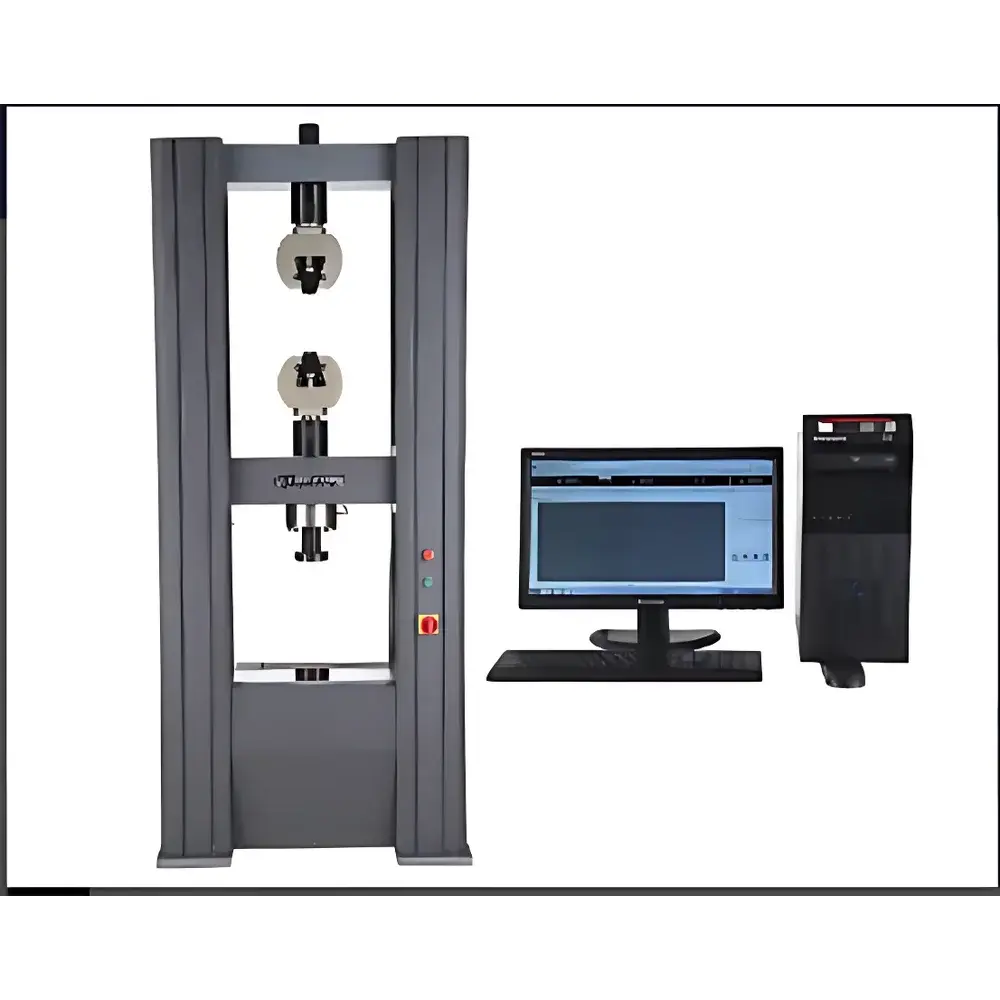
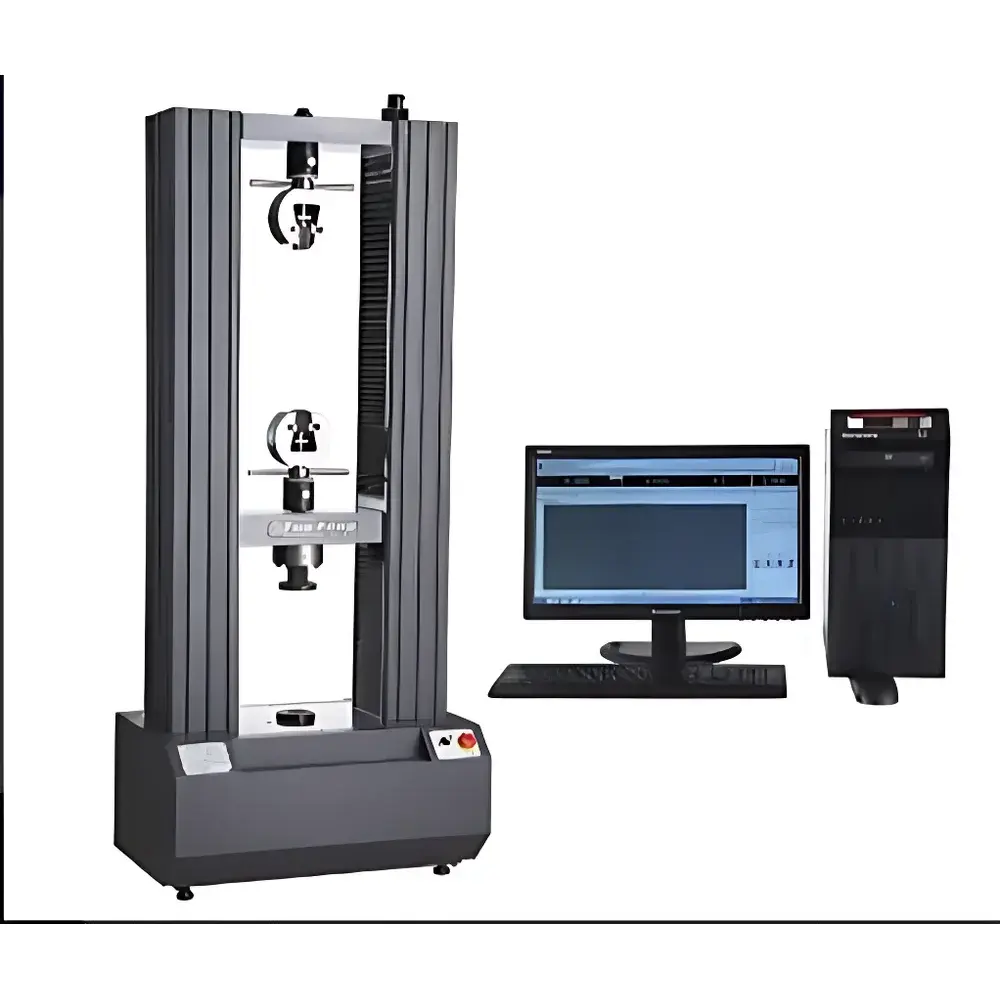
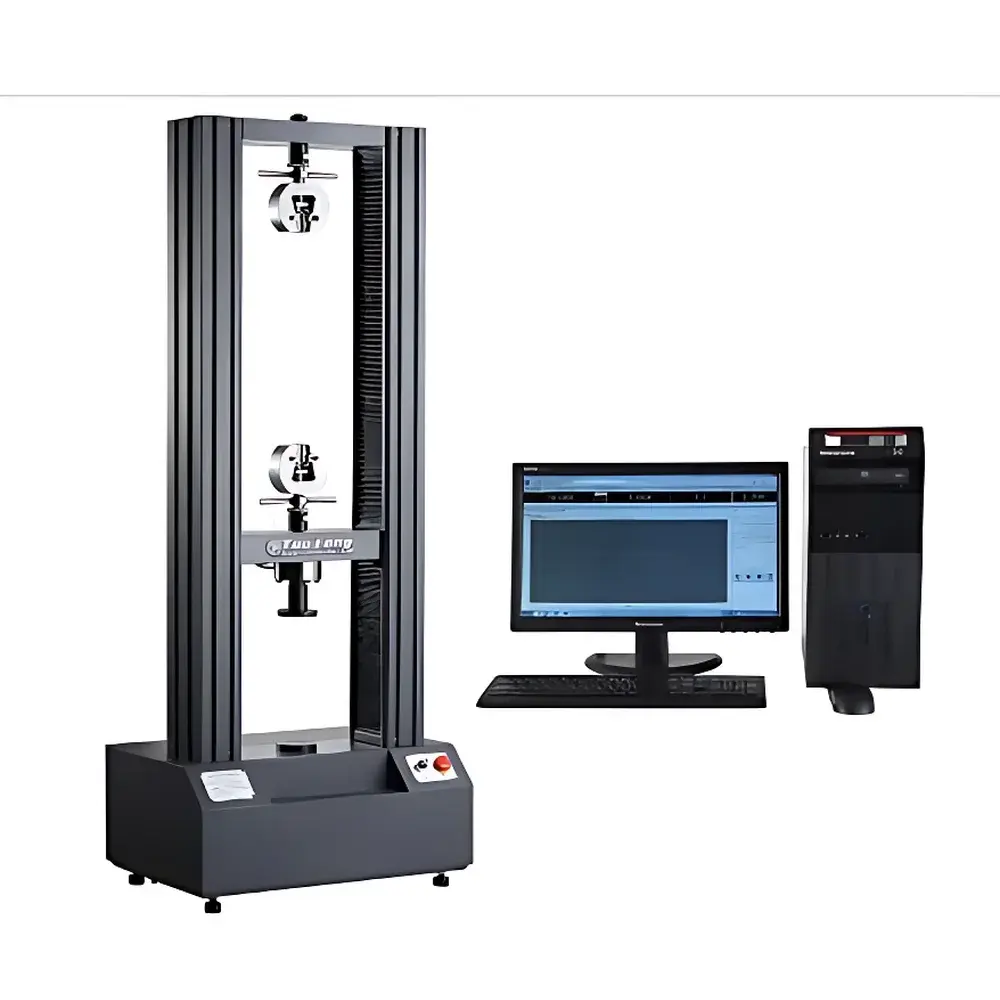
Tuofeng TFW-93 Universal Testing Machine
| Brand | Tuofeng |
|---|---|
| Origin | Shanghai, China |
| Manufacturer Type | Direct Manufacturer |
| Equipment Type | Electromechanical Universal Testing Machine |
| Model | TFW-93 |
| Force Capacity | 10 kN |
| Accuracy Class | 0.5 |
| Effective Force Range | 0.2–100% of Full Scale |
| Force Measurement Accuracy | ±0.005% of reading |
| Load Cell Resolution | 1 part in ±500,000 full-scale codes (no range switching, constant resolution) |
| Drive System | Imported servo motor with worm gear reducer |
| Lead Screw | High-precision preloaded ball screw |
| Test Width | 400 mm (customizable up to 600 mm) |
| Stroke | 800 mm (extendable) |
| Speed Range | 0.001–500 mm/min (infinitely variable) |
| Displacement Measurement | Optical encoder |
| Displacement Accuracy | ±0.005% of reading |
| Strain Measurement | Optional extensometer or large-deformation sensor |
| Protection Systems | Electronic limit switches, emergency stop, overload protection (10% above capacity), dual-speed motorized crosshead return |
| Software | Windows-based, multi-language (English/Chinese), compliant with ASTM E4, ISO 7500-1, GB/T 16491-2008, JJG 475-2008, supports GLP/GMP audit trails and FDA 21 CFR Part 11 optional modules |
Overview
The Tuofeng TFW-93 Universal Testing Machine is an electromechanical static testing system engineered for precision mechanical property evaluation of metallic, polymeric, composite, and ceramic materials. Based on the fundamental principles of uniaxial force application and controlled displacement, it operates under closed-loop servo control to deliver high reproducibility in tensile, compression, flexural, shear, peel, tear, and puncture testing. Its modular architecture integrates a high-rigidity dual-column frame, preloaded ball screw transmission, and high-resolution load cell—designed to meet international metrological requirements for Class 0.5 accuracy per ISO 7500-1 and GB/T 16491-2008. The machine satisfies essential calibration and verification criteria defined in JJG 475-2008 and is routinely deployed in accredited laboratories where traceable, standards-compliant data generation is mandatory.
Key Features
- Class 0.5 force measurement accuracy per ISO 7500-1, with a resolution of 1 part in ±500,000 full-scale load codes—ensuring consistent sensitivity across the entire 0.2–100% measurement range without range switching.
- Dual-speed motorized crosshead with programmable return functionality: rapid repositioning (up to 500 mm/min) for setup efficiency and fine-speed control (down to 0.001 mm/min) for creep or low-strain-rate testing.
- Integrated overload and safety interlocks: electronic end-limit detection, hardware emergency stop circuitry, and automatic shutdown at 110% of rated capacity (11 kN).
- Modular strain acquisition support: compatibility with clip-on extensometers (for modulus and yield point determination) and large-deformation sensors (for elongation-at-break in elastomers or foams).
- Statically rigid dual-column frame (780 × 560 × 1700 mm) with optimized thermal mass distribution to minimize drift during extended tests.
- Imported servo drive system coupled with a backlash-free worm gear reducer ensures torque stability, minimal velocity ripple, and long-term repeatability under cyclic loading.
Sample Compatibility & Compliance
The TFW-93 accommodates specimens ranging from thin films (<0.1 mm) to structural steel coupons (up to 40 mm thick), with customizable grips—including wedge-action, pneumatic, hydraulic, and specialized fixtures for ASTM D638, ISO 527, ASTM D790, ISO 178, ASTM D1876 (T-peel), and ISO 8510-2. It fully supports test protocols aligned with ASTM E4 (load verification), ASTM E8/E21 (tension and elevated temperature testing), ISO 6892-1 (metallic tensile), ISO 527-2 (plastics), and GB/T 228.1–2021. All mechanical and software subsystems are designed to facilitate compliance with GLP and GMP environments; optional audit trail logging, electronic signature support, and 21 CFR Part 11–compliant user access controls are available upon configuration.
Software & Data Management
The embedded Windows-based testing software provides deterministic real-time control across multiple test modes: constant rate of extension (CRE), constant load, constant strain, hold-to-load, and ramp-and-hold sequences. It enables simultaneous acquisition and synchronized display of up to six real-time curves—including stress–strain, load–displacement, load–time, and strain–time—with configurable axes scaling and dynamic zoom. Raw data is stored in vendor-neutral CSV format with timestamped metadata (operator ID, sample ID, environmental conditions). Reporting templates comply with ISO/IEC 17025 documentation requirements, including uncertainty estimation fields, calibration certificate references, and instrument identification. Data integrity safeguards include write-protected archives, version-controlled test method libraries, and optional digital signature workflows for regulated QA/QC departments.
Applications
The TFW-93 serves as a primary mechanical characterization tool across diverse sectors: aerospace component validation (e.g., carbon-fiber laminates per ASTM D3039), automotive polymer qualification (PP, PA66, TPU per ISO 527), medical device material certification (ISO 14224 for implant-grade PEEK), construction material compliance (rebar tensile per ASTM A615), and R&D labs evaluating novel hydrogels or biodegradable packaging films. Its versatility extends to quality assurance in wire & cable manufacturing (IEC 60811), rubber compound development (ASTM D412), and powder metallurgy sintered part densification analysis (ASTM B962). Universities utilize its open API architecture for custom algorithm integration in fracture mechanics or viscoelastic modeling projects.
FAQ
What international standards does the TFW-93 support out-of-the-box?
It natively implements test methods and reporting structures aligned with ASTM E4, ISO 7500-1, GB/T 16491-2008, and JJG 475-2008. Preconfigured test templates are provided for ASTM D638, ISO 527, ASTM D790, and ISO 178.
Can the system be validated for use in FDA-regulated environments?
Yes—optional 21 CFR Part 11 compliance packages include role-based access control, electronic signatures, audit trail generation, and data encryption. Validation documentation (IQ/OQ/PQ protocols) is supplied upon request.
Is remote diagnostics or firmware update capability supported?
The controller features Ethernet connectivity and supports secure remote maintenance via TLS-encrypted VNC sessions. Firmware updates are delivered through digitally signed packages with checksum verification.
What is the typical lead time for custom fixture design and installation?
Standard grip sets ship with the base system. Custom-designed fixtures (e.g., for orthopedic screws or battery electrode strips) typically require 3–4 weeks from final drawing approval.
Does the machine support third-party transducer integration?
Yes—the analog input module accepts ±10 V signals from external LVDTs, pressure transducers, or thermal expansion sensors, enabling hybrid multi-parameter testing configurations.



