
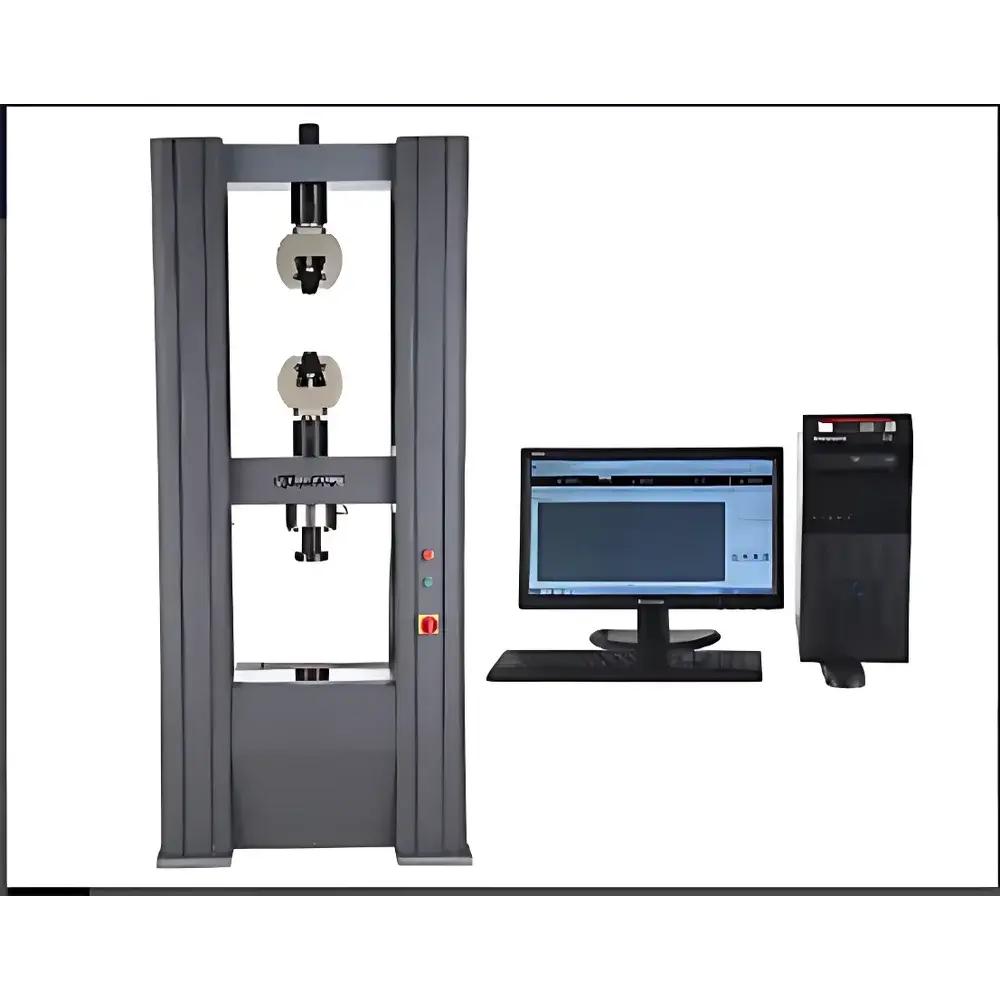
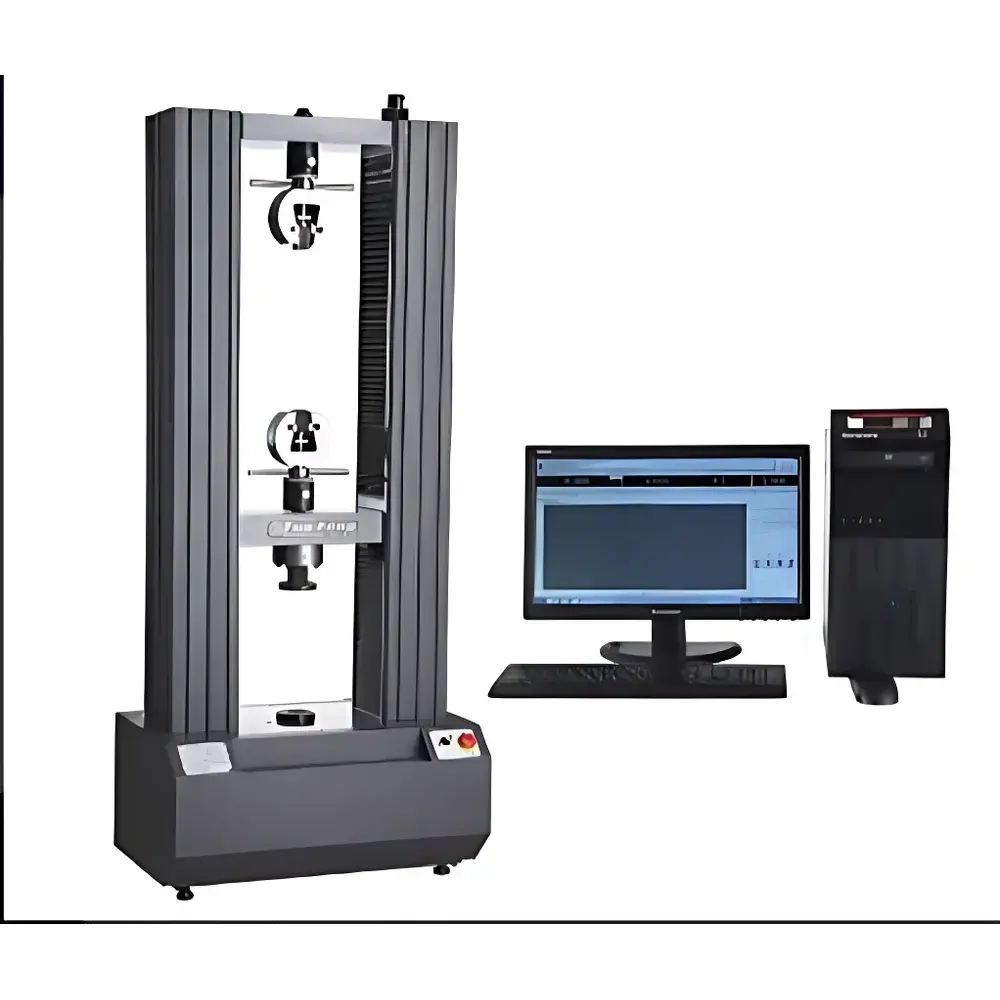
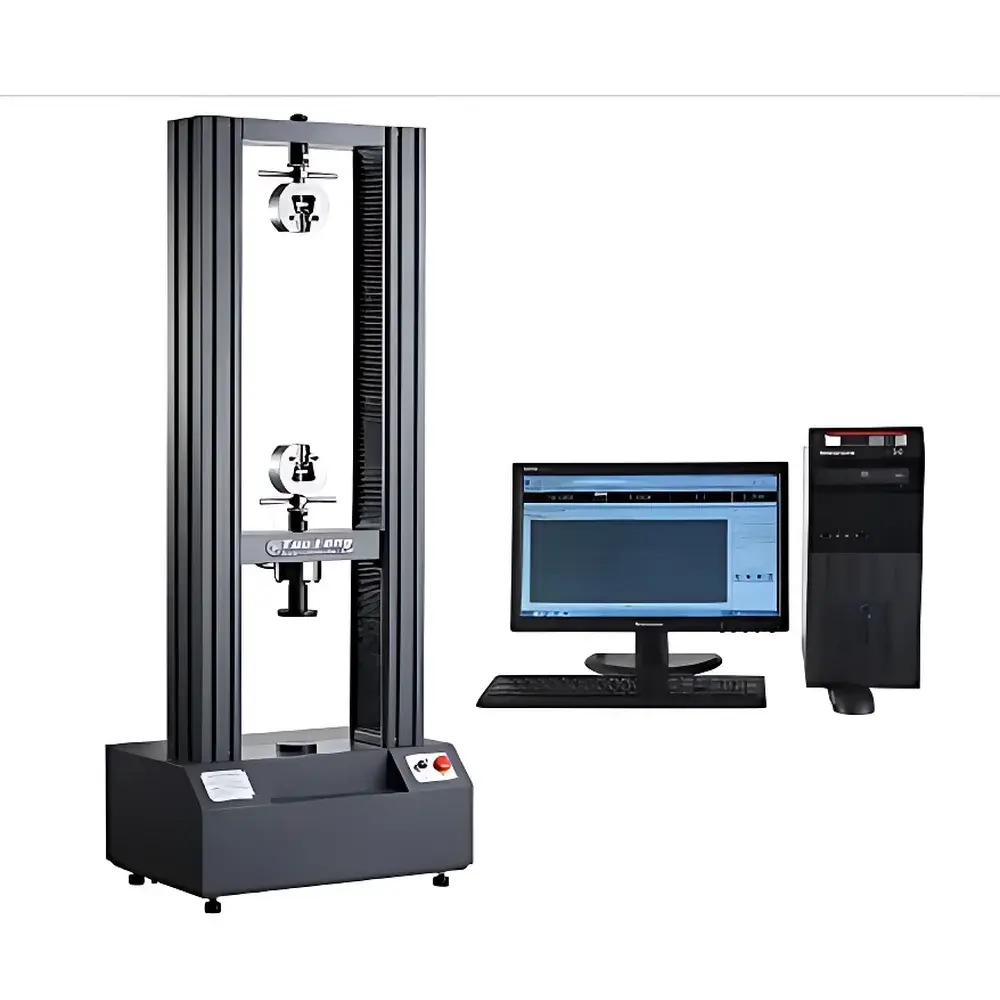
Tuofeng TFW-99 Microcomputer-Controlled Electromechanical Universal Testing Machine
| Brand | Tuofeng |
|---|---|
| Origin | Shanghai, China |
| Manufacturer Type | Direct Manufacturer |
| Instrument Type | Electromechanical Universal Testing Machine |
| Model | TFW-99 |
| Force Capacity | 5–200 kN (configurable) |
| Accuracy Class | 0.5 |
| Effective Force Range | 0.2%–100% of full scale |
| Force Measurement Accuracy | ±0.005% of reading |
| Resolution | 1 part in ±500,000 full-scale codes (no range switching, constant resolution) |
| Drive System | Imported servo motor with precision worm-gear reducer |
| Lead Screw | High-precision preloaded ball screw |
| Test Width | 400–600 mm (customizable) |
| Stroke | 800 mm (extendable) |
| Speed Range | 0.001–500 mm/min (infinitely variable) |
| Displacement Measurement | Optical encoder, accuracy ±0.005% of reading |
| Strain Measurement | Optional extensometer or large-deformation sensor, accuracy ±0.005% of reading |
| Safety Protection | Electronic limit switches, emergency stop, overload protection (110% F.S.), dual-speed motorized crosshead control |
| Software | Windows-based, multi-language (EN/CN/TC), compliant with ASTM E4, ISO 7500-1, GB/T 16491-2008, JJG 475-2008, supports GLP audit trails and 21 CFR Part 11 user access controls (optional configuration) |
Overview
The Tuofeng TFW-99 Microcomputer-Controlled Electromechanical Universal Testing Machine is a high-precision, dual-column electromechanical system engineered for static mechanical property characterization of metallic, polymeric, composite, and ceramic materials. Based on the fundamental principles of axial force application and displacement-controlled loading, the machine implements closed-loop servo control to deliver repeatable, traceable, and standards-compliant tensile, compression, bending, shear, peel, tear, and puncture testing. Its rigid structural architecture—featuring preloaded ball screws, low-backlash gear reduction, and high-resolution optical encoders—ensures minimal compliance error and exceptional load-path stability across the full operational range. Designed in strict adherence to ISO 7500-1 (Class 0.5), GB/T 16491-2008, and JJG 475-2008 metrological verification requirements, the TFW-99 serves as a primary reference-grade instrument for quality assurance laboratories, R&D centers, and third-party certification bodies operating under ISO/IEC 17025, GMP, or aerospace AS9100 frameworks.
Key Features
- Modular force capacity options from 5 kN to 200 kN, enabling scalability across material classes—from thin films and elastomers to structural alloys and reinforced composites
- Constant-resolution force measurement at 1 part in ±500,000 full-scale codes, eliminating range-switching artifacts and ensuring linearity across 0.2%–100% of rated load
- Dual-speed motorized crosshead actuation (fast positioning + fine-load control) with programmable return-to-start functionality post-test
- Integrated safety triad: hardware-based electronic limit switches, redundant emergency stop circuitry, and real-time overload cutoff at 110% of full-scale capacity
- Thermally stable base frame with vibration-damped mounting feet, minimizing environmental interference during low-force, high-sensitivity measurements
- Standardized M6–M12 threaded accessory ports on upper and lower platens for rapid fixture interchangeability per ASTM E8, ISO 6892-1, or custom test configurations
Sample Compatibility & Compliance
The TFW-99 accommodates specimens ranging from 0.1 mm-thick polymer foils to 50 mm-diameter steel rods, with customizable test widths (400–600 mm) and extended stroke (up to 1200 mm) supporting ASTM D638 Type I–V, ISO 527-2, GB/T 228.1, and EN 10002-1 geometries. It fully supports standard-compliant execution of tensile yield point determination (0.2% offset method), modulus calculation (secant/tangent), fracture elongation, compressive strength (ASTM C39, ISO 7500-1 Annex B), three- and four-point flexural testing (ASTM D790), and adhesion peel protocols (ASTM D903, ISO 8510-2). Calibration documentation complies with ISO/IEC 17025 Clause 6.5; factory-certified verification reports include uncertainty budgets per GUM (JCGM 100:2008). Optional NIST-traceable load cell calibration kits are available for on-site verification.
Software & Data Management
The embedded Windows-based TFW-TestSuite v4.2 provides full compliance with regulatory data integrity requirements. It features role-based user management, electronic signatures, and configurable audit trails meeting FDA 21 CFR Part 11 and EU Annex 11 criteria. The software supports simultaneous acquisition of up to four synchronized channels (load, displacement, strain, auxiliary analog input), with real-time display of stress–strain, load–time, and load–displacement curves. All raw data—including time-stamped metadata, operator ID, environmental conditions (if interfaced), and calibration history—are stored in encrypted SQLite databases with automatic daily backup. Export formats include CSV, PDF (print-ready reports with logo header), and XML for LIMS integration. Custom test method templates can be authored using built-in scripting (VBScript-compatible) and deployed enterprise-wide via centralized server push.
Applications
The TFW-99 is routinely deployed in accredited materials laboratories for: qualification testing of aerospace aluminum-lithium alloys per AMS 4027; validation of medical device polymer weld integrity (ISO 5832-12); QC release of automotive thermoplastic composites (SAE J2334); mechanical screening of battery electrode coatings (ASTM D7267); and fatigue pre-characterization of additively manufactured Ti-6Al-4V samples (ASTM F3001). In academic settings, it supports graduate-level instruction in solid mechanics, constitutive modeling, and fracture mechanics labs requiring sub-0.1% strain resolution. Its modular design allows seamless integration with environmental chambers (−70°C to +300°C), digital image correlation (DIC) systems, and acoustic emission sensors for advanced multimodal characterization.
FAQ
What international standards does the TFW-99 comply with for force calibration and verification?
The system conforms to ISO 7500-1:2018 (Class 0.5), ASTM E4-22, GB/T 16491-2008, and JJG 475-2008. Factory calibration certificates include expanded uncertainty values calculated per GUM guidelines.
Can the TFW-99 perform cyclic or hold tests such as creep or stress relaxation?
Yes—via the software’s programmable control module, users can define multi-step load/strain hold sequences, ramp-hold-ramp profiles, and dwell periods with duration precision of ±0.1 s.
Is third-party ISO/IEC 17025 accreditation support available for installation qualification (IQ) and operational qualification (OQ)?
Tuofeng provides IQ/OQ protocol templates, witness testing services, and on-site metrologist support for laboratory accreditation readiness assessments.
What is the warranty coverage and service response time for critical components?
Standard warranty covers 24 months on load cells, servo drive, and controller electronics; 36 months on mechanical frame and ball screws. Priority technical support guarantees remote diagnostics within 2 business hours and on-site engineer dispatch within 72 hours globally.
How is data integrity ensured during long-duration tests exceeding 72 hours?
The system employs non-volatile memory buffering, automatic checkpoint saving every 5 minutes, and power-fail recovery that resumes tests from last valid data point without loss of synchronization.



