
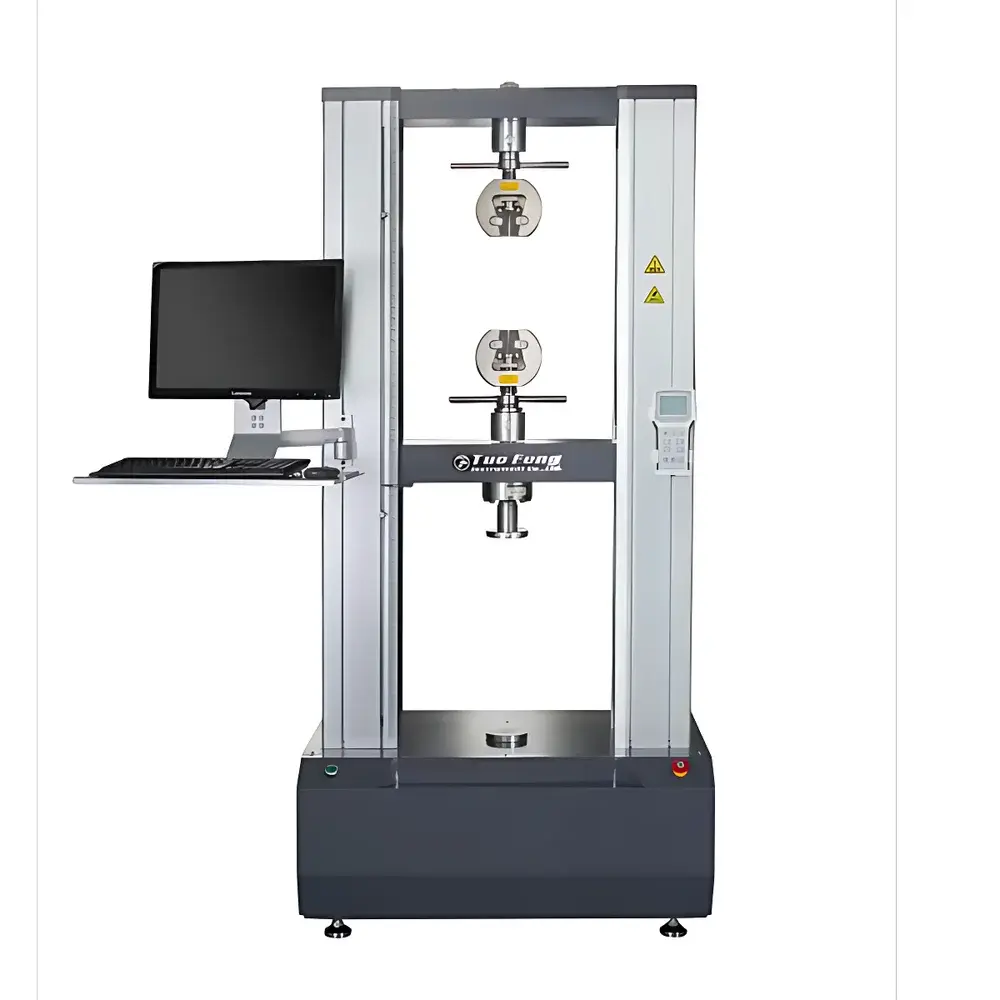
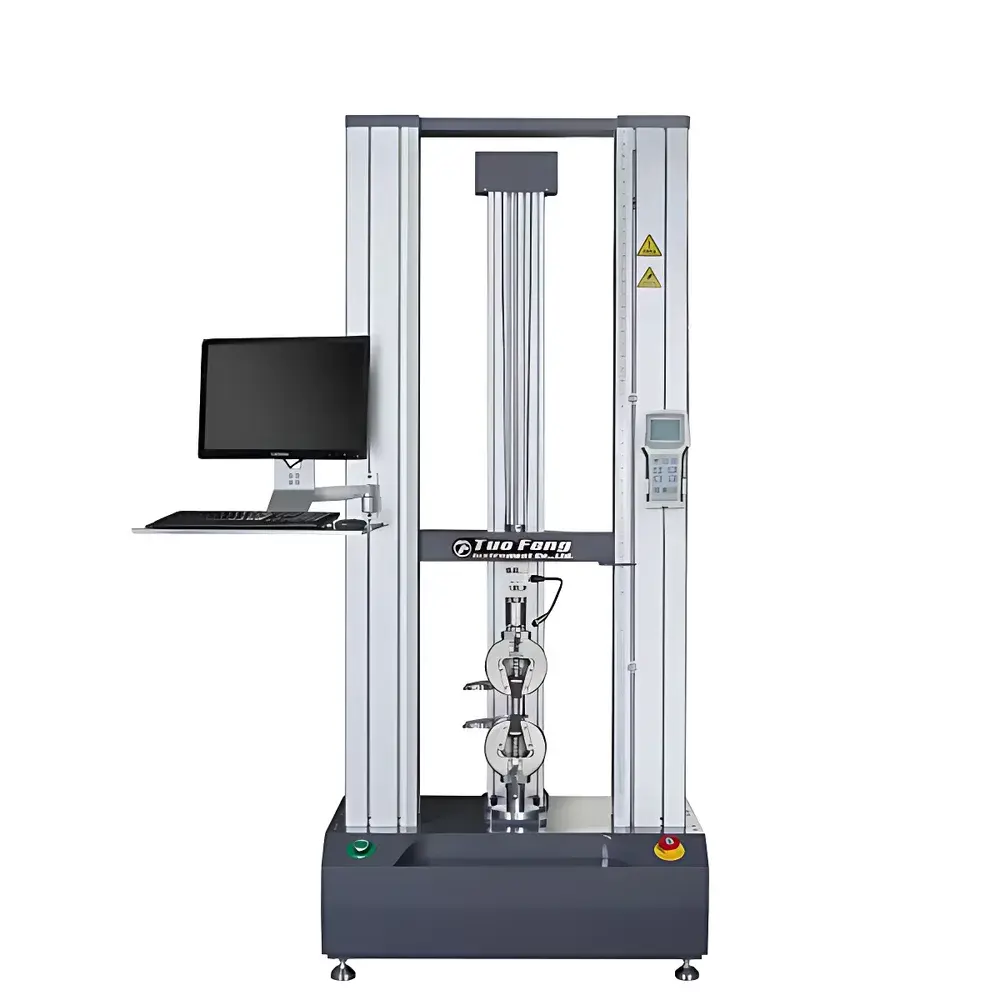
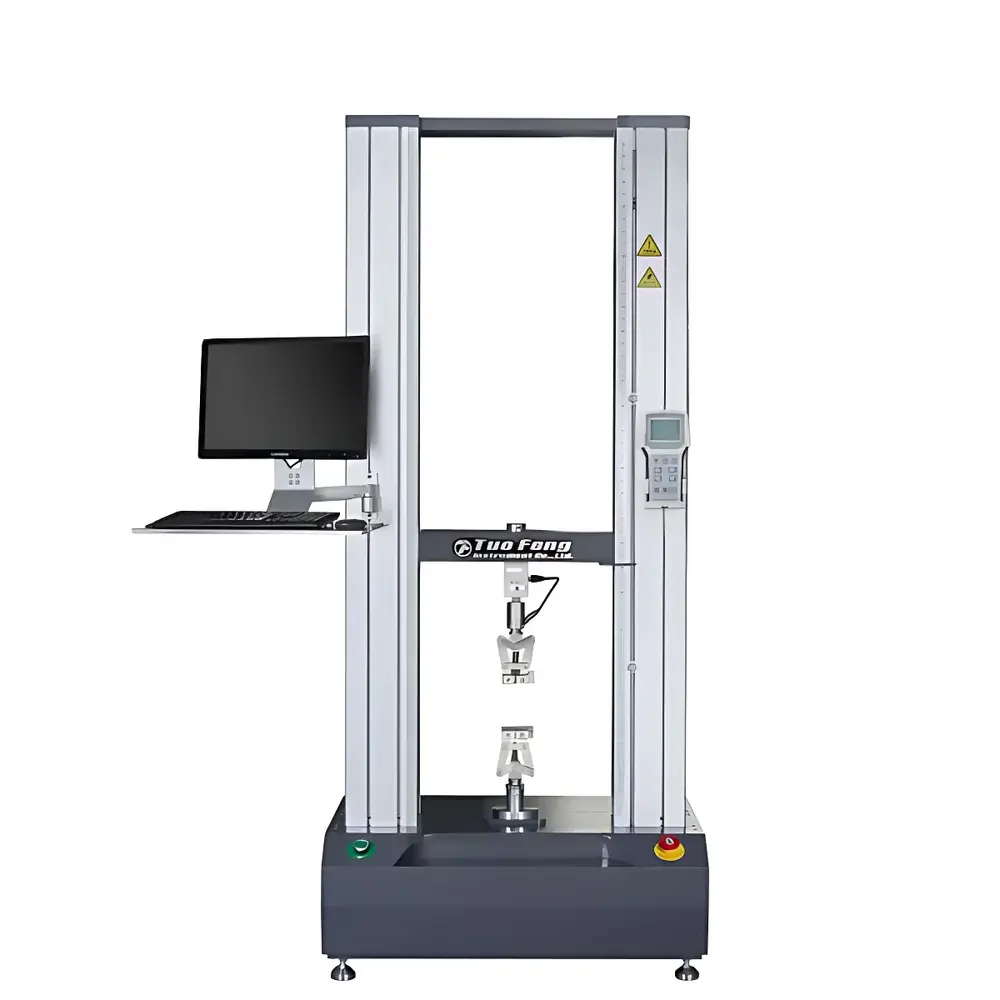
Tuofeng TFW-Series Microcomputer-Controlled Servo-Electric Universal Testing Machine
| Brand | Tuofeng |
|---|---|
| Origin | Shanghai, China |
| Manufacturer Type | Direct Manufacturer |
| Instrument Type | Electromechanical Universal Testing Machine |
| Models | TFW-05S / TFW-10S / TFW-20S / TFW-50S / TFW-100S / TFW-200S |
| Max Test Load | 5 kN / 10 kN / 20 kN / 50 kN / 100 kN / 200 kN |
| Accuracy Class | ISO 7500-1 Class 0.5 |
| Effective Force Range | 0.2–100% of Full Scale |
| Force Measurement Accuracy | ±0.005% of reading |
| Load Cell Resolution | 1 part in ±500,000 full-scale codes (no range switching, constant resolution) |
| Drive System | Imported servo motor with precision worm-gear reducer |
| Lead Screw | High-accuracy preloaded ball screw |
| Effective Test Width | 400 mm / 500 mm / 600 mm (customizable) |
| Traverse Stroke | 800 mm (extendable) |
| Speed Range | 0.001–500 mm/min (infinitely variable, programmable) |
| Displacement Measurement | Optical encoder |
| Displacement Accuracy | ±0.005% of reading |
| Strain Measurement | Optional extensometer (clip-on or video-based) or large-deformation transducer |
| Strain Accuracy | ±0.005% of reading |
| Safety Protection | Dual-limit electronic positioning, emergency stop button, overload cutoff (>110% FS), automatic return after test |
| Crosshead Control | Dual-speed (fast/slow) motorized adjustment with jog function |
| Return Function | Programmable high-speed return to initial position |
| Power Supply | 220 V AC, 750 W / 1 kW / 1.5 kW / 3 kW (model-dependent) |
| Dimensions (W×D×H) | 780×560×1700 mm to 1100×900×2600 mm |
| Weight | 280 kg to 1500 kg (model-dependent) |
| Compliance | GB/T 16491–2008, JJG 475–2008, ASTM E4, ASTM E8, ASTM D638, ASTM D790, ISO 6892-1, ISO 178, DIN 53455, JIS Z2241, BS EN 10002-1 |
Overview
The Tuofeng TFW-Series Microcomputer-Controlled Servo-Electric Universal Testing Machine is a high-precision electromechanical system engineered for static mechanical property characterization of metallic, polymeric, ceramic, composite, and elastomeric materials. Based on closed-loop servo control architecture and calibrated load cell technology, it implements fundamental uniaxial testing principles—including tensile, compressive, flexural, shear, tear, peel, and puncture—per standardized force-displacement protocols. The machine operates under ISO 7500-1 Class 0.5 accuracy certification, ensuring traceable force measurement across its full dynamic range (0.2–100% FS) with resolution stability maintained without manual range switching. Its modular mechanical design integrates a high-rigidity frame, preloaded ball screws, and low-backlash gear reduction to minimize compliance and hysteresis—critical for reproducible modulus determination and yield point detection in both brittle and ductile specimens.
Key Features
- Class 0.5 force accuracy per ISO 7500-1, validated by national metrological verification (JJG 475–2008) and aligned with GB/T 16491–2008 manufacturing standards
- Constant-resolution load measurement at 1 part in ±500,000 full-scale codes—enabling high-fidelity capture of small-force events such as initial yield or adhesive failure onset
- Programmable speed control from 0.001 to 500 mm/min, supporting quasi-static to high-rate loading profiles required for strain-rate-sensitive materials (e.g., thermoplastics, hydrogels)
- Dual-mode crosshead actuation: fast positioning (up to 200 mm/min) for setup efficiency and fine-adjustment mode (<0.1 mm/min) for precise specimen alignment and preload application
- Integrated safety architecture including hardware-based dual-limit switches, emergency stop circuitry, and automatic overload disengagement at >110% of rated capacity
- Modular extensometry support: compatibility with clip-on axial extensometers (ASTM E83 Class B-1), video extensometers (for non-contact strain mapping), and large-deformation transducers for elongation beyond 1000%
Sample Compatibility & Compliance
The TFW-Series accommodates standard and custom geometries—from miniature dog-bone coupons (ASTM D638 Type I) to structural beams (ASTM D790), wire specimens (ISO 15630-1), and laminated composites (ASTM D3039). Fixture adaptability includes wedge-action grips, pneumatic clamps, four-point bend fixtures, and peel test jigs—all designed to minimize stress concentrations and slippage. Regulatory alignment includes full support for GB, ASTM, ISO, DIN, JIS, and BS test methods. Data acquisition and reporting comply with GLP documentation requirements; audit trails, user access control, and electronic signature readiness are configurable per FDA 21 CFR Part 11 when deployed in regulated environments (e.g., medical device validation, pharmaceutical packaging qualification).
Software & Data Management
The Windows-based TFW-TestSuite software provides ISO/IEC 17025-compliant test execution and analysis. It supports multi-mode control (load-controlled, displacement-controlled, strain-controlled, hold, ramp-hold sequences) and real-time plotting of up to six synchronized axes—including stress–strain, load–time, and displacement–time. Units are freely convertible between SI, imperial, and legacy systems (e.g., MPa ↔ psi, mm ↔ in). All curves are exportable in CSV, XML, or PDF formats; batch processing enables statistical comparison (max/min/mean, COV) across 100+ specimens. Raw data files retain metadata (operator ID, calibration date, environmental conditions) and are digitally signed upon save. Software updates are delivered remotely with version-controlled changelogs—ensuring long-term method continuity and regulatory defensibility.
Applications
This system serves as a primary mechanical characterization platform in R&D laboratories and QC/QA departments across aerospace (composite laminate tensile strength per ASTM D3039), automotive (elastomer hysteresis testing per ISO 2285), medical device manufacturing (suture tensile break load per ISO 10555-1), construction materials (rebar yield strength per ASTM A615), and polymer development (impact-modified PP elongation at break per ISO 527-2). It is routinely employed for process validation (e.g., extrusion parameter optimization), failure root-cause analysis (fractography correlation), and supplier qualification against tier-1 OEM specifications (e.g., Ford WSS-M1A365-B3, GMW14872).
FAQ
What standards does the TFW-Series fully support out-of-the-box?
The system includes preconfigured test templates for ASTM E8/E21 (metals), ASTM D638/D790 (plastics), ISO 6892-1/178 (tensile/flexural), and GB/T 228.1–2021—with automatic calculation of Rp0.2, Rm, A%, Eb, and other derived parameters.
Can the system be integrated into an existing LIMS or MES environment?
Yes—via OPC UA or TCP/IP API interfaces, enabling bidirectional data exchange with LabWare LIMS, Siemens Opcenter, or custom enterprise systems for automated result ingestion and workflow triggering.
Is third-party calibration and traceability documentation provided?
Each unit ships with a NIST-traceable calibration certificate issued by CNAS-accredited labs, covering load, displacement, and speed channels—with uncertainty budgets reported per ISO/IEC 17025 Annex A.
What is the warranty coverage and service response time?
Standard warranty is 24 months parts-and-labor; extended service contracts include on-site preventive maintenance, remote diagnostics, and priority spare-part fulfillment within 72 business hours globally.
Does the software meet FDA 21 CFR Part 11 requirements for electronic records?
When configured with role-based user accounts, audit trail logging, and digital signature modules, the TFW-TestSuite satisfies Part 11 technical controls—including record retention, amendment history, and electronic approval workflows.



