
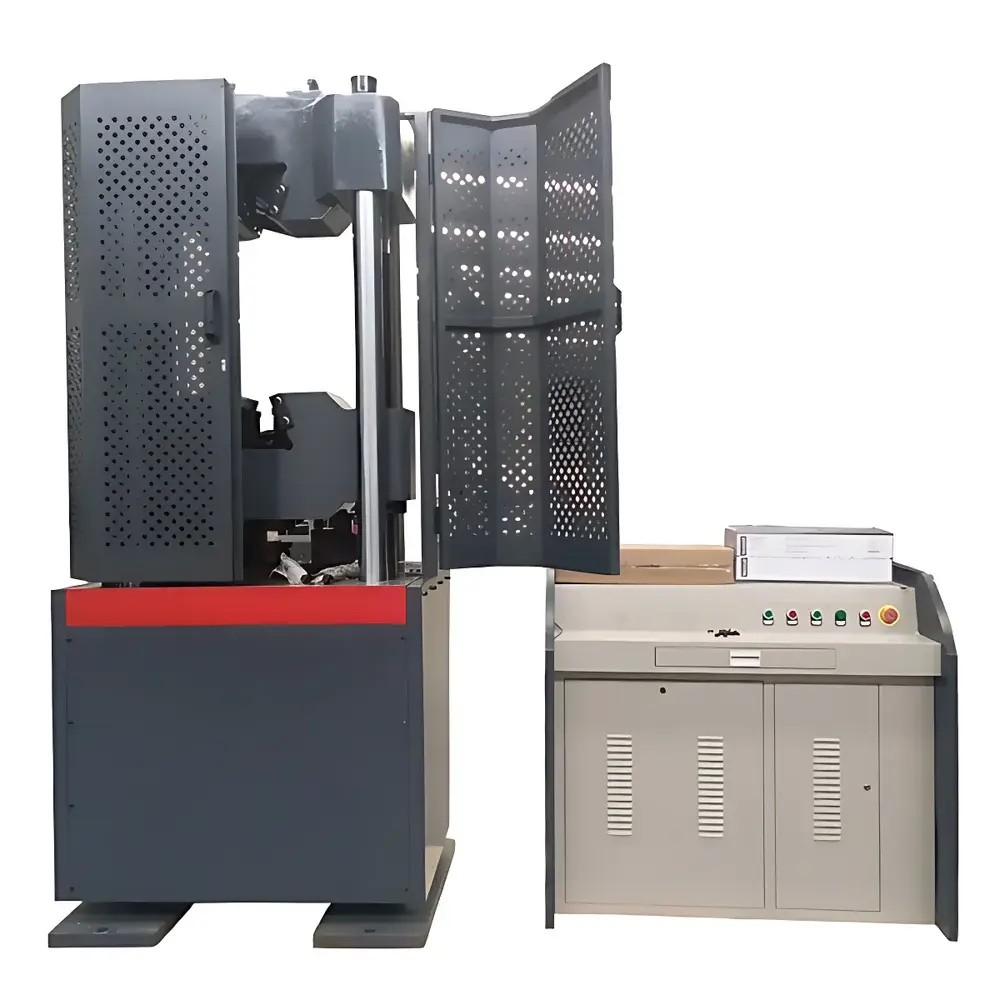
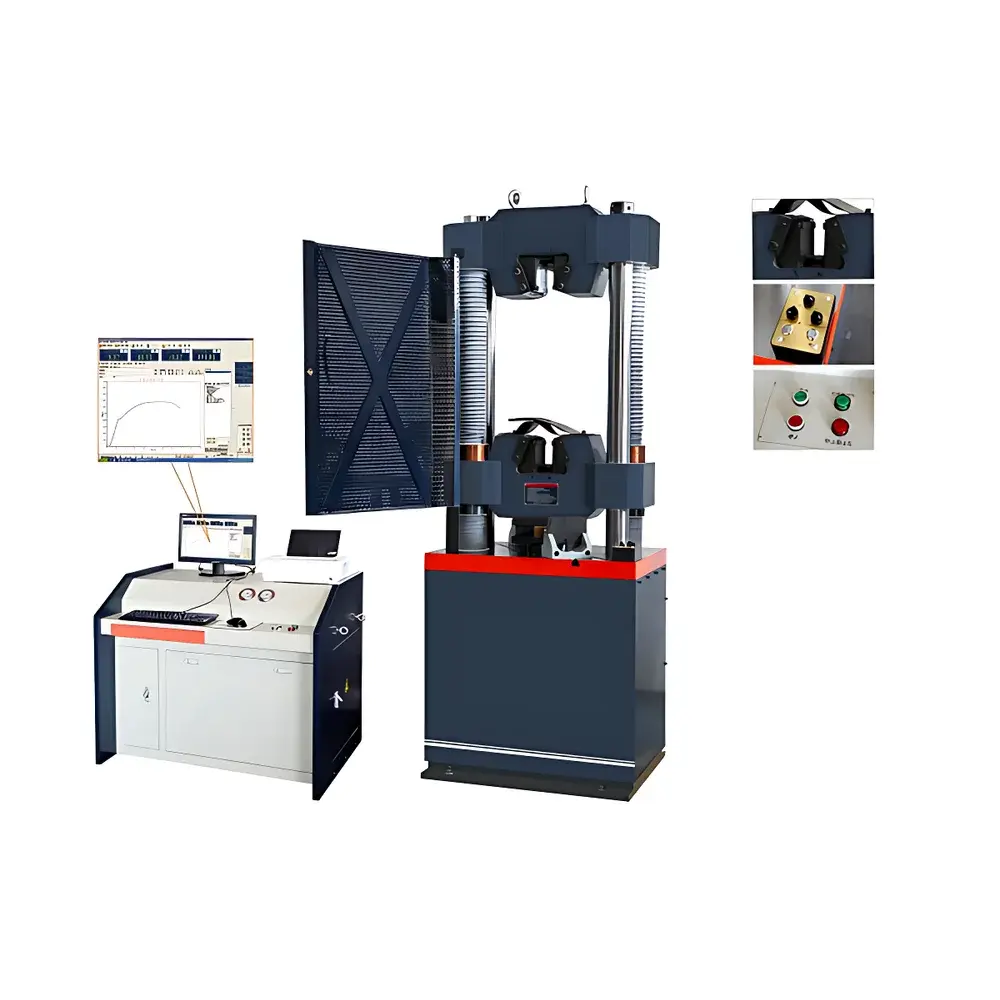
Tuofeng WAW-1000D Microcomputer-Controlled Electro-Hydraulic Servo Universal Testing Machine
| Brand | Tuofeng |
|---|---|
| Origin | Shanghai, China |
| Manufacturer Type | Direct Manufacturer |
| Model | WAW-1000D |
| Instrument Type | Electro-Hydraulic Servo Universal Testing Machine |
| Max Load Capacity | 1000 kN |
| Force Measurement Range | 1–100% of full scale |
| Force Resolution | 0.01 kN |
| Force Accuracy | ±1% of indicated value |
| Displacement Measurement | Optical Encoder |
| Displacement Accuracy | ±1% of indicated value |
| Displacement Resolution | 0.01 mm |
| Tensile Test Space | 650 mm |
| Compression Test Space | 650 mm |
| Round Specimen Clamping Diameter | Φ13–40 mm |
| Flat Specimen Clamping Thickness | 0–15 mm |
| Clamping Method | Automatic Hydraulic Clamping |
| Piston Stroke | 250 mm |
| Maximum Piston Speed | 70 mm/min |
| Bending Support Roller Spacing | 40–600 mm |
| Bending Support Roller Width | 140 mm |
| Maximum Allowable Deflection in Bending | 100 mm |
| Shear Specimen Diameter | Φ10 mm |
| Upper/Lower Compression Platens | 204 × 204 mm |
| Host Dimensions (L×W×H) | 890 × 660 × 2200 mm |
| Control Cabinet Dimensions (L×W×H) | 500 × 400 × 1200 mm |
| Power Supply | 2.2 kW, 3-phase |
| Net Weight | 3400 kg |
Overview
The Tuofeng WAW-1000D is a high-capacity, microcomputer-controlled electro-hydraulic servo universal testing machine engineered for precision mechanical property evaluation of metallic and high-strength non-metallic materials. Its structural architecture follows a proven four-column, dual-screw, bottom-mounted hydraulic cylinder configuration—optimized for stability under extreme loading conditions up to 1000 kN. The design separates functional test zones: tensile testing occurs in the upper space above the moving crosshead, while compression, bending, and shear tests are conducted between the lower fixed crosshead and the rigid worktable. This spatial segregation ensures minimal mechanical interference and enhanced alignment repeatability across test modes. The system operates on closed-loop electro-hydraulic servo control, supporting simultaneous or sequential stress-, strain-, and displacement-controlled loading profiles per ISO 6892-1, ASTM E8/E21, and GB/T 228.1–2010 standards. Real-time load and displacement feedback is acquired via high-fidelity load cells and optical encoders, enabling compliant ramp-and-hold, creep, and relaxation protocols.
Key Features
- Triple-closed-loop control architecture: independent regulation of force, strain, and displacement—with seamless, impact-free mode switching during dynamic testing.
- Automatic hydraulic clamping system with programmable clamping pressure, ensuring consistent grip integrity across round (Φ13–40 mm) and flat (0–15 mm thick) specimens.
- Motor-driven crosshead positioning via precision gearbox, chain drive, and recirculating ball screw—enabling rapid, repeatable adjustment of test space (650 mm for tension/compression).
- Dedicated high-pressure hydraulic circuit: gear motor-driven pump, high-efficiency pressure filter, differential pressure valve group, and proportional servo valve for precise flow modulation into the main cylinder.
- Modular software platform with dual-user permission levels (administrator and operator), audit-trail logging, and configurable test step sequencing—including support for multi-step cyclic loading and hold routines.
- Open Excel-based reporting engine: users define custom templates, select output fields, and batch-export results from multiple specimens with user-defined sorting and formatting rules.
Sample Compatibility & Compliance
The WAW-1000D accommodates standardized specimen geometries per ISO 6892-1 (tensile), ISO 7500-1 (calibration), ISO 15630-1 (reinforcing steel), and GB/T 228.1 (Chinese national standard). It supports axial tension, uniaxial compression, three- and four-point bending (with adjustable roller spacing from 40 to 600 mm), and punch shear (Φ10 mm shear pins). All force and displacement transducers are traceably calibrated to national metrological standards; system-level verification complies with ISO 7500-1 Class 1 accuracy requirements. The control firmware implements deterministic real-time scheduling to meet timing constraints required for dynamic test compliance (e.g., strain rate ramping per Annex G of ASTM E8). Data acquisition and storage adhere to GLP principles, with timestamped metadata, operator ID, environmental condition logging (optional sensor integration), and immutable raw data archives.
Software & Data Management
The embedded Windows-based test software provides full IEC 61508-aligned functional safety logic and supports 21 CFR Part 11-compliant electronic signatures when deployed in regulated environments. All test parameters—including control mode, target rate, hold duration, and failure criteria—are fully scriptable and exportable as XML configurations. Raw data streams (force, displacement, extensometer if connected) are recorded at ≥1 kHz sampling rate and stored in binary format with checksum validation. Post-test analysis includes modulus calculation (secant/tangent), yield point determination (0.2% offset, automatic drop detection), elongation at break, reduction in area, and bending stiffness derivation. Export formats include CSV, PDF reports, and native .tdms files compatible with MATLAB, Python (via PyTDMS), and LabVIEW. Audit trails record all parameter modifications, test starts/stops, calibration events, and user logins—retained for ≥36 months.
Applications
This system serves metallurgical laboratories, quality control departments in heavy equipment manufacturing, R&D centers evaluating high-strength alloys (e.g., aerospace Ti-6Al-4V, pipeline X80 steel), and civil engineering material testing facilities validating structural rebar and prestressed concrete components. It is routinely employed for tensile property certification (Rm, ReH, A5, Z), compressive strength assessment of cast iron and composites, bending ductility evaluation of welded joints, and shear strength benchmarking of rivet and bolt assemblies. Its robust mechanical frame and thermal-stable hydraulic actuation make it suitable for extended-duration creep testing at elevated temperatures (when integrated with environmental chambers).
FAQ
What standards does the WAW-1000D comply with for force calibration?
It meets ISO 7500-1 Class 1 requirements for static force measurement systems, verified using certified deadweight standards traceable to NIM (China) or NIST-equivalent national metrology institutes.
Can the system perform strain-controlled fatigue testing?
No—this is a quasi-static servo-hydraulic UTM optimized for monotonic and slow-cycle loading; high-frequency fatigue testing requires dedicated servo-hydraulic or electromagnetic fatigue testers.
Is third-party calibration documentation provided upon delivery?
Yes—each unit ships with a factory calibration certificate, including as-found/as-left data for load cell and encoder channels, signed by a CNAS-accredited calibration lab.
Does the software support ASTM E23 for Charpy impact correlation?
Not directly—the WAW-1000D does not measure impact energy; however, its tensile data (e.g., upper yield strength, uniform elongation) can be correlated to notch toughness trends per ASTM E1820 Annex A5 guidelines.
What maintenance intervals are recommended for the hydraulic system?
Hydraulic oil and high-pressure filter elements require replacement every 2,000 operating hours or biannually, whichever occurs first; servo valve recalibration is advised every 5,000 hours or after any contamination event.



