
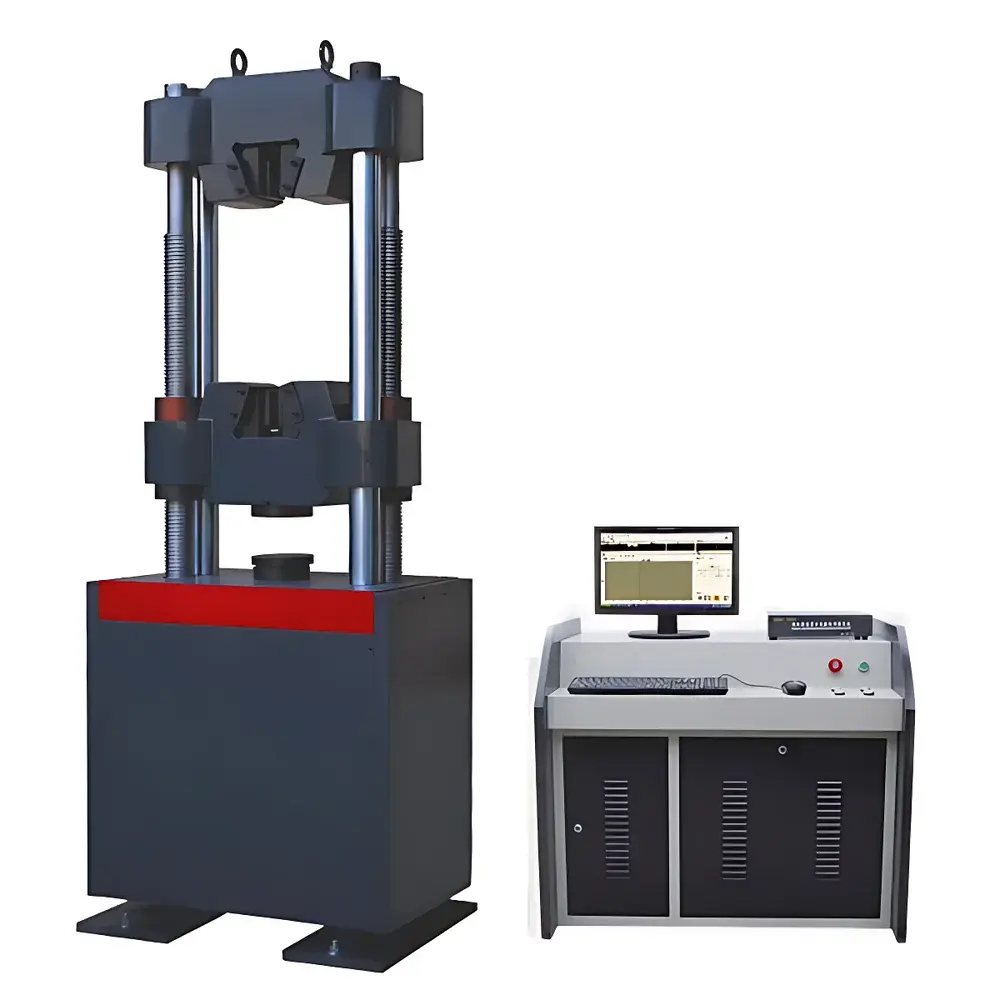
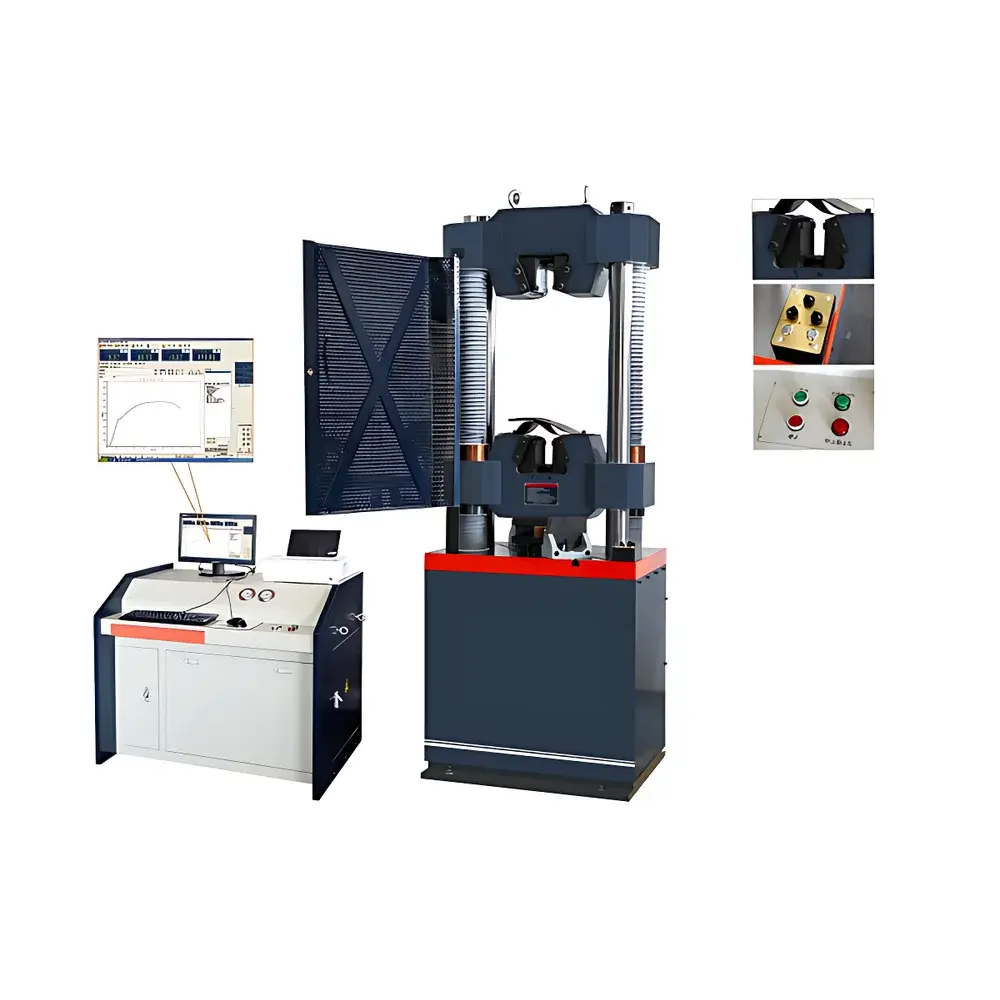
TuoFeng WAW-300D Microcomputer-Controlled Electro-Hydraulic Servo Universal Testing Machine
| Brand | TuoFeng |
|---|---|
| Origin | Shanghai, China |
| Manufacturer Type | Direct Manufacturer |
| Country of Origin | China |
| Model | WAW-300D |
| Instrument Type | Electro-Hydraulic Servo Testing Machine |
| Maximum Load Capacity | 300 kN |
| Force Measurement Range | 1–100% of full scale |
| Force Resolution | 0.01 kN |
| Force Accuracy | ±1% of indicated value |
| Displacement Measurement | Optical Encoder |
| Displacement Accuracy | ±1% of indicated value |
| Displacement Resolution | 0.01 mm |
| Tensile Test Space | 550 mm |
| Compression Test Space | 550 mm |
| Round Specimen Clamping Diameter | Φ6–26 mm |
| Flat Specimen Clamping Thickness | 0–15 mm |
| Clamping Mechanism | Automatic Hydraulic Clamping |
| Piston Stroke | 250 mm |
| Maximum Piston Speed | 70 mm/min |
| Bending Support Roller Spacing | 30–450 mm |
| Bending Support Roller Width | 140 mm |
| Maximum Allowable Deflection in Bending | 100 mm |
| Shear Specimen Diameter | Φ10 mm |
| Upper/Lower Compression Platen Size | 204 × 204 mm |
| Host Dimensions (L×W×H) | 720 × 580 × 1950 mm |
| Control Cabinet Dimensions (L×W×H) | 500 × 400 × 1200 mm |
| Power Supply | 2.2 kW, 3-phase |
| Net Weight | 2000 kg |
Overview
The TuoFeng WAW-300D is a microcomputer-controlled electro-hydraulic servo universal testing machine engineered for high-precision mechanical property evaluation of metallic and quasi-brittle materials under static loading conditions. It operates on the principle of closed-loop hydraulic actuation, where servo-controlled proportional valves regulate oil flow into a dual-acting piston cylinder to generate precisely defined axial forces. The machine’s structural architecture features a four-column, two-screw, load-frame design with a bottom-mounted hydraulic cylinder — enabling optimal load path alignment and minimized frame deflection during high-force compression and tensile testing. Its upper test zone accommodates tension tests, while the lower zone between the moving crosshead and fixed base supports compression, bending, and shear configurations per ISO 6892-1, ASTM E8/E21, and GB/T 228.1–2010 standards. The system delivers consistent force application across its full 300 kN capacity, with real-time synchronization of stress, strain, and displacement control modes — essential for generating compliant stress–strain curves, yield point determination, and modulus calculation.
Key Features
- Triple-closed-loop control architecture supporting simultaneous or sequential stress-, strain-, and displacement-controlled testing modes with seamless, impact-free transitions
- Electro-hydraulic servo system with high-response proportional servo valve, precision pressure transducers, and optical encoder-based displacement feedback
- Automated hydraulic clamping system for round (Φ6–26 mm) and flat (0–15 mm thickness) specimens, ensuring uniform gripping pressure and minimal slippage
- Motor-driven crosshead adjustment via planetary gearbox, chain drive, and precision ground ball screws for rapid, repeatable test space configuration
- Integrated digital control cabinet with industrial-grade embedded controller, real-time OS, and galvanically isolated I/O channels for noise immunity in laboratory environments
- Dual-zone mechanical design: 550 mm vertical clearance for tensile testing above the upper crosshead; 550 mm adjustable compression/bending zone below the lower crosshead
- Compliance with mechanical safety requirements per ISO 12100 and CE machinery directive (2006/42/EC) through interlocked guarding, emergency stop circuitry, and overload protection
Sample Compatibility & Compliance
The WAW-300D accommodates standardized metallic specimens per ASTM E8 (tension), ASTM E9 (compression), ASTM E290 (bend), and ISO 7438 (shear), including round bars, flat coupons, notched beams, and shear dowels. Its bending assembly supports roller spacing from 30 mm to 450 mm and accommodates up to 100 mm deflection, meeting requirements for three-point and four-point flexural testing per ISO 178 and ASTM D790. The 204 × 204 mm hardened steel platens ensure uniform stress distribution in compression tests on cast iron, concrete cylinders (with appropriate adapters), and composite laminates. All force and displacement measurements are traceable to national metrological standards, and system validation adheres to ISO 7500-1 (Class 1 accuracy) and JJG 139–2014 (Chinese verification regulation). The machine supports audit-ready operation under GLP and GMP frameworks when paired with validated software configurations.
Software & Data Management
The proprietary Windows-based test software provides full IEC 62591-compliant automation, featuring customizable test sequences, multi-step ramp/hold protocols, and real-time graphical monitoring of load–displacement, stress–strain, and time-history curves. Users may define and import custom test standards—including user-modified versions of GB/T, ASTM, and ISO methods—via XML-based template editing. Data export follows ASTM E1434 and ISO 10360-5 conventions: raw channel data (force, displacement, extensometer if connected) is saved in ASCII CSV format with timestamped metadata, while summary reports conform to Excel (.xlsx) schema for post-processing in third-party statistical or FE analysis tools. Role-based access control implements two-tier security (administrator and operator), with password-protected parameter modification, electronic signature logging, and optional 21 CFR Part 11 compliance modules for regulated industries requiring audit trails, electronic records, and user authentication.
Applications
- Mechanical characterization of structural steels, aluminum alloys, titanium grades, and stainless steels per tensile yield strength (Rp0.2), ultimate tensile strength (Rm), elongation (A5), and reduction of area (Z)
- Compression testing of ductile cast iron, sintered metals, and high-strength concrete prisms under controlled strain rates
- Flexural modulus and fracture load determination for metal matrix composites and powder metallurgy parts using three-point bending per ISO 178
- Shear strength evaluation of riveted joints, bolted connections, and adhesive bonds using standardized Φ10 mm shear specimens
- Calibration verification of load cells, proving rings, and reference standards in metrology laboratories
- Educational use in university materials science labs for hands-on instruction in mechanical behavior, plasticity theory, and fracture mechanics fundamentals
FAQ
What standards does the WAW-300D comply with for force measurement accuracy?
It meets ISO 7500-1 Class 1 requirements (±1% indication error) and is verifiable per JJG 139–2014 for static force calibration.
Can the system be integrated with an external extensometer?
Yes — the control system provides analog and digital input channels compatible with clip-on, video, or laser extensometers for high-resolution strain measurement.
Is remote diagnostics and firmware update supported?
The embedded controller supports secure remote access via Ethernet with TLS-encrypted communication; firmware updates are performed offline using signed binary packages.
What maintenance intervals are recommended for the hydraulic system?
Hydraulic oil replacement every 2,000 operating hours or biannually; filter elements replaced every 1,000 hours; annual recalibration of pressure transducers and encoder zero-point verification.
Does the software support batch testing and statistical reporting?
Yes — automated batch execution with pass/fail criteria, Weibull analysis, confidence interval calculation, and CPK/PPK metrics exportable to Minitab or JMP formats.



