
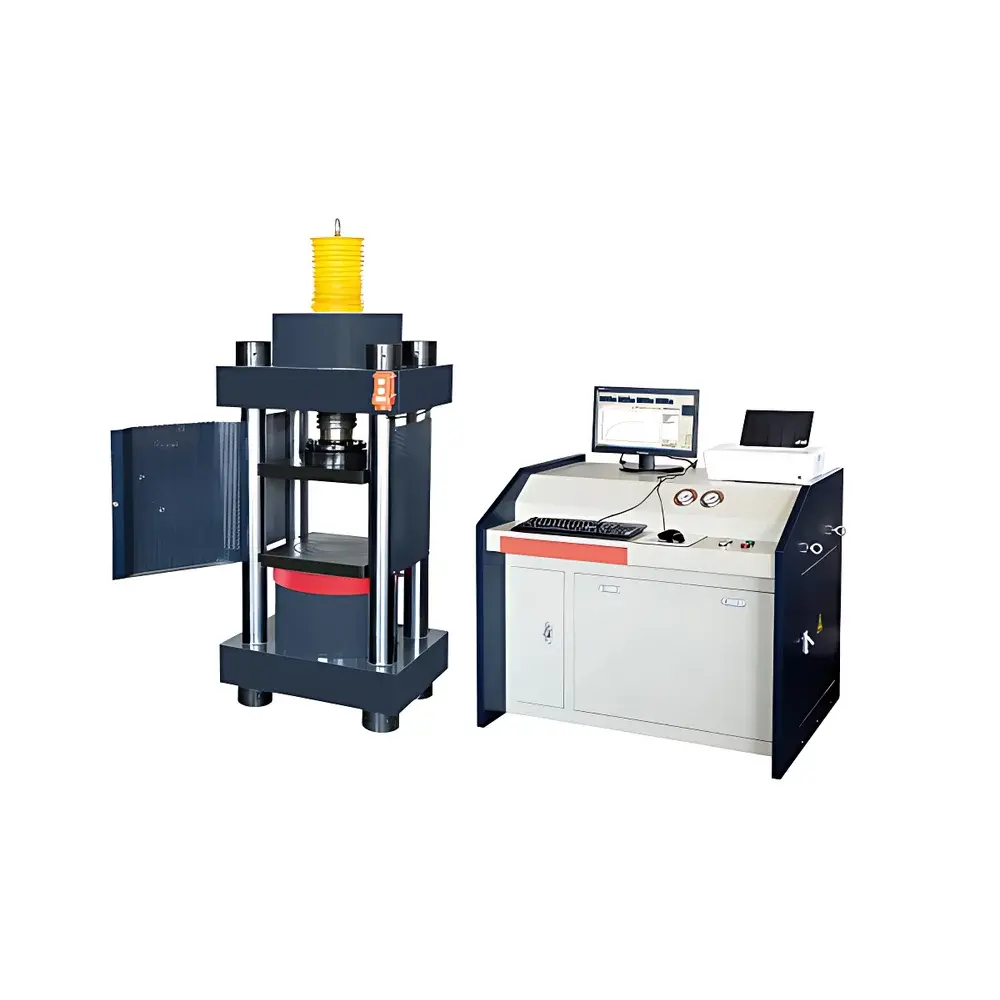
TuoFeng YAW-2000 Fully Automated Compression Testing Machine
| Brand | TuoFeng |
|---|---|
| Origin | Shanghai, China |
| Manufacturer Type | Direct Manufacturer |
| Model | YAW-2000 |
| Price Range | USD 1,400 – 7,000 (FOB) |
| Max Test Load | 2000 kN |
| Load Application Rate | 0.4–100 kN/s |
| Platen Spacing (Max) | 330 mm |
| Platen Dimensions | 370 × 370 mm |
| Load Measurement Range | 4–100% FS |
| Load Indication Accuracy | ≤ ±1% of reading |
| Piston Stroke | 50 mm |
| Piston Diameter | φ250 mm |
| Hydraulic System Pressure Rating | 40 MPa |
| Motor Power | 3-phase, 0.75 kW |
| Overall Dimensions (W×D×H) | 640 × 720 × 1500 mm |
| Net Weight | ~2000 kg |
Overview
The TuoFeng YAW-2000 Fully Automated Compression Testing Machine is a high-capacity, microprocessor-controlled hydraulic testing system engineered for precision compression strength evaluation of construction materials—including concrete cubes, cement mortar prisms, bricks, and precast structural elements. It operates on the principle of closed-loop servo-hydraulic force control, utilizing a high-bandwidth digital servo valve to regulate oil flow into the actuator cylinder. This architecture enables true constant-rate loading—either in terms of load (kN/s) or stress (MPa/s)—with real-time feedback from a high-fidelity load cell and precision signal conditioning electronics. The system conforms to fundamental mechanical testing principles defined in ISO 7500-1 (static calibration of force-proving instruments), ASTM C39/C39M (compressive strength of cylindrical concrete specimens), and GB/T 50081 (Chinese standard for mechanical properties of ordinary concrete). Its rigid frame design, large platen surface area, and optimized hydraulic response time ensure stable load application under high-force conditions up to 2000 kN.
Key Features
- Fully automated test sequence execution: specimen placement → alignment → preload → ramped loading → peak detection → unloading → data archiving
- Digital servo-valve-based hydraulic control with PID-regulated load rate, supporting programmable ramp profiles (linear, stepwise, or user-defined)
- High-resolution load measurement system with no-range-switching architecture (4–100% FS), delivering ≤ ±1% indication error per ISO 7500-1 Class 1 requirements
- Integrated electronic measurement unit featuring 24-bit A/D conversion, real-time load/strain/stress/time display, and automatic curve plotting (load vs. displacement)
- Robust dual-platen configuration: 370 × 370 mm hardened steel platens with parallelism tolerance < 0.02 mm/m, adjustable alignment mechanism for uniform stress distribution
- Self-contained hydraulic power unit with 40 MPa rated pressure, low-noise gear pump, high-efficiency cooling circuit, and multi-stage filtration (including differential-pressure monitored filter assembly)
- Compliance-ready software architecture supporting audit trails, user-level access control, and electronic signature capability per FDA 21 CFR Part 11 guidelines (when deployed with validated IT infrastructure)
Sample Compatibility & Compliance
The YAW-2000 accommodates standard civil engineering specimens per ASTM C109 (mortar cubes, 50 mm), ASTM C39 (concrete cylinders, Ø150 × 300 mm), EN 12390-3 (150 mm cubes), and GB/T 50081 (150 mm concrete cubes). Its 330 mm maximum platen spacing and 50 mm piston stroke allow testing of both standard and oversized specimens—including full-scale masonry units and lightweight aggregate blocks. The machine meets structural rigidity requirements specified in ISO 7500-1 and mechanical safety provisions of EN 61000-6-2/6-3 (EMC compliance). All firmware and software modules are designed to support GLP/GMP-aligned laboratory practices, including traceable calibration records, configurable test method templates, and exportable XML/CSV datasets compatible with LIMS integration.
Software & Data Management
The embedded Windows-based control software provides intuitive graphical interface for test setup, real-time monitoring, and post-test analysis. It supports multi-method test protocols with customizable pass/fail criteria, automatic calculation of compressive strength (MPa), modulus of elasticity (where applicable), and deformation metrics. All raw data—including time-stamped load-displacement pairs at ≥100 Hz sampling rate—are stored locally with SHA-256 hash integrity verification. Reporting complies with ISO/IEC 17025 documentation requirements: each report includes operator ID, calibration certificate ID, environmental conditions (optional sensor input), equipment identification, and digital signature fields. Data export formats include PDF (print-ready), XLSX (tabular), and TXT (ASCII for third-party analysis tools).
Applications
- Quality control testing of ready-mix concrete batches in precast plants and batching facilities
- Third-party certification laboratories performing accredited compressive strength verification per ISO/IEC 17025 scope
- University and research institutes conducting material behavior studies under monotonic compression loading
- Municipal construction supervision agencies validating compliance with national building codes (e.g., GB 50010, JGJ/T 70)
- Manufacturers of autoclaved aerated concrete (AAC), fly ash bricks, and stabilized soil blocks requiring routine compressive performance validation
FAQ
What standards does the YAW-2000 comply with for calibration and operation?
It adheres to ISO 7500-1 for static force calibration, ASTM E4 for verification of testing machines, and incorporates design features aligned with ISO 16750-1 (hydraulic system safety).
Can the system be integrated into an existing LIMS or MES environment?
Yes—via TCP/IP-based API (RESTful endpoints) and configurable ODBC-compliant database connectors; full schema documentation provided upon request.
Is remote diagnostics and firmware update supported?
Standard Ethernet connectivity enables secure remote maintenance via TLS-encrypted VNC session; over-the-air firmware updates require prior authorization and checksum validation.
What maintenance intervals are recommended for the hydraulic system?
Oil analysis every 1,000 operating hours; full hydraulic filter replacement every 2,000 hours; annual recalibration of load cell and servo valve null point.
Does the machine support multi-step loading protocols (e.g., hold-and-reload sequences)?
Yes—the software allows definition of up to 8 discrete loading segments per test, including dwell periods at specified load levels with programmable duration and tolerance bands.



