
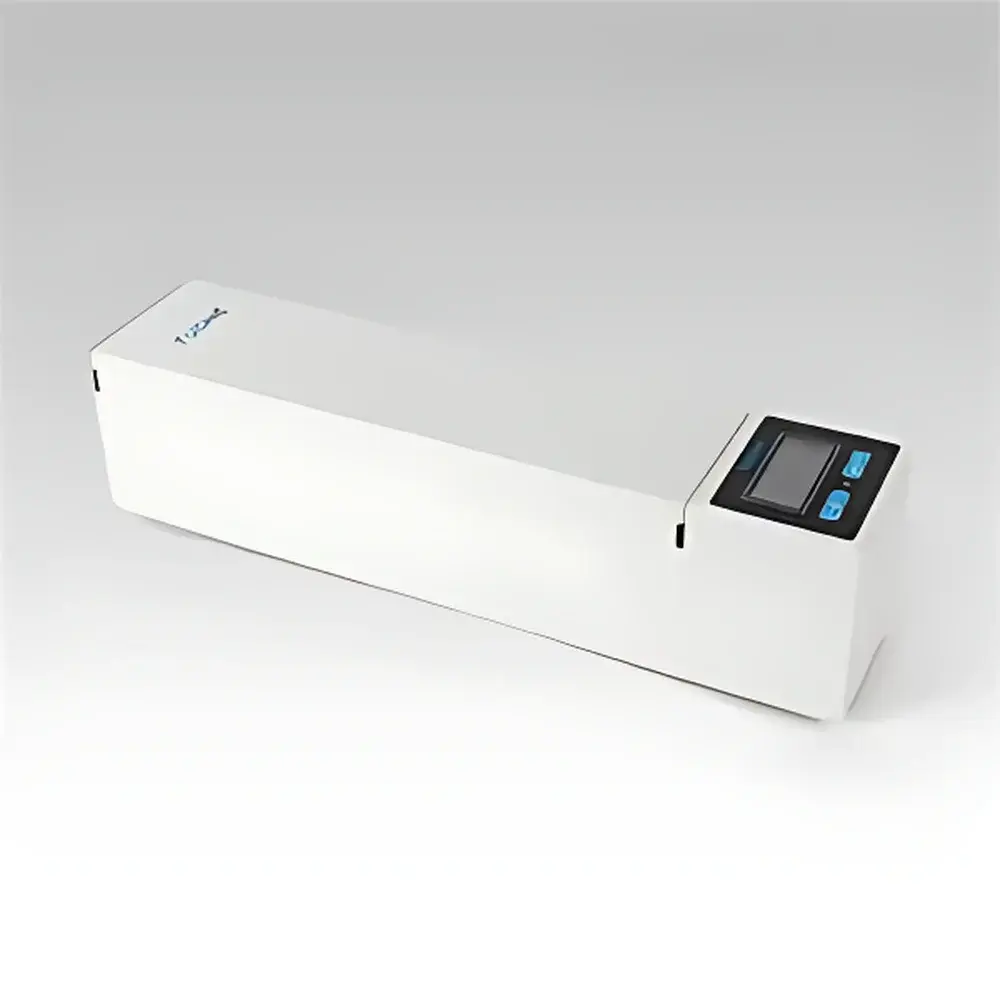
Tuohé SPX-100 HPLC Column Oven
| Brand | Tuohé |
|---|---|
| Origin | Shanghai, China |
| Model | SPX-100 |
| Temperature Control | Heating-only (no refrigeration) |
| Temperature Range | Ambient to 99.9°C |
| Temperature Stability | ±0.1°C |
| Repeatability | ±0.1°C |
| Chamber Dimensions | 80 × 40 × 400 mm |
| External Dimensions | 110 × 120 × 480 mm |
| Power Supply | AC 220 V, 50 Hz |
| Weight | 4 kg |
| Display | LCD 12864 with blue backlight and white characters |
Overview
The Tuohé SPX-100 HPLC Column Oven is a precision-engineered thermal management accessory designed for integration into high-performance liquid chromatography (HPLC) and ultra-high-performance liquid chromatography (UHPLC) systems. It operates on resistive heating principles—utilizing imported high-stability heating elements with dual-layer thermal protection—to maintain consistent column temperature under dynamic flow conditions. Unlike ambient-temperature operation, controlled column heating directly influences retention time reproducibility, peak symmetry, resolution of closely eluting analytes, and system backpressure profile. The SPX-100 is optimized for isocratic and gradient separations where temperature-induced retention shifts must be minimized—particularly critical in pharmacopeial methods (e.g., USP <621>, EP 2.2.46), stability-indicating assays, and method transfer across laboratories. Its ambient-to-99.9°C operating range accommodates standard reversed-phase, HILIC, and some ion-exchange applications without requiring active cooling.
Key Features
- Custom-engineered PID temperature control module with over-temperature cutoff protection—prevents thermal damage to expensive analytical columns during power surges or sensor failure.
- Independent circuit architecture ensures electromagnetic compatibility (EMC) with all major HPLC vendors (Agilent, Waters, Shimadzu, Thermo Fisher, and domestic platforms), eliminating signal interference or communication conflicts.
- Dual-stage heating design: primary heating element + auxiliary thermal buffer layer—delivers uniform axial and radial temperature distribution (<±0.1°C spatial deviation across chamber volume) and extends heater service life beyond 10,000 operational hours.
- Programmable ramp rate support (via optional firmware upgrade): enables user-defined temperature profiles synchronized with method runtime—essential for temperature-gradient chromatography and method development workflows.
- Modular mechanical design: chamber depth (400 mm), internal cross-section (80 × 40 mm), and mounting interface can be customized to accommodate 1–4 columns (including 150 mm, 250 mm, and 300 mm lengths) and diverse tubing routing configurations.
Sample Compatibility & Compliance
The SPX-100 supports all standard stainless steel, PEEK, and fused-silica capillary columns used in analytical- and preparative-scale HPLC, including but not limited to C18, C8, phenyl-hexyl, cyano, and silica-based phases. Its compact footprint and universal bracket system ensure seamless integration behind or beside any HPLC pump, autosampler, or detector—regardless of manufacturer-specific chassis layout. From a regulatory standpoint, the device meets IEC 61010-1 safety requirements for laboratory electrical equipment. While it does not provide active cooling, its ±0.1°C stability at 50°C (per ISO 17025-accredited validation protocols) satisfies GLP/GMP environmental control criteria for validated chromatographic methods. Full traceability is supported through manual calibration logs; optional NIST-traceable certificate documentation is available upon request.
Software & Data Management
The SPX-100 operates as a standalone hardware unit with local LCD interface (128×64 resolution, blue backlight, white character contrast) for real-time setpoint display, actual temperature readout, and status indicators (heating active, fault alarm). No proprietary software driver is required—eliminating OS compatibility constraints and cybersecurity concerns associated with networked peripherals. For laboratories implementing 21 CFR Part 11 compliance, temperature setpoints and operational history may be manually recorded in electronic lab notebooks (ELN) or LIMS-integrated audit trails. Optional RS-232 or USB-to-serial interface modules (sold separately) enable external logging via third-party SCADA or LabVIEW environments—supporting automated calibration verification and preventive maintenance scheduling.
Applications
- Pharmaceutical QC/QA: Ensuring retention time consistency per USP monographs requiring column temperature specification (e.g., assay of ibuprofen, metformin, or monoclonal antibody fragments).
- Food safety analysis: Stabilizing separation of mycotoxins, pesticides, and vitamins under variable lab ambient conditions.
- Environmental testing: Improving resolution of PAHs and PCB congeners in soil/water extracts where temperature sensitivity exceeds ±0.5°C.
- Academic research: Enabling systematic investigation of thermodynamic parameters (ΔH°, ΔS°) via van’t Hoff plots across controlled temperature gradients.
- Method transfer: Mitigating inter-laboratory variability caused by uncontrolled column temperature drift—critical for multi-site clinical trial bioanalysis.
FAQ
Does the SPX-100 support sub-ambient temperature control?
No. The unit provides heating-only functionality, with a minimum operating temperature equal to ambient laboratory conditions.
Can it accommodate multiple columns simultaneously?
Yes—standard configuration supports one 250 mm column; custom variants are available for up to four parallel columns with independent thermal zoning (contact engineering support for specifications).
Is the temperature accuracy verified at multiple setpoints?
Calibration is performed at 30°C, 50°C, and 80°C during factory acceptance testing; users may perform intermediate-point verification using a calibrated PT100 probe inserted into the chamber’s thermal well.
What safety certifications does the SPX-100 hold?
It complies with IEC 61010-1:2010 for electrical safety in measurement, control, and laboratory equipment, including dielectric strength, creepage/clearance, and thermal cut-off validation.
How is firmware updated if new features become available?
Firmware upgrades are delivered via USB flash drive and executed through the front-panel menu—no PC connection or vendor remote access required.
Related Products




