
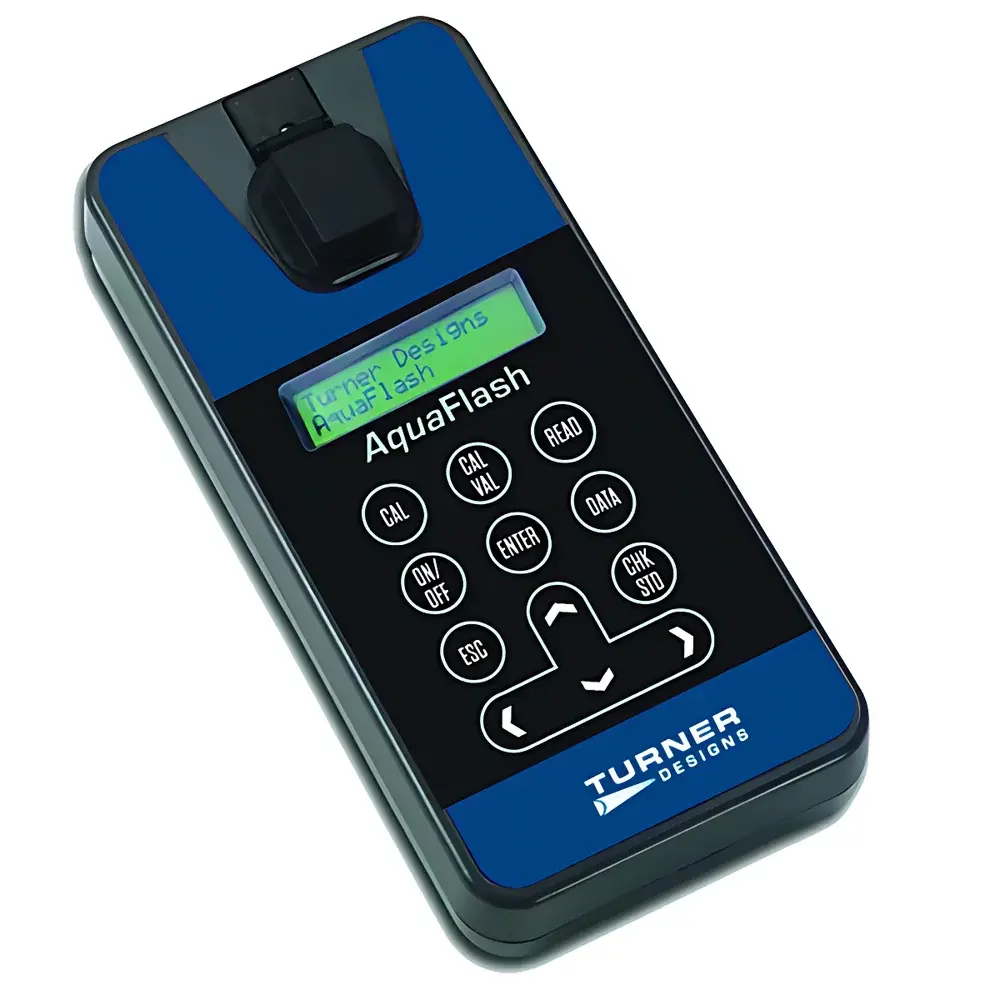
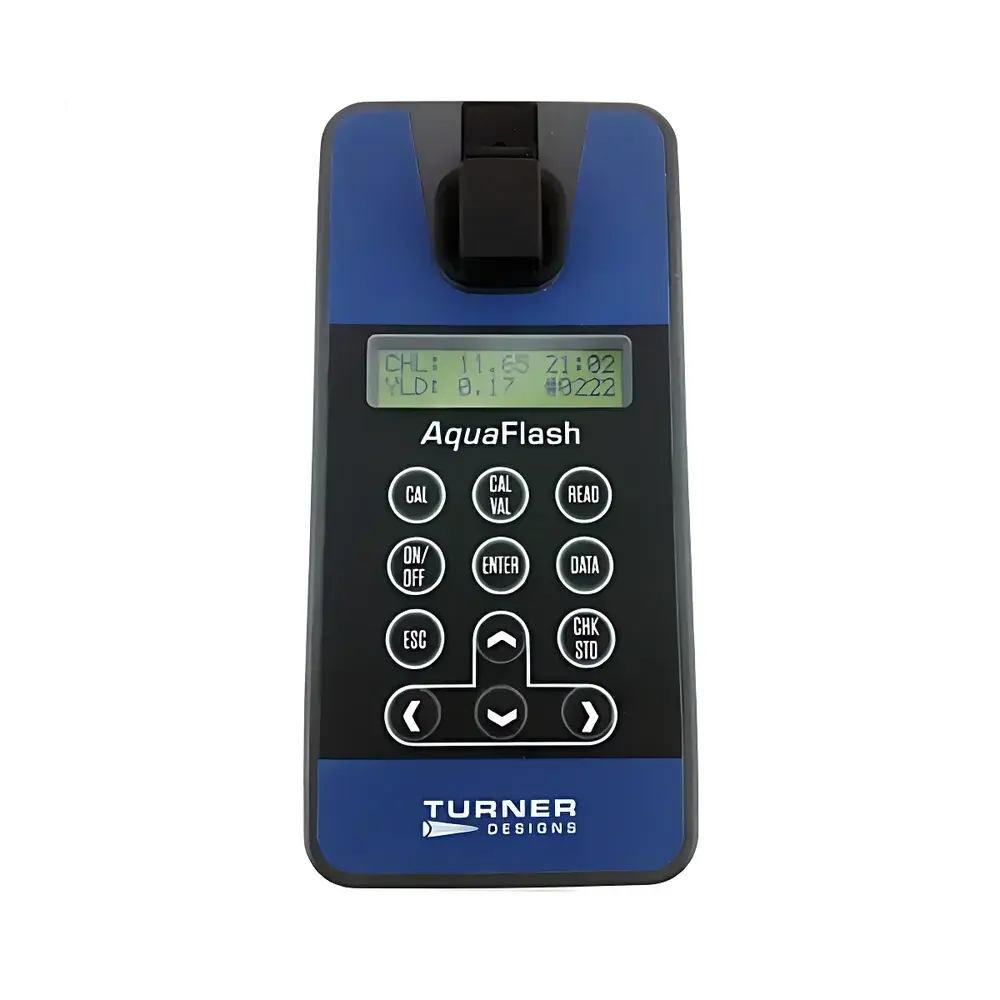
Turner Designs AquaFlash Handheld Chlorophyll a and Photosynthetic Efficiency Fluorometer
| Brand | Turner Designs |
|---|---|
| Origin | USA |
| Model | AquaFlash |
| Detection Principle | Pulse-Amplitude-Modulated (PAM) Fluorescence |
| Measurement Targets | Total Chlorophyll a Concentration (µg/L) & Maximum Quantum Yield of PSII (Fv/Fm) |
| Detection Limit | 0.30 µg/L |
| Range | 0–100 µg/L |
| Linearity | R² > 0.99 |
| Dimensions | 4.45 cm × 8.9 cm × 18.4 cm |
| Weight | 0.4 kg |
| Operating Temperature | 5–40 °C |
| Warm-up Time | 5 s |
| Detector | Silicon Photodiode (300–1000 nm) |
| Data Storage | 1000 measurements |
| Power | 4 × AAA batteries (>1000 measurements per set) |
| Enclosure Rating | IP67 |
| Sample Cell | 10 × 10 mm square quartz or glass cuvette |
| Calibration | Solid calibration block + liquid calibration standard |
| Data Output | ASCII via USB interface |
Overview
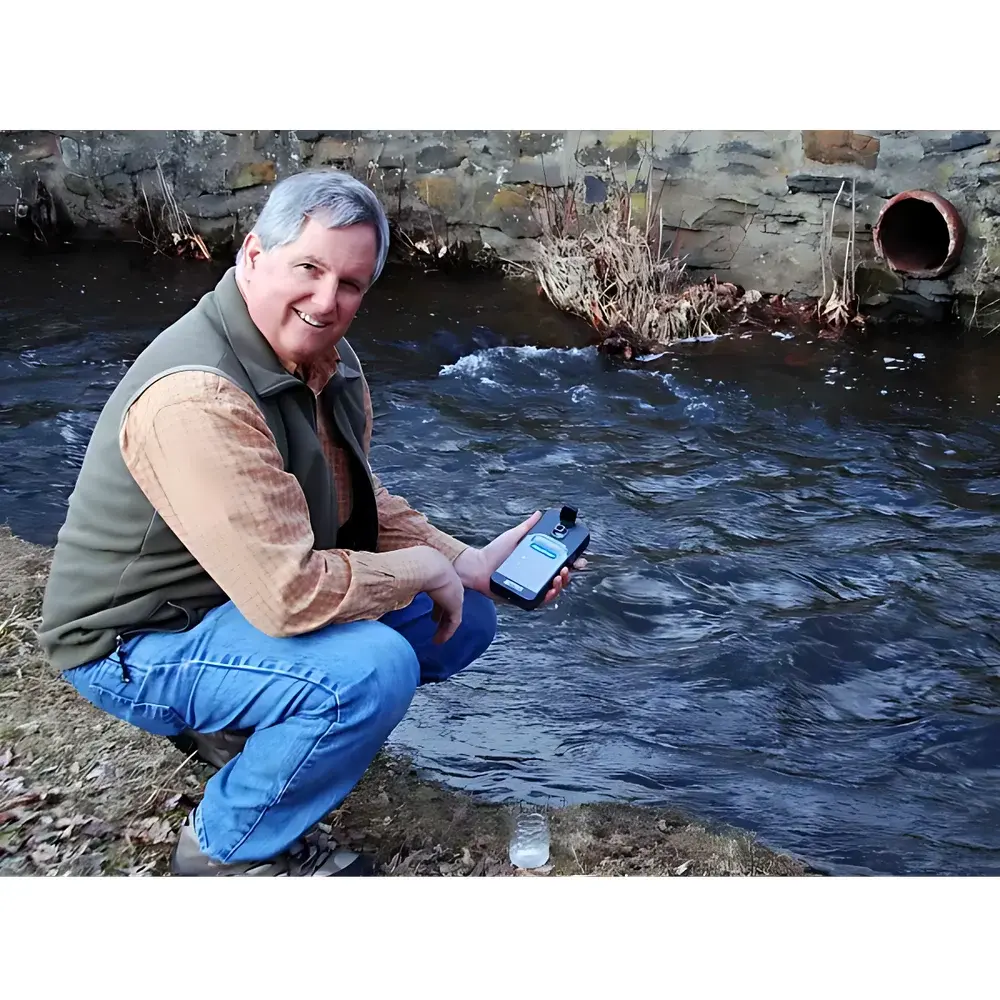
The Turner Designs AquaFlash Handheld Chlorophyll a and Photosynthetic Efficiency Fluorometer is an engineered field-deployable instrument designed for rapid, in situ quantification of phytoplankton biomass and physiological status in freshwater, marine, and wastewater systems. It operates on the principle of pulse-amplitude-modulated (PAM) fluorescence, enabling non-invasive assessment of photosystem II (PSII) photochemical efficiency through measurement of variable chlorophyll a fluorescence yield. By applying a standardized saturating light pulse—optimized to induce maximal fluorescence (Fm) without photoinhibitory artifacts—the AquaFlash calculates both total chlorophyll a concentration (reported in µg/L) and the maximum quantum yield of PSII (Fv/Fm), a robust indicator of algal health and stress response. This dual-parameter capability supports early detection of eutrophication dynamics, bloom onset, nutrient limitation, and toxicant-induced photophysiological disruption—all within ≤15 seconds per sample.
Key Features
- Rapid, single-button operation: Insert 10 × 10 mm cuvette, press READ, obtain calibrated chlorophyll a concentration and Fv/Fm in under 15 seconds.
- Field-rugged architecture: IP67-rated enclosure ensures dust-tight and immersion-resistant performance (1 m for 30 min); operational across 5–40 °C ambient range.
- Onboard data integrity: Stores up to 1000 timestamped measurements with automatic metadata logging (date, time, instrument ID, operator code if assigned).
- Traceable calibration system: Includes NIST-traceable solid calibration block for daily performance verification and aqueous chlorophyll a standard solution for primary instrument calibration.
- Low-power, high-duty-cycle design: Powered by four standard AAA alkaline cells; >1000 measurements per battery set with auto-sleep mode after 2 minutes of inactivity.
- Optimized optical path: Broadband silicon photodiode detector (300–1000 nm spectral response) coupled with narrow-band excitation and emission filters ensures minimal interference from phycobiliproteins or turbidity.
Sample Compatibility & Compliance
The AquaFlash accepts standard 10 × 10 mm square cuvettes fabricated from high-transmission quartz or optical-grade borosilicate glass. It is validated for use with natural water samples—including lake, river, estuarine, coastal, and aquaculture effluent matrices—without filtration or extraction when measuring intact phytoplankton. For regulatory and quality assurance workflows, the instrument supports GLP-compliant data handling: all stored measurements include immutable timestamps and are exportable in ASCII format for integration into LIMS or statistical analysis platforms. While not certified to ISO 10260 or ASTM D3731, its measurement protocol aligns with EPA Method 445.0 (in vivo chlorophyll a fluorometric determination) and adheres to principles outlined in ISO 10260:2019 for fluorometric algae assessment. Routine calibration verification satisfies internal QA/QC requirements for environmental monitoring programs subject to state NPDES or EU WFD reporting obligations.
Software & Data Management
Data retrieval is accomplished via USB connection to a host PC using Turner Designs’ AquaFlash Utility software (Windows-compatible). The utility enables batch download, CSV export, spectral validation plots, and Fv/Fm trend visualization over time. All exported files retain full audit trail metadata—including firmware version, calibration date, and user-defined site identifiers—supporting 21 CFR Part 11 readiness when paired with institutional electronic signature policies. No cloud dependency or subscription service is required; raw fluorescence decay curves are not stored, but derived parameters (chlorophyll a, Fv/Fm, signal-to-noise ratio) are retained with precision to three decimal places.
Applications
- Real-time monitoring of cyanobacterial and diatom bloom development in reservoirs and drinking water intakes.
- Assessment of phytoplankton photophysiological response to UV-B exposure, heavy metals, herbicides, or hypoxia.
- Validation of remote sensing algorithms (e.g., Sentinel-3 OLCI) through ground-truth chlorophyll a profiling.
- Process control in wastewater treatment plants evaluating algal-based nutrient removal efficiency.
- Field validation of laboratory-grown culture health prior to ecotoxicological assays.
- Education and outreach: portable demonstration of photosynthetic function in undergraduate limnology and marine biology curricula.
FAQ
Does the AquaFlash require solvent extraction for chlorophyll a quantification?
No. It measures in vivo fluorescence from intact, living phytoplankton cells—eliminating acetone or methanol extraction steps and associated analytical variability.
Can it distinguish between different algal taxonomic groups?
No. It reports bulk chlorophyll a and PSII efficiency; taxonomic resolution requires complementary techniques such as HPLC pigment analysis or flow cytometry.
Is temperature compensation applied during measurement?
Yes. Internal thermistor monitors sample temperature in real time and applies empirically derived correction factors to Fv/Fm output per ISO 10260 Annex B guidelines.
How often must the solid calibration block be recertified?
Turner Designs recommends annual recalibration of the solid block at an accredited metrology lab traceable to NIST SRM 2241.
What is the minimum sample volume required?
1.5 mL is sufficient to fill a standard 10 × 10 mm cuvette to the recommended height (≥10 mm optical path length).
Related Products







