
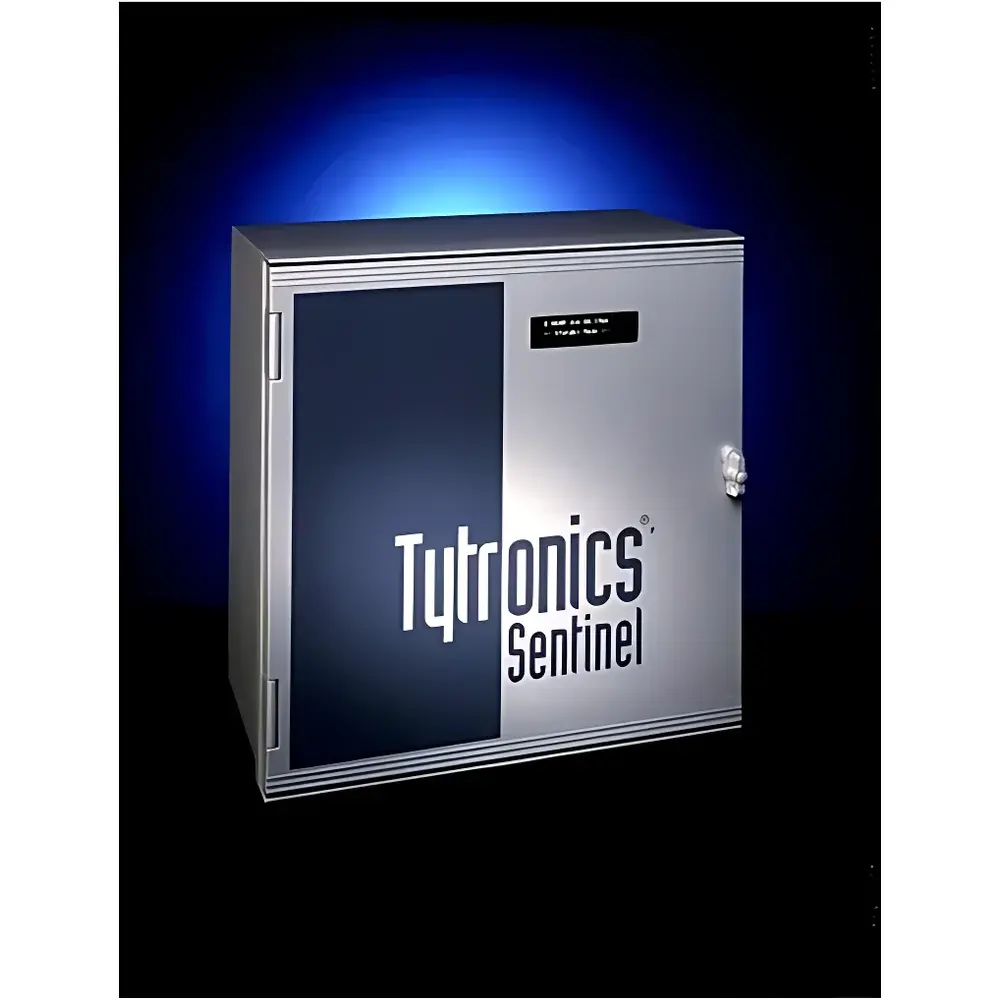
Tytronics Sentinel Fluoride Ion Online Monitor
| Origin | USA |
|---|---|
| Manufacturer Type | Authorized Distributor |
| Origin Category | Imported |
| Model | Sentinel Fluoride Ion Online Monitor |
| Instrument Type | Fluoride Ion Analyzer |
| Measurement Principle | Potentiometric Ion-Selective Electrode (ISE) |
| Range | 0–20 ppm |
| Accuracy | ±5% of reading or full scale |
| Resolution | 0.001 ppm |
| Repeatability | ±5% of reading or full scale |
| Cycle Time | 2 minutes |
| Sample Flow Rate | 50–900 mL/min |
| Sample Interface | 1/4" compression fitting |
| Sample Temperature | 5–70 °C |
| Max. Suspended Solids | 2% w/w, max. particle size 1.27 mm |
| Sample Pressure | 0–50 psig |
| Waste Outlet | 3/4" NPT male, open drain |
| Alarm Outputs | User-programmable digital outputs |
| Analog Output | 4–20 mA, fully configurable |
| Power Supply | 100–240 VAC, 50/60 Hz |
| Enclosure Rating | NEMA 4X (IP65) |
| Dimensions (W×H×D) | 610 × 640 × 330 mm |
| Weight | ~36 kg (fully assembled) |
| Mounting | Wall-mounted with included hardware |
| Certifications | CE-compliant, designed to meet general requirements for industrial environmental monitoring installations |
Overview
The Tytronics Sentinel Fluoride Ion Online Monitor is a robust, field-deployable potentiometric analyzer engineered for continuous, real-time quantification of fluoride ion (F⁻) concentration in aqueous streams. Utilizing a solid-state, membrane-based ion-selective electrode (ISE), the instrument operates on the Nernst principle—generating a millivolt potential proportional to the logarithm of fluoride activity in solution. Unlike optical or colorimetric methods, ISE-based detection is inherently insensitive to sample turbidity, color, or suspended solids up to 2% w/w, enabling stable operation in challenging matrices such as raw surface water, wastewater effluent, and industrial process water. Designed for unattended 24/7 operation, the Sentinel delivers high reproducibility (±5% repeatability) and low memory effect through optimized fluidic pathways, minimal reagent consumption, and automated electrode conditioning cycles.
Key Features
- Patented large-bore sample introduction system minimizes clogging risk and extends maintenance intervals in dirty or particulate-laden water sources.
- Programmable analysis logic supporting up to 10 user-defined measurement protocols and 3 distinct calibration strategies (single-point, two-point, or multi-point).
- Comprehensive self-diagnostic suite with real-time status monitoring of sample presence, reagent level, electrode response stability, and flow integrity.
- Full automation: auto-calibration, auto-cleaning, auto-filling, and auto-zeroing—reducing operator dependency and ensuring long-term measurement consistency.
- Modular architecture enables expansion to monitor up to six independent sample streams via optional multiplexer integration.
- Industrial-grade enclosure rated NEMA 4X (IP65), suitable for outdoor or wet-location mounting without additional sheltering.
- Configurable 4–20 mA analog output with linear or logarithmic scaling, plus programmable digital alarm relays for integration into SCADA or DCS systems.
Sample Compatibility & Compliance
The Sentinel is validated for use across diverse water matrices—including potable water, surface water, municipal wastewater, cooling tower make-up, and chemical process streams—where fluoride monitoring supports regulatory compliance (e.g., WHO guidelines, EPA Method 300.0, ISO 10304-1 for anion analysis) and process control objectives. It accommodates samples with temperatures from 5 to 70 °C and pressures up to 50 psig. Particulate tolerance is defined at ≤2% suspended solids by weight, with maximum particle dimension limited to 1.27 mm—eliminating the need for pre-filtration in many applications. While not certified to GLP or FDA 21 CFR Part 11 out-of-the-box, its audit-ready event logging, timestamped calibration records, and parameter-change tracking support validation efforts under ISO/IEC 17025 or internal QA/QC frameworks.
Software & Data Management
The embedded controller features a graphical LCD interface with intuitive menu navigation and multilingual support (English, Spanish, French). All operational parameters—including calibration coefficients, alarm thresholds, cycle timing, and output mapping—are stored in non-volatile memory and can be exported via USB for archival or reporting. Optional Ethernet or RS-485 Modbus RTU connectivity allows remote configuration and data polling using standard industrial protocols. Raw sensor voltage, temperature-compensated F⁻ concentration, diagnostic flags, and maintenance timestamps are logged at user-configurable intervals (1 min to 24 h), facilitating trend analysis and predictive maintenance planning.
Applications
- Continuous compliance monitoring of fluoride in drinking water distribution systems per national standards (e.g., US EPA MCL of 4.0 mg/L, EU Directive 2020/2184).
- Effluent monitoring at fluorine-containing industrial facilities (e.g., aluminum smelters, semiconductor etching lines, phosphate fertilizer plants).
- Process control in water softening and defluoridation units utilizing activated alumina or bone char media.
- Environmental surveillance of groundwater near landfill leachate plumes or geological fluoride-rich aquifers.
- QA/QC verification in bottled water production and pharmaceutical water systems where fluoride is a controlled impurity.
FAQ
What measurement principle does the Sentinel employ?
It uses potentiometric detection via a fluoride-specific ion-selective electrode, based on the Nernst equation, with automatic temperature compensation.
Is the instrument suitable for untreated wastewater?
Yes—its large-diameter fluid path and anti-clog inlet design accommodate up to 2% suspended solids and particles ≤1.27 mm without external filtration.
Can calibration be performed automatically?
Yes—users may configure single-, two-, or multi-point calibrations triggered on time, volume, or event-based schedules.
Does it support remote diagnostics and firmware updates?
Remote access is enabled via optional Modbus TCP or RS-485; firmware updates require local USB connection and follow version-controlled release protocols.
What are the electrical and environmental installation requirements?
It requires 100–240 VAC power, operates in ambient temperatures from –20 to 50 °C, and meets NEMA 4X for rain, dust, and hose-directed water resistance.
Related Products







