
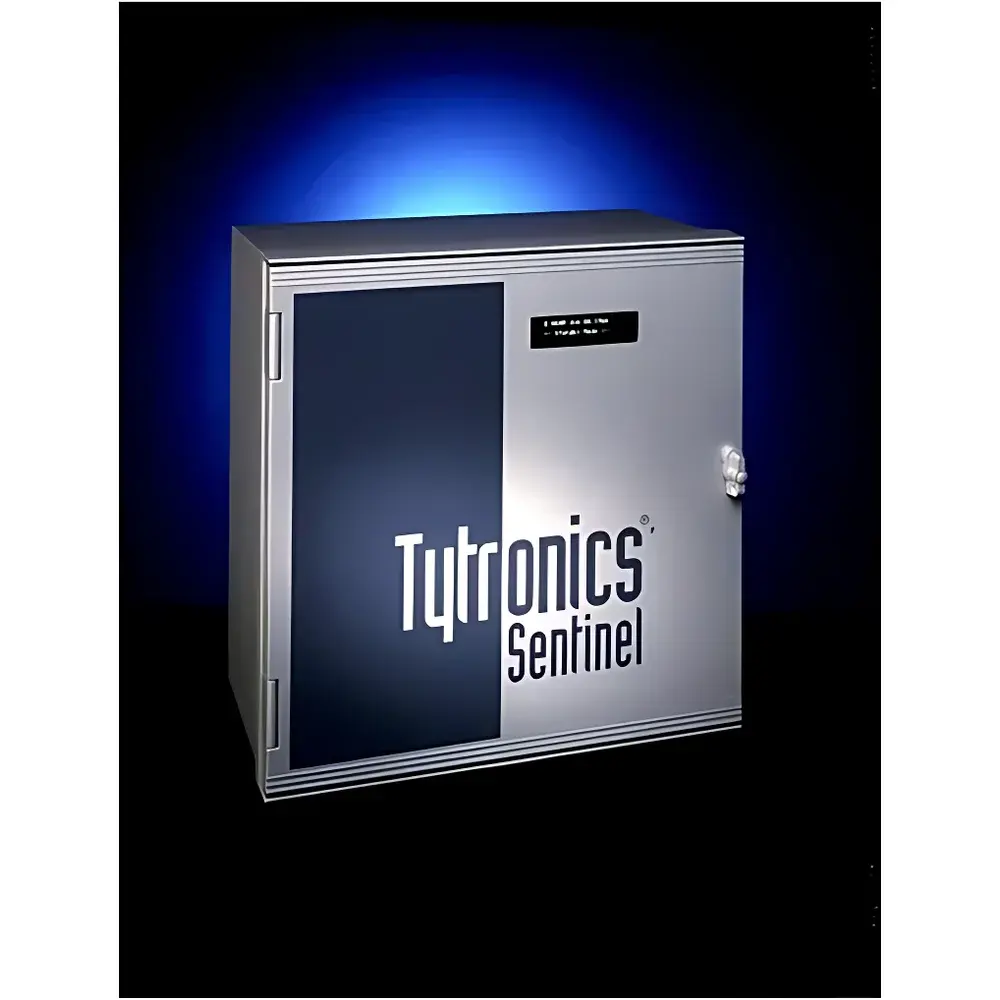
Tytronics Sentinel Silicon Online Analyzer
| Origin | USA |
|---|---|
| Manufacturer Type | Authorized Distributor |
| Origin Category | Imported |
| Model | Sentinel Silicon Online Analyzer |
| Instrument Type | Silica (Orthosilicic Acid) Analyzer |
| Measurement Principle | Colorimetric Spectrophotometry (Molybdenum Blue Method) |
| Detection Wavelengths | 810 nm (low-range), 312 nm (high-range) |
| Range Options | 0–100 ppb, 0–500 ppb, 0–1000 ppb, 0–2 ppm, 0–5 ppm, 0–10 ppm |
| Accuracy | ±2% of reading or full scale |
| Resolution | 0.001 ppb (at lowest range) |
| Repeatability | ±2% of reading or full scale |
| Sample Flow Rate | 50–900 mL/min |
| Sample Interface | 1/4" compression fitting |
| Sample Temperature | 5–70 °C |
| Max Suspended Solids | 2% w/w, particle size ≤ 1.27 mm |
| Sample Pressure | 0–50 psig |
| Drain Outlet | 3/4" NPT male, atmospheric vent |
| Alarm Outputs | User-programmable digital relays |
| Analog Output | 4–20 mA, fully configurable |
| Power Supply | 100–240 VAC, 50/60 Hz |
| Enclosure Rating | NEMA 4X (IP65) |
| Mounting | Wall-mounted with integrated hardware |
| Dimensions (W×H×D) | 387 × 406 × 210 mm |
| Weight | ~36 kg (fully assembled) |
Overview
The Tytronics Sentinel Silicon Online Analyzer is a robust, laboratory-grade continuous monitoring instrument engineered for precise, real-time quantification of dissolved silica (as SiO₂) in critical water streams. It operates on the internationally standardized molybdenum blue colorimetric method—compliant with ASTM D859 and ISO 10557—where orthosilicic acid reacts with molybdate under acidic conditions to form heteropoly-molybdosilicic acid (silicomolybdic acid), subsequently reduced to the intensely colored silicomolybdenum blue complex. Dual-wavelength photometric detection at 810 nm (for sub-ppb sensitivity) and 312 nm (for ppm-level analysis) enables automatic turbidity compensation and eliminates interferences from colored or suspended particulates. Designed for unattended operation in demanding industrial environments—including power plant boiler feedwater, semiconductor ultrapure water loops, and municipal drinking water treatment—the Sentinel delivers high reproducibility, minimal reagent consumption, and negligible carryover between measurements.
Key Features
- Patented large-bore fluidic architecture minimizes clogging risk when analyzing turbid, high-suspended-solids samples (up to 2% w/w, particles ≤1.27 mm)
- Dual-wavelength optical detection system corrects for sample turbidity and chromophore interference without mechanical filtration
- Fiber-optic probe design reduces optical path contamination and extends maintenance intervals
- Automated sequence control: self-calibration, reagent replenishment, line flushing, and zero/slope verification—all programmable via intuitive HMI
- Up to 10 user-defined analytical methods and 3 independent calibration protocols stored onboard
- Configurable alarm logic for low-sample-flow, low-reagent-level, calibration failure, and sensor fault conditions
- Modular architecture supports expansion to six independent sample inlet channels with time-multiplexed analysis
- NEMA 4X (IP65)-rated enclosure ensures reliable performance in humid, washdown-prone environments
Sample Compatibility & Compliance
The Sentinel accepts liquid samples across a broad physicochemical spectrum: potable water, surface water, wastewater effluent, condensate, demineralized process water, and aggressive chemical process streams. It accommodates inlet pressures up to 50 psig and temperatures from 5 to 70 °C. Sample compatibility includes aqueous matrices with up to 2% suspended solids (by weight) and particle diameters ≤1.27 mm. The analyzer meets key regulatory and quality framework requirements: its data integrity architecture supports audit trails per FDA 21 CFR Part 11, and operational protocols align with GLP and GMP principles for critical water monitoring. Calibration traceability follows NIST-traceable standards, and method validation documentation is provided for ISO/IEC 17025-compliant laboratories.
Software & Data Management
The embedded firmware features a secure, password-protected web interface accessible via Ethernet (TCP/IP) or optional RS-485 Modbus RTU. All configuration parameters—including method selection, calibration schedules, alarm thresholds, and analog output scaling—are remotely configurable and version-logged. Full audit trail functionality records operator actions, calibration events, and measurement anomalies with timestamps and user IDs. Data export supports CSV and XML formats; integration with SCADA, DCS, or LIMS systems is achieved through standard 4–20 mA analog outputs or Modbus TCP. Firmware updates are performed over HTTPS with cryptographic signature verification to ensure integrity and compliance with cybersecurity best practices for industrial IoT devices.
Applications
- Power generation: Continuous monitoring of silica in boiler feedwater and steam condensate to prevent turbine blade deposition and heat exchanger scaling
- Semiconductor manufacturing: Ultrapure water (UPW) surveillance at sub-ppb levels to meet SEMI F63 specifications for silicon wafer cleaning processes
- Pharmaceutical water systems: Monitoring of purified water (PW) and water for injection (WFI) per USP and EP 2.2.44 guidelines
- Municipal drinking water treatment: Early detection of silica breakthrough in ion exchange or reverse osmosis trains
- Chemical process water: Real-time control of silica concentration in catalyst cooling loops and reactor feed streams
- Environmental compliance: Automated reporting for EPA NPDES permits requiring silica discharge limits
FAQ
What silica species does the Sentinel measure?
It quantifies total reactive silica (orthosilicic acid, Si(OH)₄), the biologically and industrially relevant fraction that participates in the molybdenum blue reaction.
Can the analyzer operate without manual intervention for extended periods?
Yes—typical unattended run time exceeds 30 days with standard reagent packs; optional remote diagnostics and predictive maintenance alerts further extend operational uptime.
Is the instrument suitable for high-purity water applications?
Absolutely—the low-range configuration (0–100 ppb) achieves detection limits of 0.05 ppb with <±2% accuracy, validated per ASTM D859 Annex A1 for UPW applications.
How is turbidity compensated during measurement?
By simultaneous dual-wavelength photometry (810 nm for analyte signal, 312 nm for scattering correction), eliminating the need for inline filters or centrifugation.
Does the system support regulatory audit requirements?
Yes—full electronic record retention, user access logs, calibration history, and tamper-evident data export comply with FDA 21 CFR Part 11, EU Annex 11, and ISO 17025 data integrity clauses.
Related Products







