
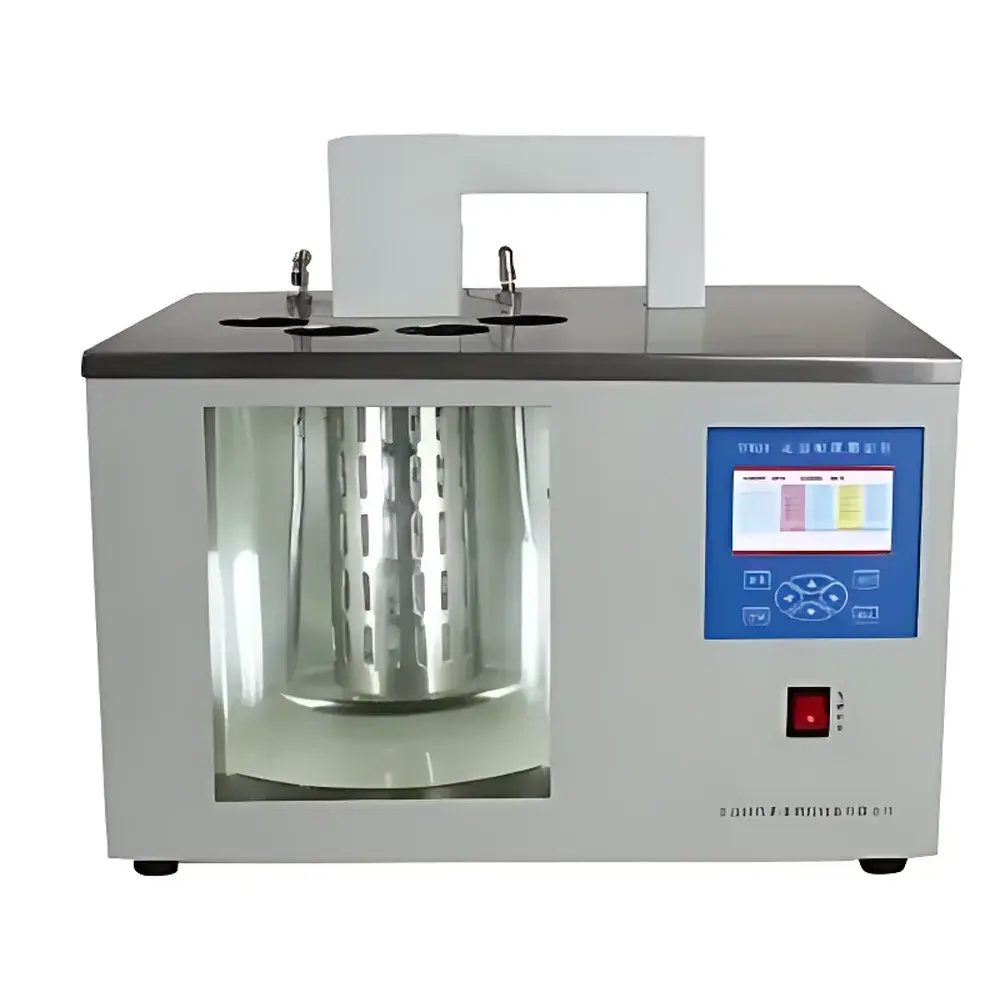
Ubbelohde Viscometer TP625 by TimePower
| Brand | TimePower |
|---|---|
| Origin | Beijing, China |
| Manufacturer | Yes |
| Country of Origin | China |
| Model | TP625 |
| Pricing | Upon Request |
| Temperature Control Range | 0–100 °C (0 °C to ambient requires optional chiller) |
| Temperature Stability | ±0.05 °C |
| Temperature Resolution | 0.01 °C |
| Bath Capacity | 4 capillary positions |
| Display | 5.0-inch resistive touch LCD |
| Control System | Microprocessor-based PID temperature control |
| Sensors | Imported high-accuracy Pt100 RTD sensors |
| Illumination | Integrated LED backlighting for capillary observation |
| Power Supply | AC 220 V ±10%, 50 Hz ±5 Hz |
| Heating Power | 1500 W |
| Dimensions (W×D×H) | 400 mm × 400 mm × 620 mm |
| Weight | 20 kg |
| Compliance | Designed per GB/T 265–1988 (equivalent to ASTM D445 and ISO 3104) |
Overview
The TimePower TP625 Ubbelohde Viscometer is a precision-engineered kinematic viscosity tester designed for routine and quality-control analysis of petroleum products, lubricants, base oils, transformer oils, and other Newtonian or near-Newtonian liquids. It operates on the fundamental principle of capillary flow viscometry—measuring the time required for a fixed volume of liquid to flow under gravity through a calibrated Ubbelohde-type capillary tube immersed in a thermostatically controlled water bath. This method directly yields kinematic viscosity (ν, in mm²/s or cSt) according to the equation ν = C × t, where C is the capillary constant (determined via calibration with certified reference oils) and t is the efflux time. The instrument strictly adheres to the procedural requirements of GB/T 265–1988, which aligns with internationally recognized standards including ASTM D445 (Standard Test Method for Kinematic Viscosity of Transparent and Opaque Liquids) and ISO 3104 (Petroleum products — Determination of kinematic viscosity and calculation of dynamic viscosity). Its robust architecture supports reproducible measurements across laboratories in power generation, petrochemical refining, third-party inspection agencies, and R&D institutions.
Key Features
- Microprocessor-controlled PID temperature regulation ensures thermal stability within ±0.05 °C over the full 0–100 °C operating range—critical for minimizing thermal drift during extended efflux timing.
- Four independent immersion wells accommodate simultaneous placement of multiple Ubbelohde or reverse-flow capillaries, enabling parallel testing and improved throughput without cross-contamination.
- 5.0-inch resistive touch LCD interface provides intuitive navigation, real-time bath temperature monitoring, clock-synchronized test logging (year/month/day/hour/minute), and on-screen calibration prompts.
- High-fidelity Pt100 platinum resistance thermometers deliver rapid thermal response (<1 s settling time) and long-term drift <0.02 °C/year, ensuring traceable temperature measurement per ISO/IEC 17025 requirements.
- Integrated LED illumination system enhances visual clarity during manual meniscus alignment and efflux timing—particularly essential when working with low-contrast or dyed samples.
- Optional chiller integration extends operational capability to sub-ambient temperatures (e.g., –20 °C to 0 °C), supporting low-temperature viscosity profiling required for winter-grade engine oils and aviation fuels per ASTM D5293 and SAE J300 specifications.
Sample Compatibility & Compliance
The TP625 is validated for use with transparent and opaque Newtonian fluids meeting the physical criteria defined in ASTM D445 Section 6—namely, kinematic viscosity between 0.2 and 300,000 mm²/s (cSt) at test temperatures from 15 °C to 100 °C. Compatible capillary types include standard Ubbelohde (ASTM D445 Annex A1), reverse-flow (ASTM D445 Annex A2), and dilution-capable variants for intrinsic viscosity determination of polymer solutions (per ASTM D2857). All hardware and firmware configurations support GLP-compliant data integrity: automatic timestamping, non-editable test records, and audit-ready parameter logs. The system’s temperature control algorithm and sensor calibration protocol are documented to satisfy internal validation requirements under ISO/IEC 17025 Clause 6.4 and FDA 21 CFR Part 11 (when paired with TimePower’s optional secure data export module).
Software & Data Management
While the TP625 operates as a standalone benchtop instrument with embedded firmware, it supports RS232 serial output for direct connection to laboratory information management systems (LIMS) or custom QC databases. Exported data includes: test ID, sample ID, bath temperature (°C), efflux time (s), capillary constant (mm²/s²), calculated kinematic viscosity (mm²/s), repeatability deviation (%), operator ID, and timestamp. Firmware version 2.3+ enables CSV-formatted batch exports and integrates configurable pass/fail thresholds against specification limits (e.g., ASTM D975 for diesel fuel). No proprietary software installation is required; raw data files are natively readable in Excel, Python pandas, or statistical process control (SPC) platforms.
Applications
- Quality assurance of crude oil fractions and refined distillates in refinery QC labs.
- Viscosity grading of industrial lubricants per ISO VG classification (ISO 3448).
- Transformer oil condition monitoring per IEC 60296 and ASTM D877.
- Intrinsic viscosity determination of synthetic polymers (e.g., PET, PA6) in solvent systems using dilution protocols.
- Research-level characterization of biofuel blends (e.g., FAME, HVO) across seasonal temperature ranges.
- Third-party certification testing for customs clearance and international trade compliance (e.g., CNCA, SGS, BV).
FAQ
What capillary types are supported out-of-the-box?
The TP625 ships with one calibrated Ubbelohde capillary (standard configuration); reverse-flow and dilution capillaries are available as optional accessories.
Is external calibration required before first use?
Yes—users must perform initial calibration using NIST-traceable reference oils (e.g., Cannon N4000 series) to determine the capillary constant (C-value) prior to routine testing.
Can the instrument store historical test results internally?
It retains up to 1,000 test records in non-volatile memory with full metadata; older entries are overwritten on a FIFO basis unless exported externally.
Does the system meet electromagnetic compatibility (EMC) requirements for industrial labs?
Yes—the TP625 complies with GB/T 18268.1–2010 (equivalent to IEC 61326-1:2012) for emission and immunity in Class A environments.
What maintenance intervals are recommended for long-term accuracy?
Bath fluid should be replaced every 6 months; temperature sensor verification against a certified reference thermometer is advised quarterly; capillary cleaning after each sample group is mandatory per ASTM D445 Section 9.3.




