
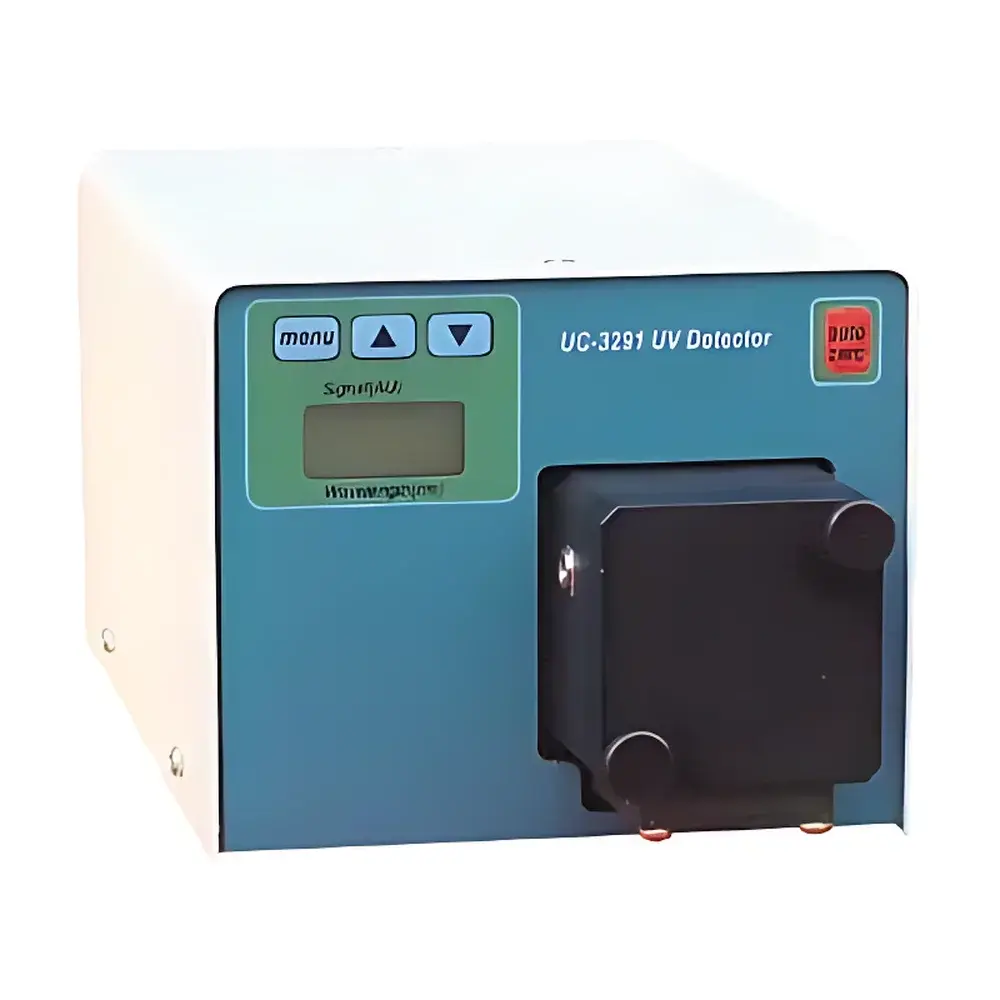
UC-3291 Miniature Single-Wavelength UV Detector for HPLC
| Brand | Ulink Optoelectronics |
|---|---|
| Origin | Beijing, China |
| Model | UC-3291 |
| Detector Type | Ultraviolet Absorbance Detector (UVD) |
| Wavelength Options | 254 nm, 280 nm, 365 nm, 415 nm |
| Light Source | Low-Pressure Mercury Lamp / LED Hybrid |
| Lamp Lifetime | 5,000 h |
| Noise | 4 × 10⁻⁵ AU (at 1 mL/min in methanol) |
| Drift | 3 × 10⁻⁴ AU/h (at 1 mL/min in methanol) |
| Minimum Detectable Concentration | 2 × 10⁻⁸ g/mL (naphthalene standard, 1 mL/min in methanol) |
| Auto-Zero Function | Local panel or remote via RS-232/RS-485 |
| Linear Range | 0–2.5 AU |
| Display | 2-line × 8-character LCD |
| Dimensions (L×H×D) | 130 × 210 × 110 mm |
| Weight | 1.7 kg |
| Flow Cell Options | Analytical and Semi-Preparative Configurations |
Overview
The UC-3291 Miniature Single-Wavelength UV Detector is a compact, high-stability absorbance detector engineered for integration into benchtop and modular high-performance liquid chromatography (HPLC) systems. It operates on the principle of ultraviolet-visible (UV-Vis) absorbance photometry, measuring analyte concentration based on Beer-Lambert law compliance at fixed wavelengths—254 nm, 280 nm, 365 nm, and 415 nm—selected via front-panel switching. Designed for routine QC/QA laboratories, academic research settings, and OEM instrument builders, the UC-3291 delivers consistent baseline stability and low electronic noise without requiring temperature-controlled enclosures or complex optical alignment. Its hybrid light source combines the spectral purity of a low-pressure mercury lamp with the longevity and instant-on capability of LED technology, ensuring reproducible response across extended operational cycles.
Key Features
- Ultra-compact footprint (130 × 210 × 110 mm) enables seamless integration into space-constrained HPLC configurations, including portable and educational systems.
- Robust optical architecture with dual-wavelength verification capability ensures long-term wavelength accuracy and minimizes drift-induced calibration drift.
- Low-noise analog signal processing chain achieves 4 × 10⁻⁵ AU RMS noise under standard flow conditions (1 mL/min methanol), supporting detection of trace-level aromatic compounds such as nucleotides, phenols, and polycyclic aromatics.
- Auto-zero functionality supports both local manual initiation and remote triggering via RS-232 or RS-485 serial interface—compatible with legacy and modern chromatography data systems (CDS).
- Interchangeable flow cells accommodate analytical (e.g., 10 mm pathlength, 1 µL volume) and semi-preparative (e.g., 6 mm pathlength, 5 µL volume) applications without hardware modification.
- LCD display provides real-time monitoring of absorbance output, zero status, and lamp operational hours—critical for GLP-compliant recordkeeping and preventive maintenance scheduling.
Sample Compatibility & Compliance
The UC-3291 is compatible with common reversed-phase, normal-phase, and ion-pairing HPLC mobile phases—including aqueous buffers, acetonitrile, methanol, and tetrahydrofuran—provided they exhibit adequate UV transparency at the selected wavelength. Its stainless-steel wetted surfaces and chemically resistant flow cell windows meet ISO 8573-1 cleanliness standards for liquid handling components. While not certified to IEC 61010-1 as a standalone safety-certified instrument, it conforms to electromagnetic compatibility (EMC) requirements per EN 61326-1 when installed within a compliant HPLC platform. The detector supports audit-trail-ready operation when interfaced with CDS software compliant with FDA 21 CFR Part 11 (electronic records/signatures) and adheres to ASTM E2500-13 guidance for analytical instrument qualification.
Software & Data Management
The UC-3291 communicates via ASCII-based serial protocol over RS-232 or RS-485, enabling bidirectional control and real-time analog output (0–1 V or 0–5 V scalable to 0–2.5 AU). It integrates natively with open-architecture chromatography software platforms—including OpenLab CDS, Chromeleon, and custom LabVIEW or Python-based acquisition tools—without proprietary drivers. All configuration parameters (wavelength selection, auto-zero trigger, gain scaling) are stored in non-volatile memory and persist through power cycling. Remote firmware updates are not supported; however, calibration coefficients may be externally loaded via serial command sequence to support multi-instrument standardization protocols.
Applications
- Routine pharmaceutical assay of active pharmaceutical ingredients (APIs) and degradation products using USP/EP-compliant isocratic or gradient methods.
- Quality control of food additives, preservatives, and natural pigments (e.g., anthocyanins, carotenoids) in beverage and dairy matrices.
- Environmental monitoring of phenolic contaminants and polycyclic aromatic hydrocarbons (PAHs) in water extracts per EPA Method 8330B.
- Academic teaching labs performing fundamental chromatography experiments with emphasis on retention time reproducibility and peak area linearity.
- OEM integration into compact LC systems for point-of-need analysis in field-deployable or process-analytical technology (PAT) environments.
FAQ
Is the UC-3291 compatible with gradient elution?
Yes—the detector’s fast response time (<1 s rise time) and stable baseline performance support gradient methods up to 2 mL/min flow rate with minimal baseline offset.
Can the wavelength be changed during a run?
No—wavelength selection is static per analysis; users must select a fixed wavelength prior to method execution.
Does the detector support analog output for connection to chart recorders or PLCs?
Yes—configurable 0–1 V or 0–5 V analog output is provided alongside digital serial communication.
What maintenance is required for the lamp module?
Lamp replacement is recommended after 5,000 hours of operation; no optical recalibration is required post-replacement due to factory-aligned collimation.
Is the flow cell pressure-rated for UHPLC applications?
No—the standard flow cell is rated to 20 MPa (2,900 psi), suitable for conventional HPLC but not for sub-2-µm particle UHPLC systems operating above 40 MPa.
Related Products






