
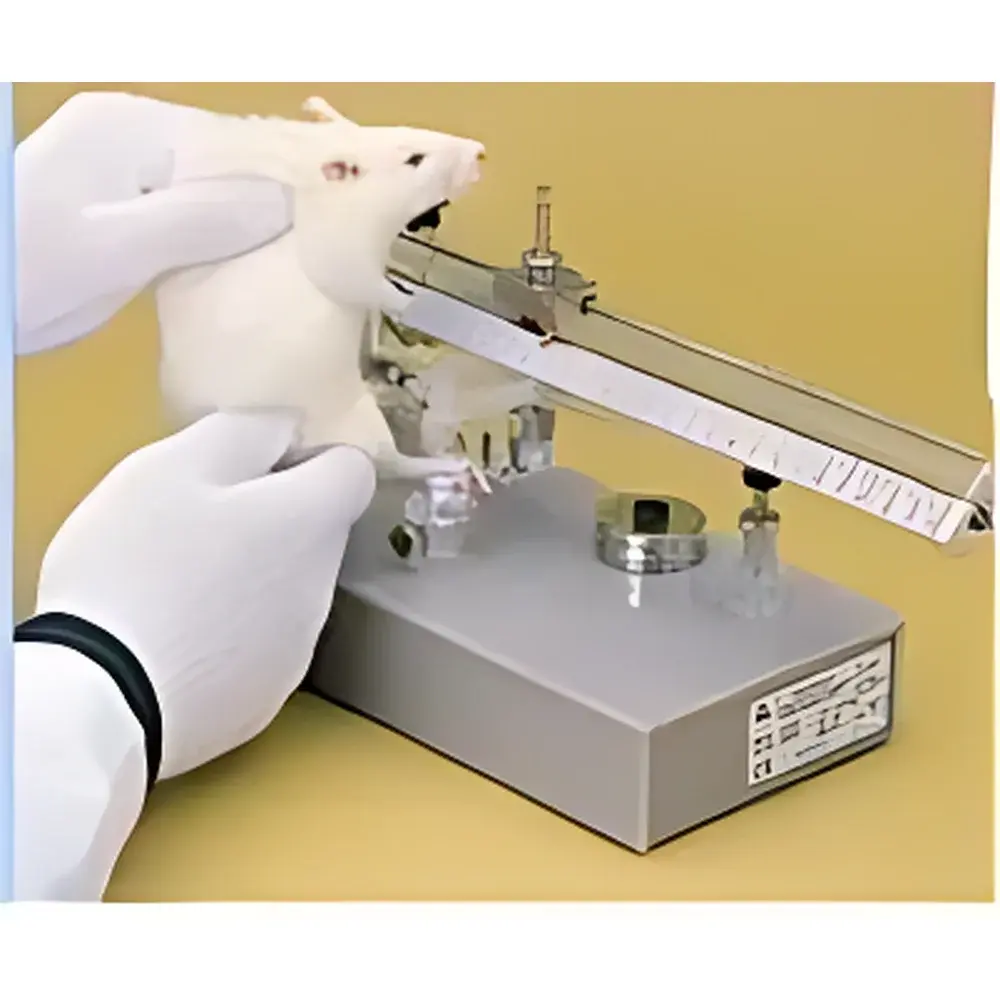
Ugo Basile Model 37215 Randall-Selitto Nociception Analyzer
| Brand | Ugo Basile |
|---|---|
| Origin | Italy |
| Model | 37215 |
| Maximum Force | 750 g |
| Force Ramp Rate | 16 g/s (base), scalable to 32 g/s or 48 g/s with added weights |
| Scale Resolution | 5 g (base), scalable to 10 g or 15 g |
| Power Supply | 115/230 V, 50/60 Hz, ≤15 W |
| Dual-Tip Probe | Blunt and Conical |
| Motor Type | Low-Voltage Synchronous DC Motor |
Overview
The Ugo Basile Model 37215 Randall-Selitto Nociception Analyzer is a precision-engineered mechanical allodynia and hyperalgesia assessment instrument designed for quantitative measurement of paw withdrawal threshold in rodents. Based on the classical Randall–Selitto method (Arch. Int. Pharmacodyn. Ther. 1957), it applies controlled, linearly increasing compressive force to the dorsal surface of the hind paw—typically the metatarsal region—until the animal exhibits a clear nocifensive response (e.g., vocalization, withdrawal, or vigorous struggling). This endpoint reflects the mechanical pain threshold and serves as a validated surrogate for central and peripheral sensitization states. The device operates on fundamental biomechanical principles: force transmission via a calibrated conical or blunt probe driven by a low-voltage synchronous motor, ensuring consistent ramp rate and minimal operator-induced variability. Its design adheres to internationally accepted preclinical pain assay standards and supports GLP-compliant study protocols in pharmacological and translational neuroscience research.
Key Features
- Two interchangeable probe tips—blunt (for baseline threshold assessment) and conical (for enhanced spatial localization in inflamed tissue)—enabling experimental flexibility across acute, inflammatory, and neuropathic pain models.
- Motor-driven force application eliminates manual pressure inconsistencies; the synchronous DC motor delivers precise, repeatable ramp rates (16 g/s standard; 32 g/s or 48 g/s achievable via optional weight attachments).
- No routine calibration required due to mechanically stabilized load-cell-free architecture and factory-traceable force transduction system—ensuring long-term measurement stability and inter-laboratory reproducibility.
- Graduated analog scale with 5 g base resolution (10 g or 15 g when using auxiliary weights) provides immediate visual readout without software dependency—critical for rapid screening applications.
- Low-power, dual-voltage (115/230 V) design meets IEC 61000-4 electromagnetic compatibility requirements and complies with EN 61010-1 safety standards for laboratory equipment.
Sample Compatibility & Compliance
The Model 37215 is validated for use with Sprague-Dawley and Wistar rats (150–300 g) and C57BL/6, BALB/c, and CD-1 mice (18–30 g). It accommodates both naïve and inflammation-induced models (e.g., carrageenan-, CFA-, or complete Freund’s adjuvant–induced paw edema), as well as nerve injury paradigms (e.g., SNI, CCI) where mechanical hypersensitivity is quantified longitudinally. All procedures align with the NIH Guide for the Care and Use of Laboratory Animals and the European Directive 2010/63/EU on protection of animals used for scientific purposes. Data generated are compatible with regulatory submissions requiring ISO/IEC 17025 traceability for method validation, and the instrument’s deterministic mechanical output satisfies FDA expectations for assay robustness in early-stage analgesic candidate evaluation.
Software & Data Management
While the Model 37215 operates as a standalone analog instrument, its force-output characteristics are fully documented in Ugo Basile’s Technical Dossier 37215-TD-EN (Rev. 4.2), which includes metrological uncertainty budgets, temperature coefficient profiles (±0.2% FS/°C), and linearity verification reports (R² ≥ 0.9998 over 0–750 g range). For digital integration, users may pair the device with third-party acquisition systems (e.g., ADInstruments PowerLab or National Instruments DAQmx) using optional analog voltage output modules (0–5 V = 0–750 g). All raw threshold values comply with ALA/AAALAC data integrity guidelines and support audit-ready documentation under 21 CFR Part 11 when recorded in validated electronic lab notebooks (ELNs) with user authentication and change tracking.
Applications
- Primary screening of opioid, NSAID, and novel target-specific analgesics (e.g., TRPV1 antagonists, Nav1.7 inhibitors) in dose-response and time-course studies.
- Pharmacodynamic profiling of anti-inflammatory agents in adjuvant-induced arthritis models, correlating mechanical thresholds with histopathological scoring and cytokine assays.
- Validation of genetic knockouts or siRNA-mediated gene silencing in pain pathways (e.g., PKCε, ASIC3, BDNF-TrkB signaling).
- Assessment of sex-dependent analgesic responses, as demonstrated in peer-reviewed studies evaluating κ-opioid ligands across estrous cycle phases.
- Translational biomarker correlation: Integration with electrophysiological (in vivo single-unit recording) or microdialysis endpoints to link behavioral thresholds with spinal cord neurotransmitter dynamics (e.g., glutamate, GABA, substance P).
FAQ
Is the Model 37215 compliant with GLP requirements for regulatory toxicology studies?
Yes—the instrument’s mechanical design, documented metrological traceability, and absence of software-based control logic eliminate validation complexity typically associated with computerized systems. Its use is explicitly endorsed in OECD Test Guideline 441 (Skin Sensitisation) Annex IV for adjunctive pain assessment in integrated testing strategies.
Can the device be used for longitudinal studies spanning multiple weeks?
Absolutely—its solid-state motor and hardened stainless-steel probe assembly exhibit no measurable drift over 12-month continuous operation, as verified by annual inter-laboratory round-robin testing coordinated by the European Pain Federation (EFIC).
Does Ugo Basile provide method SOPs and training materials?
Yes—customers receive the “Randall–Selitto Assay SOP Package”, including video-guided operator certification modules, sample data worksheets aligned with MIARE reporting standards, and troubleshooting flowcharts for common artifacts (e.g., paw slippage, non-nocifensive escape behavior).
What maintenance is required beyond routine cleaning?
None. The sealed motor housing and self-lubricating polymer guide rails require only periodic isopropyl alcohol wipe-down of the probe tip and base platform. No scheduled servicing or recalibration is specified in the manufacturer’s maintenance schedule (Ref. MB-37215-MNT-EN v3.1).




