
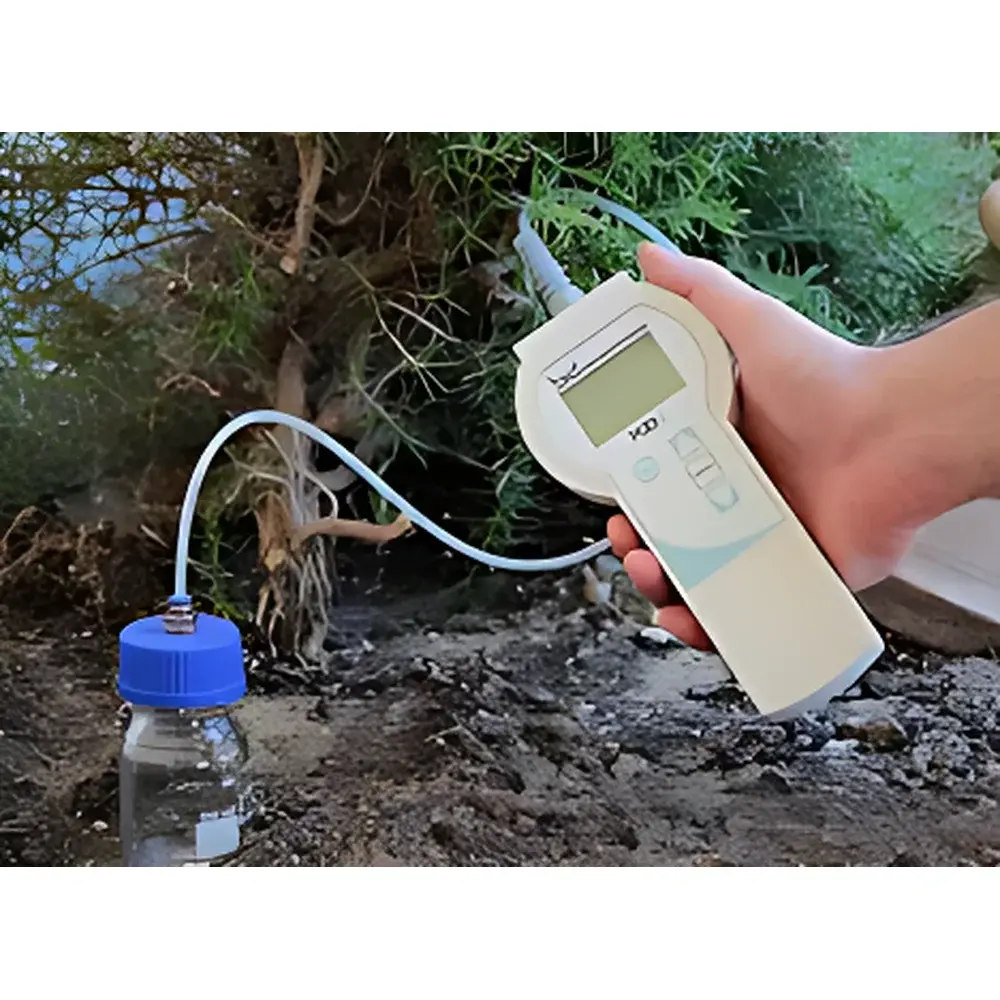
UGT FOG II Digital Soil Calcium Carbonate Analyzer
| Brand | UGT |
|---|---|
| Origin | Germany |
| Model | FOG II |
| Measurement Principle | Pressure-based CO₂ evolution from HCl–CaCO₃ reaction |
| Display | Backlit LCD with membrane keypad |
| Power | 3×AA alkaline or rechargeable batteries |
| Measurement Range | 0–100% CaCO₃ (w/w) |
| Accuracy | ±0.5% CaCO₃ |
| Resolution | 0.1% CaCO₃ |
| Linearity (r²) | ≥0.999 |
| Temperature Compensation | Built-in sensor, 5–50 °C |
| Sample Mass | 0.5–5 g |
| Analysis Time | ~30 s per sample |
| Data Storage | Last 50 measurements |
| Ingress Protection | IP65 |
| Dimensions (L×W×H) | 200×94×39 mm |
| Weight | 350 g |
| Housing Material | UL 94 HB-rated ABS |
| Keypad | Polyester (PET) membrane |
| Display Coating | Scratch-resistant resin |
| Standard Kit | Analyzer unit, glass reaction vials, 100 mL sampling bottle, silicone tubing, precision micro-scale (0.01 g resolution), batteries, operation manual, and rugged carry case |
Overview
The UGT FOG II Digital Soil Calcium Carbonate Analyzer is a field-deployable, pressure-transduction-based instrument engineered for rapid, quantitative determination of total calcium carbonate (CaCO₃) content in soil samples. It operates on the stoichiometric principle that calcium carbonate reacts quantitatively with hydrochloric acid to produce carbon dioxide gas: CaCO₃ + 2HCl → CaCl₂ + H₂O + CO₂↑. The evolved CO₂ induces a measurable pressure increase within a sealed reaction vessel; this pressure change is linearly correlated to the mass of CaCO₃ present, enabling direct % (w/w) calculation without calibration curves for routine use. Designed for high reproducibility under variable ambient conditions, the FOG II integrates real-time temperature compensation via an embedded sensor (5–50 °C), eliminating thermal drift errors common in volumetric or titrimetric methods. Its compact architecture and battery-powered operation make it suitable for on-site analysis in agricultural fields, ecological transects, and soil survey campaigns—bridging the gap between laboratory-grade accuracy and field-portable practicality.
Key Features
- Direct pressure transduction measurement ensures high specificity for CaCO₃ without interference from bicarbonates or organic carbon.
- Automatic temperature compensation across 5–50 °C maintains analytical integrity in diverse climatic conditions—from temperate croplands to arid pedons.
- Backlit LCD display with tactile membrane keypad enables reliable operation under low-light or dusty outdoor environments.
- IP65-rated enclosure provides dust-tight sealing and protection against water jets—critical for durability during extended field deployments.
- Onboard memory stores the last 50 measurements with timestamped values, supporting traceability in GLP-aligned workflows.
- Integrated micro-scale (0.01 g resolution) and standardized glass reaction vials ensure consistent sample mass control and minimize operator-induced variability.
Sample Compatibility & Compliance
The FOG II accepts air-dried, sieved (<2 mm) soil samples ranging from 0.5 to 5 g—covering typical carbonate concentrations in agricultural, forest, and semi-arid soils. It is compatible with calcareous loams, limestone-derived regoliths, and anthropogenically limed profiles. While not intended for highly saline or sulfidic soils (where H₂S evolution may interfere), its method aligns with ASTM D4373–22 (“Standard Test Method for Carbonate Content of Soils”) for rapid screening. Data output meets basic traceability requirements for ISO/IEC 17025-compliant labs when paired with documented SOPs, and the device’s internal storage supports audit-ready data review per GLP principles.
Software & Data Management
The FOG II operates as a standalone instrument with no external software dependency. All calculations—including mass-normalized %CaCO₃, temperature-corrected pressure integration, and linear regression validation (r² ≥ 0.999)—are performed onboard using firmware-embedded algorithms. Measurement history is accessible via scroll navigation on the LCD; data export requires manual transcription. For laboratories requiring digital integration, third-party CSV logging can be implemented via optional RS-232 or Bluetooth adapters (not included). The system does not comply with FDA 21 CFR Part 11 electronic record requirements due to absence of user authentication or audit trail generation—making it appropriate for research and agronomic decision support rather than regulated quality control environments.
Applications
- Site-specific lime requirement assessment in precision agriculture to optimize neutralization rates and prevent over-application.
- Rapid stratigraphic profiling of carbonate horizons (e.g., Bk, K, or calcic horizons) during soil mapping and land classification.
- Monitoring temporal changes in soil carbonate pools following land-use conversion, afforestation, or irrigation management.
- Evaluating efficacy of soil amelioration practices in acidic Ultisols and Oxisols where pH buffering capacity is directly linked to CaCO₃ content.
- Field validation of laboratory XRD or TGA results in pedological and geochemical surveys.
FAQ
How does the FOG II differentiate CaCO₃ from other carbonates (e.g., MgCO₃)?
The method assumes stoichiometric CO₂ release exclusively from CaCO₃. While MgCO₃ also reacts with HCl, its contribution is negligible in most soils due to low natural abundance and slower reaction kinetics under standard assay conditions (30 s dwell time). For Mg-rich dolomitic soils, supplementary XRF or ICP-OES analysis is recommended.
Can the FOG II measure organic carbon?
No. The instrument detects only inorganic carbon liberated as CO₂ from acid-reactive carbonates. It does not quantify total organic carbon (TOC) or particulate organic matter.
What maintenance is required?
Routine cleaning of the glass reaction vial and silicone tubing with deionized water after each use; periodic verification of battery voltage and keypad responsiveness. No recalibration is needed if factory-specified reagents and sample protocols are followed.
Is the device suitable for wet or frozen soils?
Samples must be air-dried and homogenized prior to analysis. Moisture interferes with precise mass determination and may cause incomplete acid contact or condensation in the pressure chamber.
Does the FOG II comply with ISO 10390 for soil pH measurement?
No. It is not a pH meter. Its function is strictly quantitative CaCO₃ determination via gas evolution—not hydrogen ion activity measurement.







