
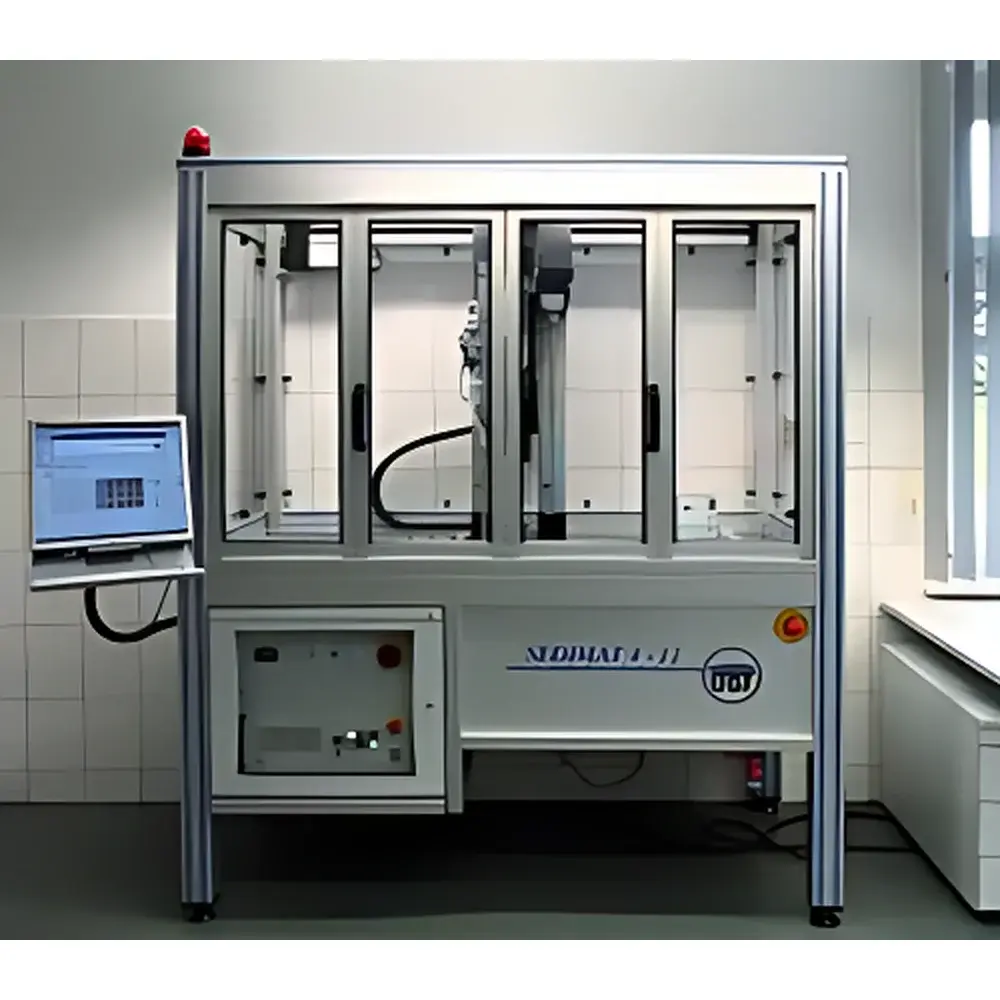
UGT SEDIMAT 4-12 Automated Sedimentation Particle Size Analyzer for Soil Texture Analysis
| Brand | UGT |
|---|---|
| Origin | Germany |
| Model | SEDIMAT 4-12 |
| Standard Compliance | DIN ISO 11277, ASTM D422 (optional) |
| Sample Capacity | 12 samples per run |
| Fractionation Levels | 4 (F1–F4) or 2 (ASTM F1–F2) |
| Temperature Control | Precise 25 °C water bath |
| Automation | 4-axis robotic arm (X: 1290 mm, Y: 990 mm, Z1 stirring: 790 mm, Z2 pipetting: 490 mm) |
| Dimensions (L×W×H) | 2080 × 860 × 1940 mm |
| Weight | ~400 kg |
| Power Supply | CEE 16, 16 A, 3N/PE, AC 380 V / 50 Hz |
| Pipetting Accuracy | Depth- and time-synchronized sampling per ISO-defined intervals |
Overview
The UGT SEDIMAT 4-12 is a fully automated sedimentation-based particle size analyzer engineered specifically for standardized soil texture analysis in accordance with DIN ISO 11277 — the internationally recognized reference method for mineral soil particle-size distribution. Unlike optical or laser-based techniques, this system implements the Kühn pipette method, a gravity-driven sedimentation protocol grounded in Stokes’ law. It quantifies particle settling velocity in aqueous suspension to resolve four discrete size fractions: coarse silt (F1), medium silt (F2), fine silt (F3), and clay (F4). The method inherently accounts for particle shape, density heterogeneity, and hydrodynamic drag—factors critical for geotechnical, agronomic, and environmental applications where empirical correlation with field behavior is essential. By automating the historically labor-intensive manual pipette procedure—including sample homogenization, temperature-stabilized suspension, timed depth-specific sampling, and gravimetric solid content determination—the SEDIMAT 4-12 eliminates operator-dependent variability while maintaining strict adherence to regulatory timing and spatial parameters defined in the standard.
Key Features
- Full automation of DIN ISO 11277-compliant sedimentation analysis for up to 12 soil samples per batch
- Integrated 4-axis robotic manipulator with independent Z1 (stirring) and Z2 (pipetting) axes, enabling precise control over immersion depth (±0.5 mm), sampling time (±0.1 s), and suspension homogenization intensity
- Stable 25 °C thermostatic water bath with PID-controlled circulation, ensuring thermal consistency across all 12 sample cylinders during extended sedimentation periods (up to 6h 53min)
- Pre-programmed fractionation logic supporting both DIN ISO 11277 (4-fraction) and optional ASTM D422 (2-fraction) protocols, with configurable sampling depths (10 cm or 20 cm) and durations
- High-reproducibility liquid handling: calibrated 30 mL weighing cups, 1000 mL standardized sedimentation cylinders, and metal sample trays designed for traceability and minimal cross-contamination
- Rugged industrial frame with ESD-safe enclosure, CE-marked electrical architecture, and fail-safe emergency stop circuitry compliant with EN 60204-1
Sample Compatibility & Compliance
The SEDIMAT 4-12 accepts air-dried, disaggregated soil samples pre-sieved to ≤0.063 mm and chemically pretreated (e.g., removal of carbonates via HCl and organic matter via H2O2) as required by DIN ISO 11277. It supports suspensions prepared in 0.1 mol/L sodium pyrophosphate solution and accommodates variable solid concentrations within validated dynamic range. All operational parameters—including stirring duration, rest period prior to sampling, pipette immersion depth, and volumetric withdrawal—are programmable and auditable. The system satisfies requirements for GLP-compliant laboratories: full electronic log of all instrument actions (start/stop timestamps, axis positions, temperature readings, error flags), user-access-level controls, and non-modifiable raw data export. It is routinely deployed in national soil monitoring networks, university soil physics labs, and environmental consulting firms requiring ISO/IEC 17025 traceable reporting.
Software & Data Management
Control and analysis are executed via UGT’s proprietary SedimatControl software running on an embedded industrial PC. The interface provides real-time visualization of robotic motion, temperature stability, and elapsed sedimentation time per cylinder. All raw mass measurements from the integrated analytical balance (not included but interfaced) are timestamped and linked to specific sample IDs, fraction labels (F1–F4), and replicate numbers. Calculations follow the exact equations specified in Annex B of DIN ISO 11277, including correction for particle density (assumed 2.65 g/cm³ unless overridden), temperature-dependent viscosity, and meniscus height compensation. Export formats include CSV (for LIMS integration), PDF reports with digital signatures, and XML structured for FAIR data principles. Audit trails comply with FDA 21 CFR Part 11 requirements when paired with appropriate network authentication and electronic signature modules.
Applications
- Soil classification per USDA Textural Triangle and WRB reference groups
- Hydraulic conductivity and water retention curve modeling inputs
- Erosion risk assessment and sediment transport simulation calibration
- Land-use change impact studies on clay/silt ratio dynamics
- Quality control in manufactured soils, green roof substrates, and remediation amendments
- Method validation and inter-laboratory comparison programs under ISO/IEC 17043
FAQ
Does the SEDIMAT 4-12 require external balance integration?
Yes — an external analytical balance (0.1 mg resolution, ≥30 g capacity) is required for gravimetric determination of suspended solids and must be connected via RS232 or USB for automated data ingestion.
Can the system handle samples with high organic content?
Only after standardized pretreatment per DIN ISO 11277 Section 6.2; untreated organic-rich soils introduce buoyancy artifacts and violate Stokes’ law assumptions.
Is ASTM D422 support hardware- or software-enabled?
ASTM D422 operation is enabled via software configuration; no hardware modification is needed, though users must validate pipetting timing against local calibration standards.
What maintenance intervals are recommended?
Daily visual inspection of pipette tips and cylinder cleanliness; quarterly calibration of Z-axis encoders and temperature sensor traceability to NIST-certified references; annual preventive service by UGT-certified engineers.
How is data integrity ensured during long-duration clay fraction analysis?
The system logs every motor command, sensor reading, and environmental parameter at 100 ms resolution; unscheduled power loss triggers automatic recovery mode without data corruption.



