
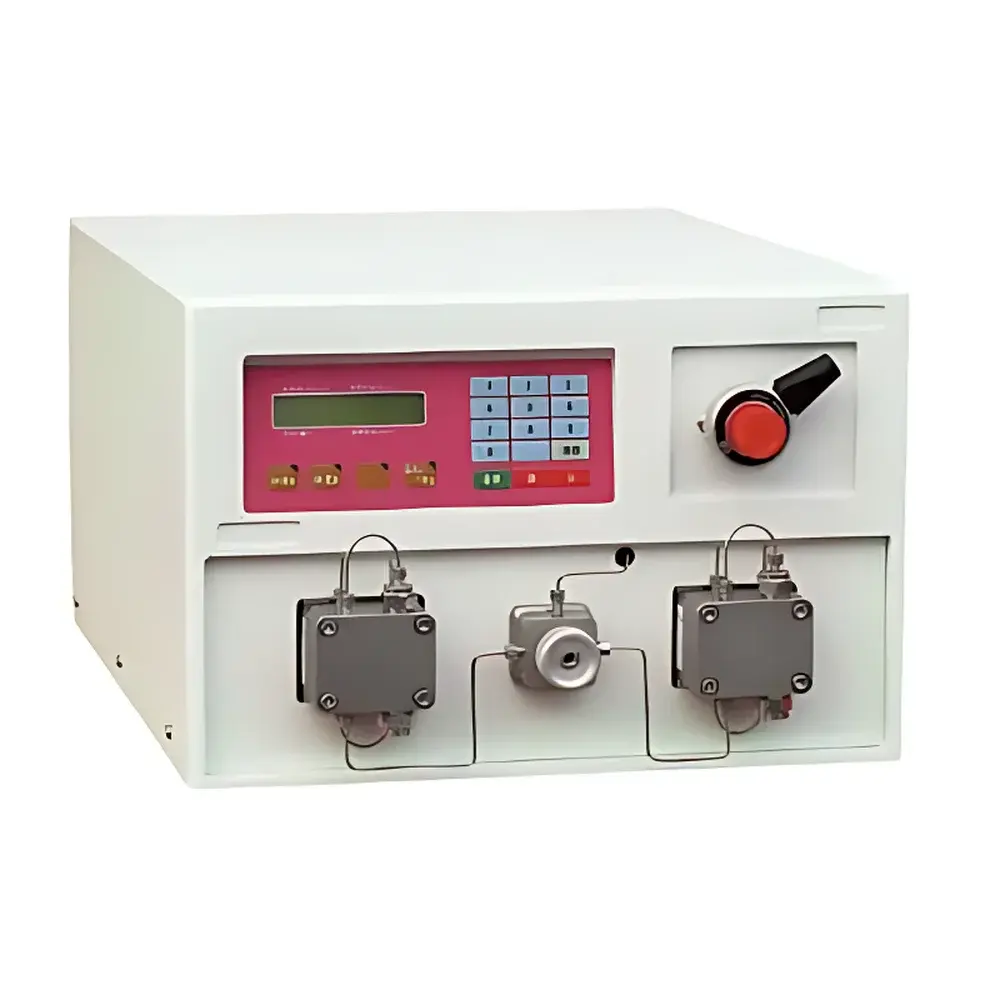
Ulion UC-3283d Binary High-Pressure Gradient HPLC Pump System
| Brand | Ulion |
|---|---|
| Model | UC-3283d |
| Origin | Beijing, China |
| Pump Type | Dual-piston serial reciprocating pump |
| Flow Rate Range | 0.001–9.999 mL/min (with 10 mL pump head) |
| Flow Accuracy | <0.4% RSD |
| Flow Precision | ±0.1% RSD |
| Pressure Range | 0–40 MPa |
| Pressure Pulsation | <0.05 MPa (deionized water, 1 mL/min at 10 MPa) |
| Control Interface | RS-232 |
| Display | 2×16-character LCD |
| Dimensions (L×H×D) | 306×210×420 mm |
| Weight | 3.8 kg |
Overview
The Ulion UC-3283d Binary High-Pressure Gradient HPLC Pump System is an engineered solution for precise, stable, and scalable liquid delivery in high-performance liquid chromatography applications. Unlike low-pressure mixing systems, this dual-pump architecture implements gradient formation at the high-pressure side—prior to the injection valve—enabling rapid solvent composition switching, minimized dwell volume, and superior retention time reproducibility. The system employs a serial dual-piston reciprocating pump design, where two independently controlled pistons operate in tandem within a single fluidic path. This architecture eliminates the need for parallel flow paths and associated check valves, reducing potential failure points and intrinsic flow pulsation. Coupled with electronic pressure pulsation suppression—replacing mechanical dampers—the UC-3283d achieves sub-0.05 MPa pressure ripple under standard operating conditions, directly contributing to baseline stability and peak shape fidelity in UV, fluorescence, and mass spectrometric detection.
Key Features
- Serial dual-piston reciprocating pump architecture minimizes dead volume and eliminates one pair of check valves versus parallel configurations—reducing system failure probability by approximately 50%.
- Electronic pressure pulsation suppression technology actively compensates for compressibility effects and valve dynamics, delivering consistent flow without mechanical dampers or added extra-column volume.
- High-resolution DC servo motor with optical encoder ensures precise piston positioning and real-time feedback control, enabling robust flow accuracy (<0.4% RSD) and repeatability (±0.1% RSD) across the full 0.001–9.999 mL/min range.
- Intelligent flow compensation algorithms dynamically adjust stroke timing and dwell parameters based on column backpressure, mobile phase compressibility, and check valve response—maintaining nominal flow rate stability under variable load conditions.
- Integrated design supports direct coupling with standard HPLC autosamplers and detectors; optional integration of a high-pressure selection valve enables seamless expansion to ternary or quaternary gradient capability.
- Front-panel LCD (2×16 characters) provides real-time display of flow rate, pressure, status flags, and error codes; RS-232 interface enables bidirectional communication with industry-standard chromatography data systems (CDS) for remote method execution and parameter logging.
Sample Compatibility & Compliance
The UC-3283d is compatible with common reversed-phase, normal-phase, ion-exchange, and size-exclusion HPLC mobile phases—including aqueous buffers, acetonitrile, methanol, THF, and chlorinated solvents—provided they are filtered and degassed per ICH Q2(R2) and USP guidelines. Its 40 MPa maximum pressure rating supports sub-2 µm particle-packed columns and UHPLC-compatible methods. The system meets electromagnetic compatibility requirements per IEC 61326-1 and safety standards per IEC 61010-1. While not pre-certified for 21 CFR Part 11, its RS-232 interface and deterministic control logic support audit-trail-capable CDS integration when deployed in GLP/GMP environments compliant with ISO/IEC 17025 and ASTM E2500-15.
Software & Data Management
The UC-3283d operates as a peripheral device under host-based chromatography software (e.g., Chromeleon, Empower, OpenLab CDS). It accepts ASCII command sets via RS-232 for flow programming, pressure limit setting, start/stop commands, and status polling. All operational parameters—including actual flow output, measured system pressure, and fault logs—are timestamped and relayed to the CDS for inclusion in raw data files. When paired with validated CDS platforms, the system supports electronic signatures, user access control, and change history tracking required for regulated QC laboratories following FDA, EMA, or PMDA expectations.
Applications
This pump system is routinely deployed in pharmaceutical impurity profiling, peptide mapping, small-molecule assay development, environmental contaminant analysis (e.g., PAHs, pesticides), and natural product fractionation. Its low dwell volume (<400 µL typical with integrated valve) and high gradient reproducibility make it suitable for method transfer between laboratories and for multi-method sequence automation in contract research organizations (CROs). Academic and industrial labs utilize it for method scouting, robustness testing per ICH Q5C, and forced degradation studies requiring precise pH and organic modifier ramping.
FAQ
Does the UC-3283d support gradient delay volume optimization?
Yes—the system’s fixed internal volume is characterized and documented; users may calibrate dwell volume empirically using step-gradient tests per USP guidance.
Can it be operated standalone without a computer?
Yes—front-panel controls allow manual flow and pressure setup; however, gradient programming requires external CDS communication via RS-232.
Is the pump compatible with corrosive mobile phases such as TFA or HFBA?
Stainless steel 316 wetted parts provide compatibility with common acidic modifiers up to 0.1% v/v; extended exposure to halogenated acids requires passivation verification and routine maintenance per manufacturer protocol.
What maintenance intervals are recommended for check valves and seals?
Under typical use (aqueous/organic solvents, <30 MPa), check valves should be inspected every 6 months and replaced annually; piston seal replacement is recommended every 12–18 months depending on usage frequency and solvent aggressiveness.
Does the system include built-in leak detection or pressure over-limit shutdown?
Yes—user-configurable maximum pressure limits trigger immediate pump halt and visual/audible alert; however, it does not incorporate active solvent leak sensors—external leak detection must be implemented at the column oven or detector interface.
Related Products





