
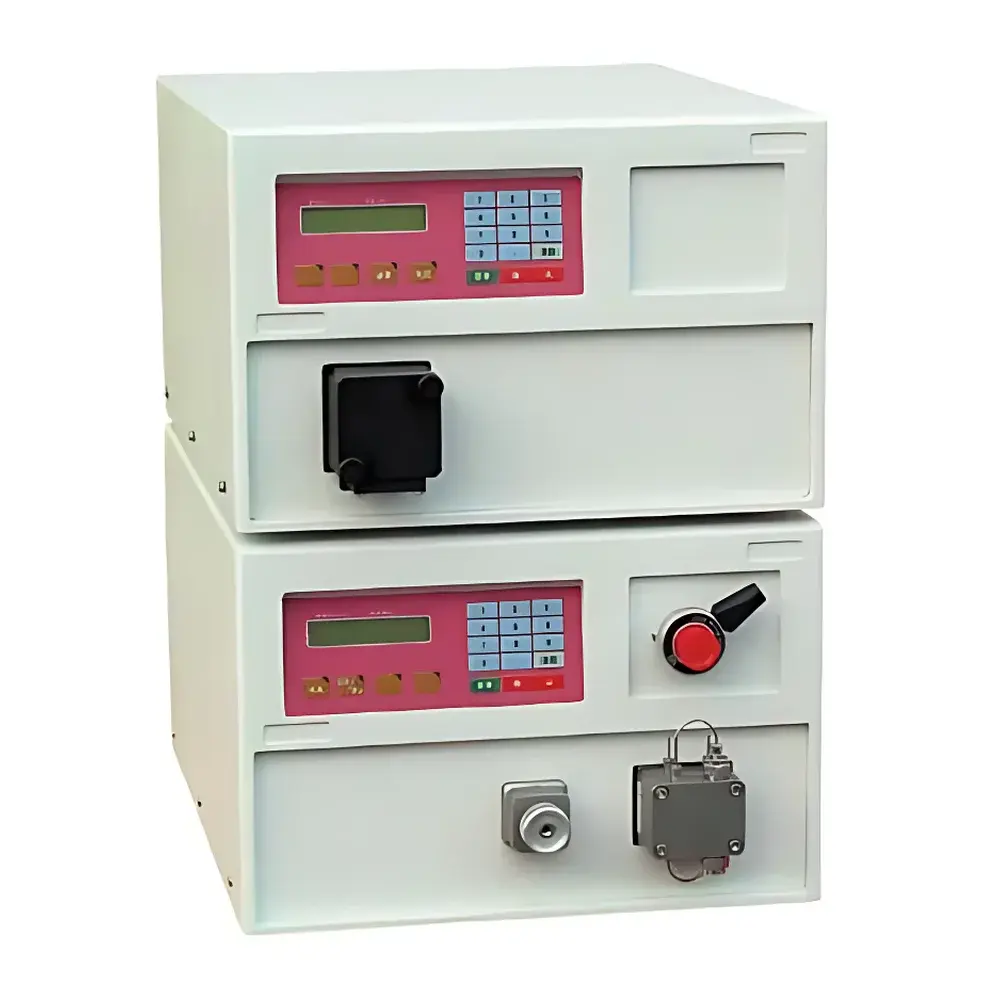
UltimateChrom UC-3235 Low-Pressure Gradient HPLC System
| Brand | UltimateChrom |
|---|---|
| Model | UC-3235 |
| Instrument Type | Conventional High-Performance Liquid Chromatograph |
| Flow Rate Range | 0.001–9.999 mL/min |
| Pump Architecture | Dual-plunger serial configuration with electronic pressure pulsation suppression |
| Flow Accuracy | <0.4% RSD at 1 mL/min (deionized water, 25 °C) |
| Flow Precision | 0.1% RSD at 1 mL/min (deionized water, 25 °C) |
| Maximum Pressure | 40 MPa at 1 mL/min (deionized water, 25 °C) |
| Pressure Pulsation | <0.05 MPa peak-to-peak at 1 mL/min (deionized water, 25 °C) |
| Gradient Accuracy | ±1% |
| Wavelength Range | 190–740 nm |
| Light Source | Deuterium lamp |
| Wavelength Accuracy | ±1 nm |
| Spectral Scan Mode | Stop-flow automatic scan |
| Baseline Noise | 2×10⁻⁵ AU at 240 nm (25 °C) |
| Baseline Drift | 15×10⁻⁵ AU/h at 240 nm (25 °C) |
| LOD | 5×10⁻⁹ g/mL (naphthalene standard, methanol mobile phase, 254 nm, 25 °C) |
| Communication Interface | RS-232 for full bidirectional instrument control |
| Display | 2×16-character LCD with English interface |
Overview
The UltimateChrom UC-3235 Low-Pressure Gradient HPLC System is a modular, benchtop high-performance liquid chromatograph engineered for method development, routine QC/QA analysis, and research-grade separations in pharmaceutical, environmental, food safety, and academic laboratories. Unlike fixed-architecture systems, the UC-3235 implements a volumetric building-block design—enabling flexible configuration as an isocratic, binary high-pressure gradient, or quaternary low-pressure mixing system without hardware replacement. Its core separation principle relies on differential partitioning of analytes between a pressurized liquid mobile phase and a stationary phase packed within a stainless-steel column. The low-pressure gradient architecture integrates four independently controlled solvent channels upstream of a single high-precision metering pump, allowing precise blending of up to four solvents prior to pressurization—a configuration particularly suited for method screening, buffer-intensive protocols (e.g., ion-pairing or pH-gradient methods), and applications requiring frequent mobile-phase reconfiguration.
Key Features
- Modular architecture supporting field-upgradable configurations: isocratic, binary high-pressure gradient, or quaternary low-pressure gradient modes
- Dual-plunger serial pump with real-time electronic pressure pulsation suppression—eliminating mechanical dampeners and enhancing long-term flow stability and seal life
- Field-replaceable pump heads and flow cells—minimizing downtime during maintenance or method-specific optimization (e.g., switching between standard and biocompatible wetted paths)
- UV-Vis detector featuring full digital signal processing, stop-flow spectral scanning, and programmable wavelength-time profiles for multi-wavelength detection and peak purity assessment
- Integrated self-diagnostic routines covering pressure calibration, leak detection, lamp energy verification, and baseline integrity validation—executed at power-on or user command
- Full bidirectional RS-232 communication enabling remote parameter setting, real-time status monitoring, and synchronized method execution via external chromatography data systems
Sample Compatibility & Compliance
The UC-3235 accommodates standard 3.9–4.6 mm I.D. analytical columns (up to 250 mm length) and is compatible with reversed-phase (C18, C8), normal-phase, HILIC, and ion-exchange chemistries. Its low-pressure mixing design ensures compatibility with viscous or high-salt mobile phases (e.g., phosphate buffers ≥50 mM) without risk of check-valve clogging or gradient delay volume artifacts. The system meets essential regulatory expectations for analytical instrumentation: it supports audit-trail-capable data acquisition when paired with compliant chromatography software (e.g., Chromeleon™ or Empower™ configured per 21 CFR Part 11 requirements), and its performance specifications align with ASTM E260 and ISO 17025 method validation benchmarks for precision, linearity, and detection sensitivity. All fluidic components contacting the mobile phase are constructed from 316L stainless steel or PEEK, ensuring chemical resistance across pH 1.5–12.0 and organic solvent concentrations up to 100% acetonitrile or methanol.
Software & Data Management
The UC-3235 operates under a fully integrated, PC-based chromatography workstation that provides complete instrument control—including gradient programming, valve sequencing, detector wavelength scheduling, and autosampler triggering—from a unified graphical interface. Raw data are stored in vendor-neutral .CDF format (compatible with AIA/ANDI standards), enabling seamless import into third-party analysis platforms. The software enforces role-based access control, electronic signatures, and time-stamped audit trails for all method edits, sequence changes, and report generation—facilitating GLP/GMP compliance in regulated environments. Batch processing tools support automated integration, retention time alignment, and relative standard deviation (RSD) calculation across replicate injections. Calibration curves may be generated using linear, quadratic, or weighted least-squares regression models, with residual plots and correlation coefficients displayed in real time.
Applications
- Pharmaceutical QC: Assay and impurity profiling of active pharmaceutical ingredients (APIs) per USP and EP 2.2.46 guidelines
- Environmental analysis: Quantification of PAHs, pesticides, and endocrine disruptors in water and soil extracts (EPA Methods 8330B, 8081B)
- Food and beverage testing: Determination of preservatives (sorbates, benzoates), sweeteners (aspartame, sucralose), and mycotoxins (aflatoxin B1)
- Academic research: Separation and characterization of natural product extracts, synthetic oligomers, and peptide fragments
- Biochemical analysis: Purification monitoring of recombinant proteins and monoclonal antibodies using SEC or ion-exchange HPLC
FAQ
What gradient delay volume does the UC-3235 exhibit in low-pressure mode?
The system’s typical gradient delay volume is 1.2–1.5 mL, measured from mixer outlet to column inlet—consistent with industry-standard quaternary low-pressure systems and suitable for method transfer from legacy Agilent 1100 or Waters 2695 platforms.
Can the detector perform real-time spectral deconvolution?
No—the UV-Vis module supports stop-flow spectral acquisition only; real-time spectral processing requires external chemometric software or optional add-on modules.
Is the pump compatible with THF or chlorinated solvents?
Yes—when equipped with optional PTFE/FFKM seals and solvent-resistant pump heads, the system handles tetrahydrofuran, dichloromethane, and chloroform within specified pressure and temperature limits.
Does the system support GMP-compliant electronic signatures?
The hardware provides secure RS-232 communication and timestamped event logging; full 21 CFR Part 11 compliance depends on validated software configuration and organizational procedural controls.
What is the maximum column backpressure the system can sustain during extended operation?
Rated continuous operation is specified up to 40 MPa at 1 mL/min with aqueous-miscible solvents; sustained use above 35 MPa is recommended only with active cooling and verified seal integrity.
Related Products





