
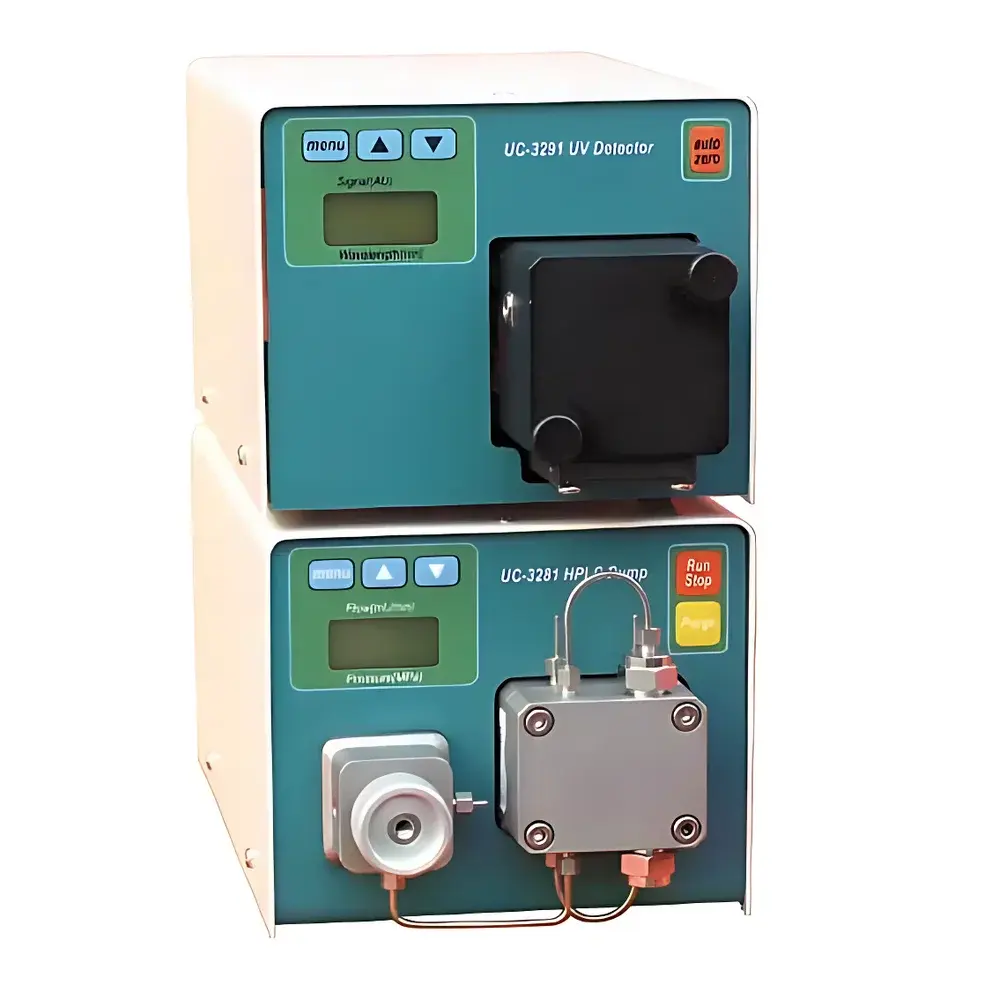
Ultron UC-3231 Micro-Scale High-Performance Liquid Chromatograph
| Brand | Ultron |
|---|---|
| Origin | Beijing, China |
| Model | UC-3231 |
| Instrument Type | Conventional HPLC System |
| Flow Rate Range | 0.001–9.999 mL/min |
| Max Operating Pressure | 40 MPa |
| Wavelength Range | 190–740 nm |
| Spectral Bandwidth | 20 nm |
| Baseline Noise | 4×10⁻⁵ AU (MeOH, 1 mL/min) |
| Baseline Drift | 3×10⁻⁴ AU (MeOH, 1 mL/min) |
| LOD | 2×10⁻⁸ g/mL (naphthalene in MeOH, 1 mL/min) |
| Data Acquisition Rate | 10 Hz |
| Pump Type | Dual-piston serial configuration with electronic pressure pulsation suppression |
| Detector Light Source | Low-pressure mercury lamp (5,000 h lifetime) |
| Control Interface | RS-232 |
| Display | 2×8-character LCD |
Overview
The Ultron UC-3231 Micro-Scale High-Performance Liquid Chromatograph is a compact, modular HPLC system engineered for precision separations in resource-constrained environments—including academic teaching labs, QC/QA screening stations, and field-deployable analytical platforms. Unlike conventional benchtop HPLC systems, the UC-3231 integrates core chromatographic functionality into a footprint under 30 cm × 25 cm × 20 cm, enabling operation on shared lab benches or within fume hoods without compromising hydraulic integrity or detection sensitivity. Its separation principle adheres to reversed-phase, normal-phase, and ion-exchange liquid chromatography methodologies, delivering reproducible retention time stability (<0.1% RSD at 1 mL/min) and linear dynamic range across UV-absorbing analytes from 190 nm to 740 nm. The system operates under isocratic or quaternary low-pressure gradient elution modes, supporting method development workflows compliant with ICH Q2(R2) guidelines for analytical method validation.
Key Features
- Dual-piston serial pump architecture with real-time electronic pressure pulsation suppression—eliminating mechanical dampeners and reducing baseline ripple to <0.05 MPa (1 mL/min, water), thereby enhancing peak shape fidelity and integration accuracy.
- Modular flow cell and pump head design allows tool-free replacement of wetted components, minimizing downtime during maintenance and enabling compatibility with alternative solvents (e.g., THF, acetonitrile/water mixtures) and column chemistries (C18, phenyl-hexyl, HILIC).
- UV-Vis detector featuring a low-pressure mercury lamp (5,000 h rated lifetime) and fixed-bandwidth optics (20 nm), calibrated against NIST-traceable standards; supports stop-flow spectral scanning for qualitative peak identification.
- Full bidirectional RS-232 communication enables complete instrument parameter control—including flow rate, gradient profile, wavelength selection, and detector gain—from the host workstation software, satisfying FDA 21 CFR Part 11 requirements for electronic records and signatures when configured with audit trail logging.
- Embedded 2×8-character LCD display provides real-time status feedback (pressure, flow, lamp status, error codes) independent of PC connectivity—critical for standalone operation in educational or remote settings.
Sample Compatibility & Compliance
The UC-3231 accommodates standard 4.6 mm ID analytical columns (5–25 cm length) and microbore formats (2.1 mm ID), supporting injection volumes from 1 µL to 100 µL via compatible autosamplers (external). It is validated for use with common HPLC-grade mobile phases, including aqueous buffers (pH 2–8), organic modifiers (acetonitrile, methanol), and ion-pairing reagents. System compliance extends to ISO/IEC 17025:2017 (general requirements for competence of testing and calibration laboratories), ASTM D4307 (standard practice for preparing liquid mixtures for analysis), and USP Chromatography. Pressure transducers and flow sensors are factory-calibrated per ISO 9001 traceable procedures, with documentation provided upon request for GLP/GMP audits.
Software & Data Management
The UC-3231 is operated via Ultron ChromoView™, a Windows-based chromatography data system (CDS) supporting method building, sequence definition, real-time chromatogram visualization, and quantitative report generation (area%, external standard, internal standard, calibration curve fitting). The software implements secure user role management (administrator, analyst, reviewer), electronic signature capture, and immutable audit trails—including timestamped records of parameter changes, data exports, and report approvals. Raw data files adhere to ANDI/NetCDF format for long-term archival and third-party software interoperability (e.g., OpenLab CDS, Chromeleon). All firmware updates are digitally signed and delivered through authenticated channels to ensure system integrity.
Applications
- Routine purity assessment of pharmaceutical intermediates and APIs per USP monographs.
- Quality control of food additives (e.g., preservatives, colorants) and environmental contaminants (e.g., PAHs, pesticides) in regulatory-compliant labs.
- Teaching chromatographic fundamentals—retention mechanism, resolution optimization, and detector response linearity—in undergraduate chemistry curricula.
- Method scouting and robustness testing prior to transfer to full-scale production HPLC systems.
- Stability-indicating assays for forced degradation studies (acid/base/oxidative stress) where minimal solvent consumption and rapid equilibration are advantageous.
FAQ
Is the UC-3231 compatible with UHPLC columns?
No—the system’s maximum pressure rating of 40 MPa and flow path design are optimized for conventional HPLC columns (≤300 Å pore size, 3–5 µm particles); it does not support sub-2-µm particles requiring >60 MPa operation.
Can the wavelength be set to non-predefined values (e.g., 220 nm)?
Yes—while default presets include 254 nm, 265 nm, 280 nm, and 415 nm, the detector supports arbitrary wavelength selection across its full 190–740 nm range via software interface.
Does the system meet GLP requirements for regulated laboratories?
When deployed with ChromoView™ configured for audit trail logging, electronic signatures, and user access controls, the UC-3231 satisfies core GLP principles outlined in OECD Series on Principles of Good Laboratory Practice; formal validation documentation packages are available upon request.
What maintenance intervals are recommended for the pump seals and flow cell?
Pump seal replacement is advised every 6 months under continuous operation (8 h/day); quartz flow cell cleaning is recommended after every 50 injections of viscous or particulate-laden samples using 10% nitric acid followed by methanol rinse.
Is gradient delay volume characterized and compensatable in software?
Yes—the system’s low-pressure quaternary mixing chamber has a measured dwell volume of 1.2 mL ± 0.1 mL (measured per ASTM D7217), and ChromoView™ includes dwell time correction algorithms for accurate gradient timing alignment.






