
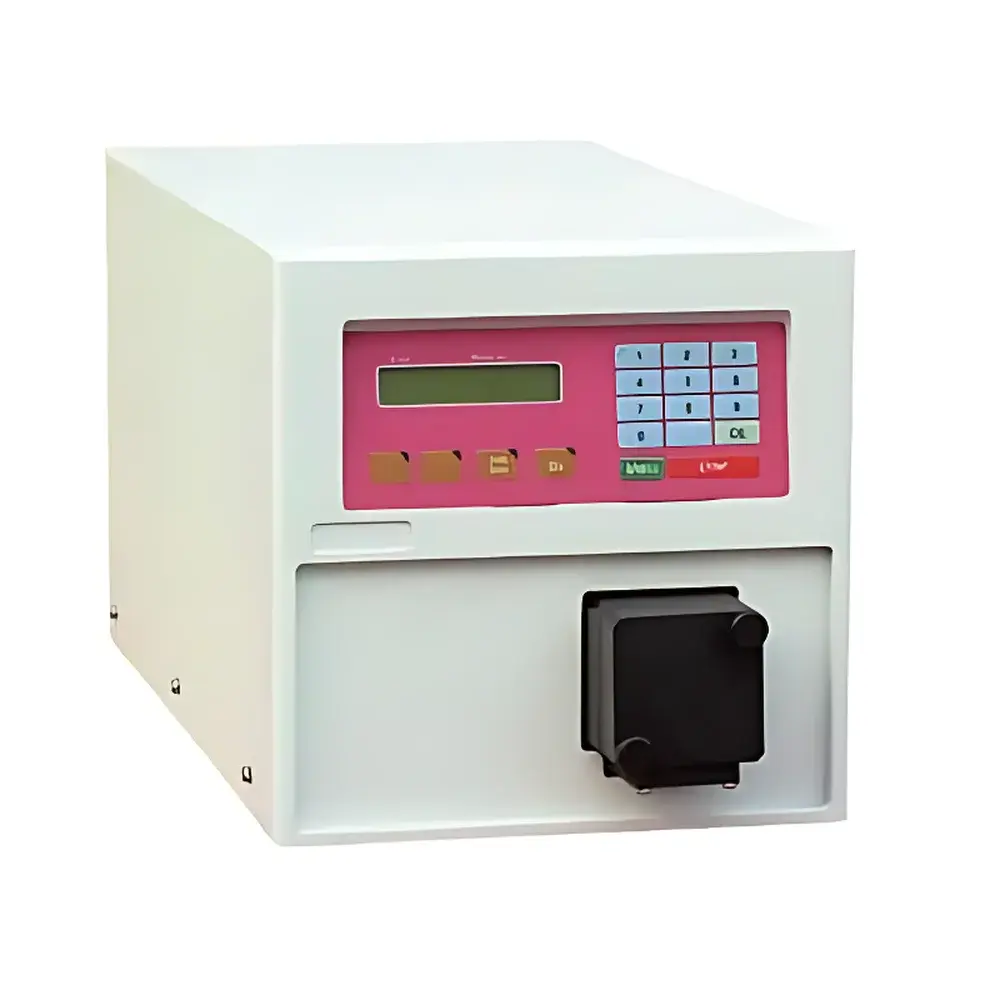
Ultron UC-3292 HPLC UV-Vis Detector
| Brand | Ultron |
|---|---|
| Model | UC-3292 |
| Detector Type | Ultraviolet-Visible Absorbance Detector (UVD) |
| Wavelength Range | 190–740 nm |
| Cutoff Filter | 370 nm |
| Light Sources | Deuterium Lamp (standard), Tungsten-Halogen Lamp (optional) |
| Spectral Bandwidth | 8 nm |
| Wavelength Accuracy | ±1 nm |
| Noise | ≤2 × 10⁻⁵ AU (at 254 nm, 1 mL/min, methanol) |
| Drift | ≤15 × 10⁻⁵ AU/h (at 254 nm, 1 mL/min, methanol) |
| Minimum Detectable Concentration | 5 × 10⁻⁹ g/mL (naphthalene standard, 254 nm, 1 mL/min, methanol) |
| Absorbance Range | 0–2 AU |
| Display | 2×16-character LCD (English) |
| GLP Functions | Lamp operating time logging, ignition cycle counter |
| Flow Cell Design | Z-shaped thermostatted flow cell |
| Optical Design | Dual-beam compensation |
| Data Output | 24-bit A/D conversion, RS232 interface, analog output (0–1 V or 0–5 V) |
| Dimensions (L×H×D) | 200 × 210 × 420 mm |
| Weight | 7.1 kg |
Overview
The Ultron UC-3292 HPLC UV-Vis Detector is a high-stability, dual-beam absorbance detector engineered for precise quantification and qualitative analysis in reversed-phase, normal-phase, and ion-exchange liquid chromatography systems. Operating on the principle of Beer-Lambert absorption spectroscopy, it measures analyte concentration by detecting ultraviolet and visible light attenuation at user-selectable wavelengths between 190 nm and 740 nm. Its optical architecture integrates a deuterium lamp for deep-UV performance (190–370 nm) and an optional tungsten-halogen lamp for extended visible-range detection (370–740 nm), enabling broad-spectrum method development across pharmaceutical, environmental, food safety, and academic research applications. The detector employs a direct-coupled grating mechanism mounted on a stepper motor shaft—eliminating mechanical sine-bar linkages—and executes real-time wavelength calibration upon power-up, ensuring long-term spectral fidelity and reproducibility.
Key Features
- Dual-beam optical path with real-time reference beam compensation to minimize baseline drift induced by ambient temperature fluctuations or lamp intensity drift.
- Z-shaped thermostatted flow cell design, actively stabilized to reduce thermal noise and improve signal-to-noise ratio (S/N ≥ 4,000:1 at 254 nm).
- 24-bit analog-to-digital conversion with on-board microcontroller-based logarithmic transformation and zero-baseline correction—ensuring linear dynamic range across 0–2 AU without hardware gain switching.
- Programmable wavelength scanning during flow-stop mode for rapid spectral identification of eluting peaks and peak purity assessment.
- Modular flow cell configuration supporting adjustable optical path lengths (e.g., 6 mm, 10 mm, or 20 mm cells) to optimize sensitivity for analytical, semi-preparative, and preparative-scale separations.
- Full RS232 serial communication protocol compliant with ASTM E1319 and ISO/IEC 17025 data exchange standards; supports bidirectional control from third-party chromatography data systems (CDS) including Chromeleon, Empower, and OpenLab.
- GLP-compliant audit trail functions: automatic logging of lamp operational hours, ignition cycles, and firmware revision history—traceable for FDA 21 CFR Part 11–aligned environments when paired with validated CDS software.
Sample Compatibility & Compliance
The UC-3292 is compatible with standard stainless steel, PEEK, and fused-silica capillary HPLC systems operating at pressures up to 400 bar. Its chemically resistant flow cell accommodates common mobile phases including aqueous buffers (pH 1.5–12), acetonitrile, methanol, tetrahydrofuran, and isopropanol. The detector meets IEC 61010-1 safety requirements for laboratory electrical equipment and complies with electromagnetic compatibility (EMC) standards per EN 61326-1. While not certified for GMP manufacturing release testing per USP , its stability metrics (noise ≤2 × 10⁻⁵ AU, drift ≤15 × 10⁻⁵ AU/h) satisfy routine QC/QA validation protocols under ISO 17025 and internal SOPs for method transfer and system suitability testing.
Software & Data Management
The UC-3292 delivers digital absorbance data via RS232 at configurable baud rates (9600–115200 bps), supporting ASCII-formatted time-stamped absorbance values synchronized with pump and autosampler events. Analog output (0–1 V or 0–5 V, switchable) enables integration with legacy chart recorders or PLC-based process monitoring systems. Firmware supports wavelength programming sequences (up to 16 steps) and timed spectral scans—exportable as CSV or .xy files for post-run spectral deconvolution in tools such as MATLAB or Python SciPy. When operated with compliant chromatography software, raw detector logs are archived with metadata (lamp hours, calibration timestamps, user ID) to support ALCOA+ data integrity principles.
Applications
- Pharmaceutical impurity profiling and assay validation per ICH Q2(R2) guidelines.
- Environmental pesticide residue analysis in water and soil extracts (EPA Method 531.1, 8081B).
- Food additive quantification (e.g., benzoic acid, sorbic acid) per AOAC 992.15 and ISO 13879.
- Natural product fingerprinting in herbal extracts using multi-wavelength channel switching.
- Quality control of oligonucleotide synthesis intermediates via 260 nm UV monitoring.
- Method development for chiral separations requiring wavelength-specific selectivity optimization.
FAQ
Is the UC-3292 compatible with gradient HPLC systems?
Yes—the dual-beam design and active flow-cell temperature control ensure stable baseline performance during solvent gradient elution, even with refractive index shifts from acetonitrile/water transitions.
Can the detector be used for quantitative analysis in regulated laboratories?
It supports essential GLP functions (lamp hour tracking, calibration history) and generates audit-ready digital logs; however, full 21 CFR Part 11 compliance requires validation of the connected CDS and electronic signature workflow.
What maintenance is required for long-term wavelength accuracy?
No manual wavelength calibration is needed—the built-in holmium oxide filter verification routine executes automatically at startup and can be triggered manually via RS232 command.
Does the detector support peak purity analysis?
Yes—stop-flow spectral scanning across 190–400 nm enables collection of full UV spectra at each retention time, allowing spectral library matching and peak homogeneity evaluation.
Is the analog output galvanically isolated?
Yes—the 0–1 V / 0–5 V output features opto-isolated circuitry to prevent ground-loop interference in multi-instrument rack installations.




