
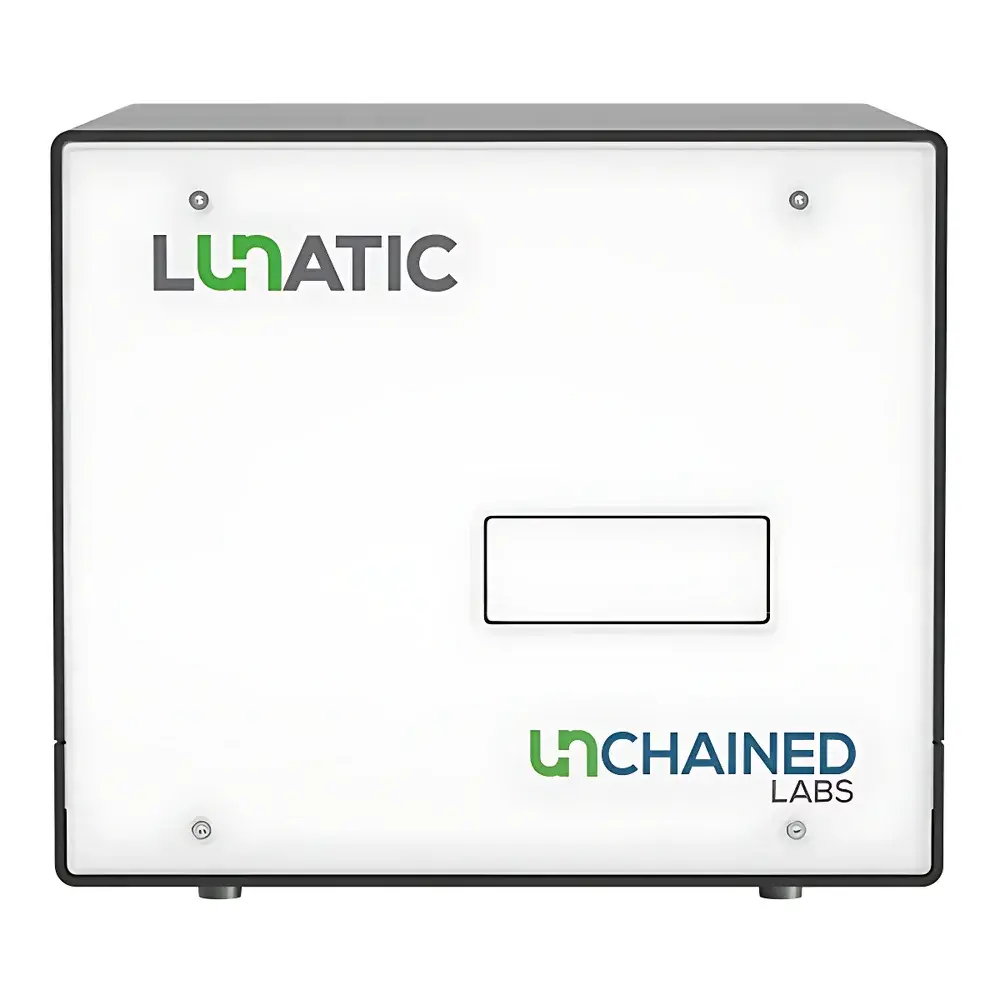
Unchained Labs Lunatic High-Throughput Microvolume Protein and Nucleic Acid Quantifier
| Brand | Unchained Labs |
|---|---|
| Origin | Belgium |
| Manufacturer Type | Original Equipment Manufacturer (OEM) |
| Import Status | Imported |
| Model | Lunatic |
| Detection Time | 10 min per 96-well plate |
| Wavelength Accuracy | ±1 nm at ≤400 nm |
| BSA Detection Range | 0.02–275 mg/mL |
| DNA Detection Range | 1.5–13,750 ng/μL |
| Sample Types | Proteins, DNA, RNA, ssDNA, dsDNA, oligonucleotides |
| Sample Volume | 2 µL per well |
| Cuvette-Free Microfluidic Sample Handling | Yes |
| Plate Format | SBS-compliant 96-well microplate |
| Instrument Category | UV-Vis Microvolume Spectrophotometer for Biomolecular Quantification |
Overview
The Unchained Labs Lunatic is an engineered high-throughput microvolume UV-Vis spectrophotometer designed specifically for rapid, label-free quantification of proteins, nucleic acids (DNA, RNA, ss/dsDNA), and synthetic oligonucleotides directly in standard SBS-format 96-well plates. Unlike conventional cuvette-based or capillary-drop spectrophotometers, the Lunatic employs a patented microfluidic optical path architecture that eliminates the need for manual pipetting into dedicated sample zones or alignment-dependent droplet formation. Each well functions as an independent, self-contained optical cell with precisely defined pathlength—enabling consistent Beer-Lambert law application across all 96 samples without user calibration or pathlength correction. The system operates across 190–850 nm with dual-grating monochromators and thermally stabilized photodiodes, delivering traceable absorbance linearity from 0.01 to >3.5 AU. Its core design principle centers on reproducible, operator-independent measurement integrity—critical for biopharmaceutical process development, QC release testing, and next-generation sequencing (NGS) library QC workflows where sample scarcity, throughput pressure, and regulatory traceability converge.
Key Features
- True 96-well parallel quantification in ≤10 minutes—no serial loading, no repositioning, no pathlength variability
- 2 µL sample requirement per well—compatible with precious clinical isolates, CRISPR editing intermediates, and low-yield expression supernatants
- Automated spectral acquisition with real-time baseline correction and scatter compensation algorithms optimized for turbid or viscous biological matrices
- No dilution required across full dynamic range: BSA 0.02–275 mg/mL; dsDNA 1.5–13,750 ng/µL—eliminates dilution error and cross-contamination risk
- Integrated wavelength validation using internal holmium oxide and didymium reference filters—per ASTM E275 and ISO 6327 compliance protocols
- Robust mechanical architecture with vibration-damped optical bench and active thermal stabilization (±0.1°C) ensuring long-term photometric stability
Sample Compatibility & Compliance
The Lunatic accommodates native, unmodified biomolecules—including denatured proteins, fragmented genomic DNA, modified RNA (e.g., 5-methylcytosine, pseudouridine), and synthetic antisense oligonucleotides—without requiring assay-specific reagents or enzymatic amplification. It supports direct quantification in common buffers (Tris, HEPES, PBS, TE), detergents (Triton X-100, CHAPS), reducing agents (DTT, β-mercaptoethanol), and glycerol up to 20% v/v. All measurements adhere to ICH Q5C guidelines for protein higher-order structure assessment via A280/A260 ratios and comply with USP <857> for spectrophotometric assay validation. Data audit trails meet FDA 21 CFR Part 11 requirements, including electronic signatures, immutable timestamped records, and role-based access control—fully deployable under GLP and GMP environments.
Software & Data Management
Controlled via Lunatic Control Software v5.x, the platform provides instrument configuration, method definition, real-time spectral visualization, and automated report generation (PDF/CSV/XLSX). Methods are stored as encrypted XML files with embedded metadata (operator ID, timestamp, plate barcode, environmental logs). Raw absorbance spectra (1 nm resolution) and derived concentration values are archived with SHA-256 checksums. Integration with LIMS via RESTful API enables bidirectional data exchange compliant with ASTM E1578 and ISO/IEC 17025:2017 Annex A2. Software validation documentation (IQ/OQ/PQ protocols) and 21 CFR Part 11 configuration packages are available upon request.
Applications
- Biologics upstream process monitoring: rapid titer estimation of monoclonal antibodies, Fc-fusion proteins, and viral vectors in harvest and purification fractions
- NGS library QC: accurate molarity determination prior to pooling and sequencing—reducing run failures caused by over- or under-clustering
- CRISPR/Cas9 RNP complex characterization: simultaneous quantification of guide RNA and Cas9 protein in ribonucleoprotein formulations
- Vaccine development: dsDNA plasmid quantification for mRNA template production and residual host cell DNA analysis
- Academic core facility deployment: high-turnover service model supporting >500 samples/day with minimal hands-on time
FAQ
Does the Lunatic require routine lamp replacement or optical recalibration?
No—its xenon flash lamp has a rated lifetime of >10⁹ flashes, and wavelength accuracy is maintained via onboard reference filters with automatic daily verification.
Can the Lunatic distinguish between degraded and intact RNA?
It does not perform electrophoretic separation, but A260/A230 and A260/A280 ratios provide empirical indicators of contamination; full integrity assessment requires orthogonal methods such as Bioanalyzer or TapeStation.
Is plate barcode scanning supported?
Yes—integrated 2D barcode reader validates plate identity and auto-links sample IDs to LIMS during acquisition.
What maintenance is required beyond routine cleaning?
Annual performance verification per ISO 8579-1 is recommended; no user-serviceable optics or alignment components exist.
How is data security enforced during networked operation?
All communications use TLS 1.2+ encryption; local database storage employs AES-256 encryption with hardware-backed key management.





