
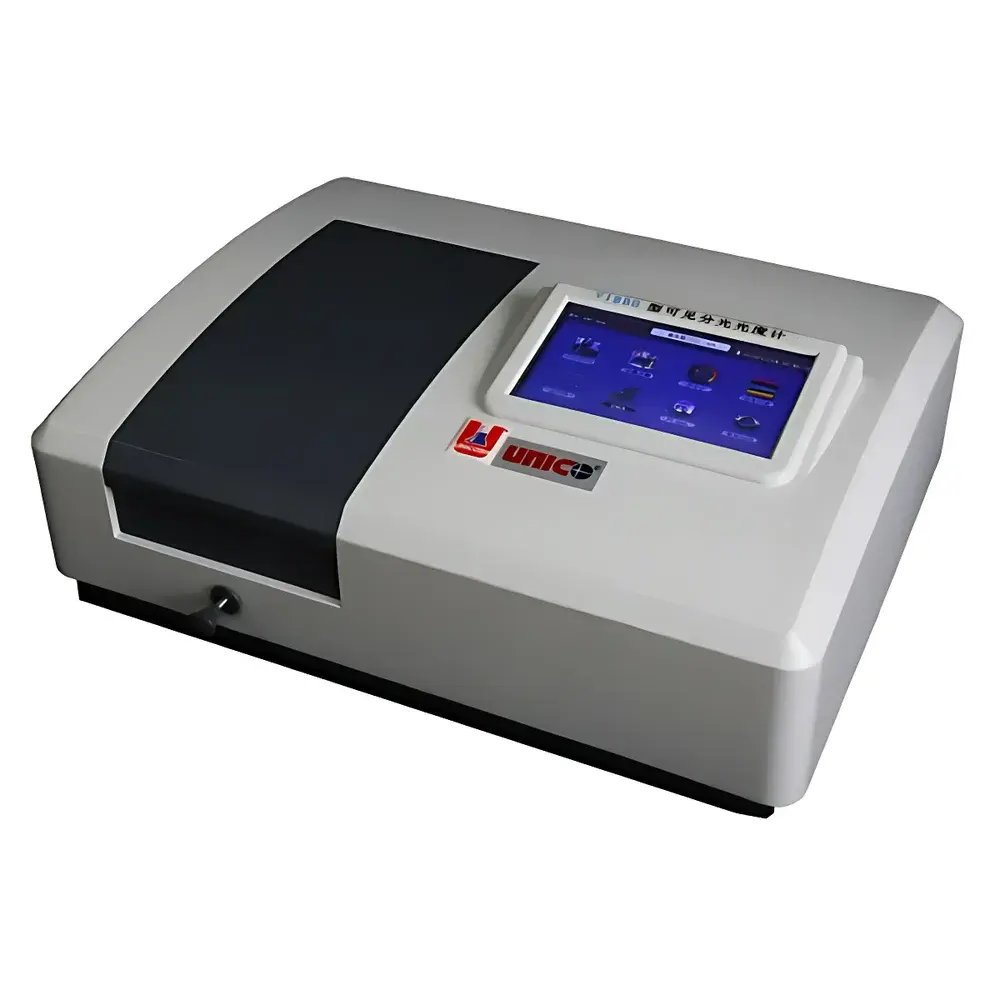
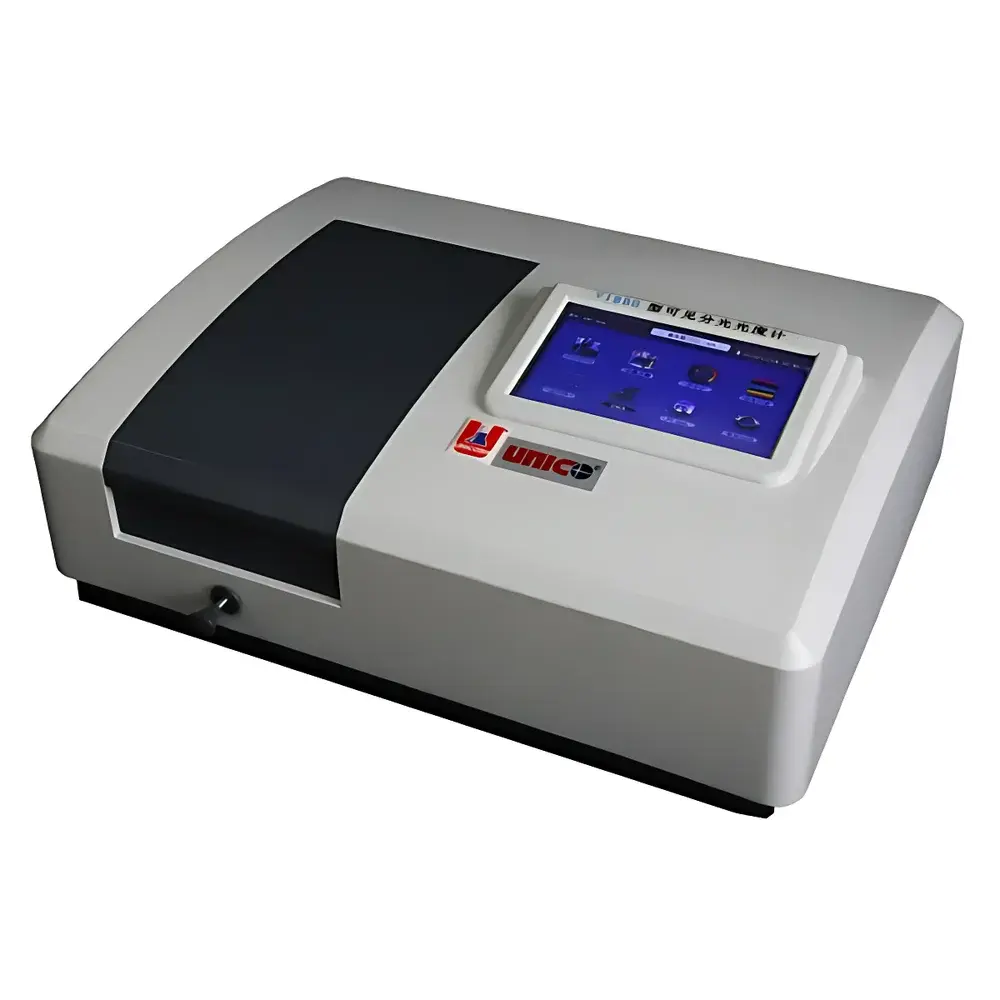
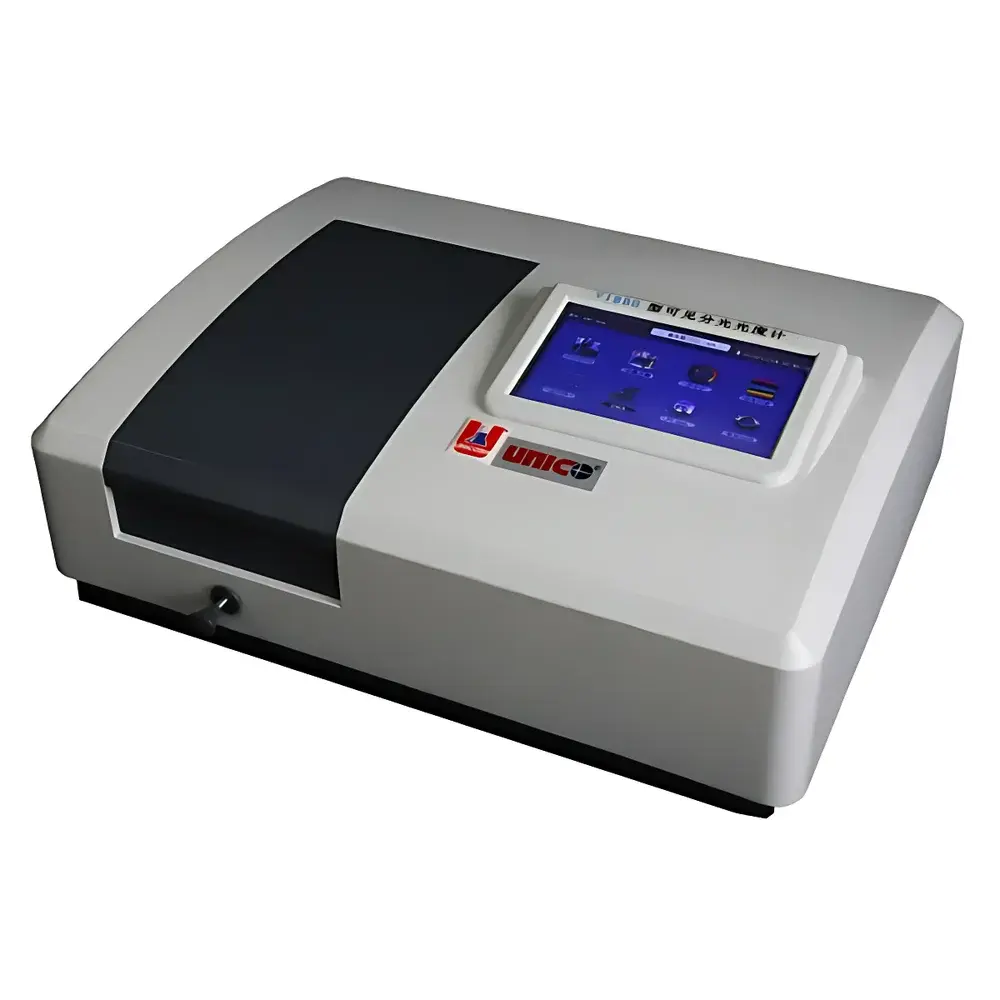
UNICO V-1850 Scanning UV-Visible Spectrophotometer
| Brand | UNICO |
|---|---|
| Origin | Shanghai, China |
| Model | V-1850 |
| Optical System | Single-beam |
| Detector | Photodiode Array |
| Wavelength Range | 315–1100 nm |
| Spectral Bandwidth | 2 nm |
| Wavelength Accuracy | ±0.3 nm |
| Wavelength Repeatability | ≤0.2 nm |
| Stray Light | ≤0.05% T (at 220 nm & 340 nm) |
| Display Resolution | 0.1 nm |
| Interface | USB, Bluetooth, Touchscreen (7″ TFT, 800×480) |
| Power Input | 80–250 V AC, 50/60 Hz |
| Dimensions | 485 × 365 × 200 mm |
| Weight | 11 kg |
Overview
The UNICO V-1850 Scanning UV-Visible Spectrophotometer is a precision single-beam instrument engineered for routine and research-grade quantitative and qualitative analysis in the ultraviolet and visible spectral regions. It employs a high-efficiency 1200 lines/mm holographic diffraction grating and a photodiode array (PDA) detector to deliver stable, reproducible spectral acquisition across a wavelength range of 315–1100 nm. Unlike scanning instruments based on moving monochromators with PMT detectors, the V-1850 leverages fixed-grating PDA architecture—enabling rapid full-spectrum acquisition without mechanical wavelength scanning, thereby improving long-term optical alignment stability and reducing mechanical wear. Its 2 nm spectral bandwidth complies with standard requirements for routine absorbance and transmittance measurements per ISO 9001-certified manufacturing protocols. The instrument is designed for laboratories requiring regulatory-compliant data integrity, including those operating under GLP or GMP frameworks where traceability and instrument performance verification are essential.
Key Features
- Single-beam optical architecture with optimized light path geometry for high photometric stability and minimal baseline drift
- Photodiode array detector enabling simultaneous multi-wavelength detection and real-time spectral acquisition
- 7-inch capacitive touchscreen interface (800 × 480 resolution) with intuitive graphical navigation and embedded method storage
- Automatic zeroing (0% T) and reference setting (100% T), wavelength calibration, and dual-lamp (tungsten and deuterium) auto-switching
- Three selectable scan speeds up to 3000 nm/min; user-defined scan ranges and step intervals from 0.1 to 5 nm
- Integrated lamp usage monitoring system with automatic shutdown to extend source lifetime and ensure consistent irradiance output
- Plug-in lamp module design eliminates need for optical realignment during lamp replacement—reducing downtime and technician dependency
- Comprehensive built-in protection logic to prevent erroneous operation, including overvoltage safeguards and sample compartment interlock
Sample Compatibility & Compliance
The V-1850 accommodates standard rectangular cuvettes ranging from 5 mm to 100 mm pathlength, with an internal cuvette storage tray for organized workflow management. Its spacious sample compartment supports both air- and liquid-filled cells, as well as optional accessories such as temperature-controlled holders (not included). The instrument meets international metrological requirements for spectrophotometric accuracy: wavelength accuracy of ±0.3 nm and repeatability ≤0.2 nm align with ASTM E275 and ISO 6223 standards for UV-Vis instrument validation. Stray light performance ≤0.05% T at 220 nm and 340 nm satisfies USP specifications for pharmaceutical assay applications. All firmware and embedded software modules comply with basic data integrity principles—including audit trail capability for critical parameters—and support implementation within FDA 21 CFR Part 11 environments when paired with UNICO’s validated PC-based control software.
Software & Data Management
The V-1850 operates autonomously via its onboard operating system but also integrates seamlessly with UNICO SpectraPro™ PC software (Windows 10/11 compatible) for advanced data processing, report generation, and instrument qualification. Onboard memory stores up to 100 calibration curves and 200 test datasets, each containing up to 100 individual records. Data export options include CSV, Excel (.xlsx), and Word-compatible formats via USB flash drive or Bluetooth transmission. Real-time spectral visualization, peak identification (auto-find max/min), derivative spectra, and multi-order polynomial curve fitting (1st–3rd order) are supported for nucleic acid and protein quantification workflows (e.g., A260/A280 ratio calculations). Bluetooth printing enables direct thermal or inkjet output without intermediate devices. Optional mobile application support allows remote data retrieval and cloud synchronization through secure HTTPS endpoints.
Applications
The V-1850 serves diverse analytical needs across regulated and academic laboratories. In pharmaceutical quality control, it performs dissolution testing, excipient compatibility screening, and active pharmaceutical ingredient (API) assay per USP methods. Environmental labs utilize it for COD, nitrate, phosphate, and heavy metal ion determination using standardized colorimetric protocols. Food and beverage testing includes pigment quantification (e.g., anthocyanins, carotenoids), preservative concentration analysis, and adulteration screening. Biotechnology applications encompass DNA/RNA purity assessment, enzyme kinetics (via time-resolved absorbance), and cell culture density monitoring. Its broad dynamic range (–3.000 to +3.000 A; 0–200% T) and low stray light enable reliable measurements of highly absorbing or turbid samples without dilution artifacts.
FAQ
Does the V-1850 support GLP-compliant data recording?
Yes—the instrument logs timestamps for all critical operations (calibrations, measurements, lamp changes) and supports exportable audit trails when used with SpectraPro™ software configured for 21 CFR Part 11 compliance.
Can I perform kinetic measurements with sub-second sampling intervals?
Yes—minimum sampling interval is 0.5 seconds, with configurable duration up to 9 hours, suitable for enzyme reaction monitoring and rapid equilibration studies.
Is the tungsten lamp replaceable without optical recalibration?
Yes—the plug-in lamp module design ensures mechanical and optical alignment retention after replacement, eliminating the need for user-side collimation or wavelength recalibration.
What is the maximum pathlength supported for cuvettes?
The sample chamber accommodates cuvettes up to 100 mm pathlength, with adjustable height positioning for optimal beam alignment.
Does the instrument require external PC connectivity for basic operation?
No—all core functions—including spectrum scanning, multi-wavelength analysis, and standard curve generation—are fully operational without a connected computer.




