
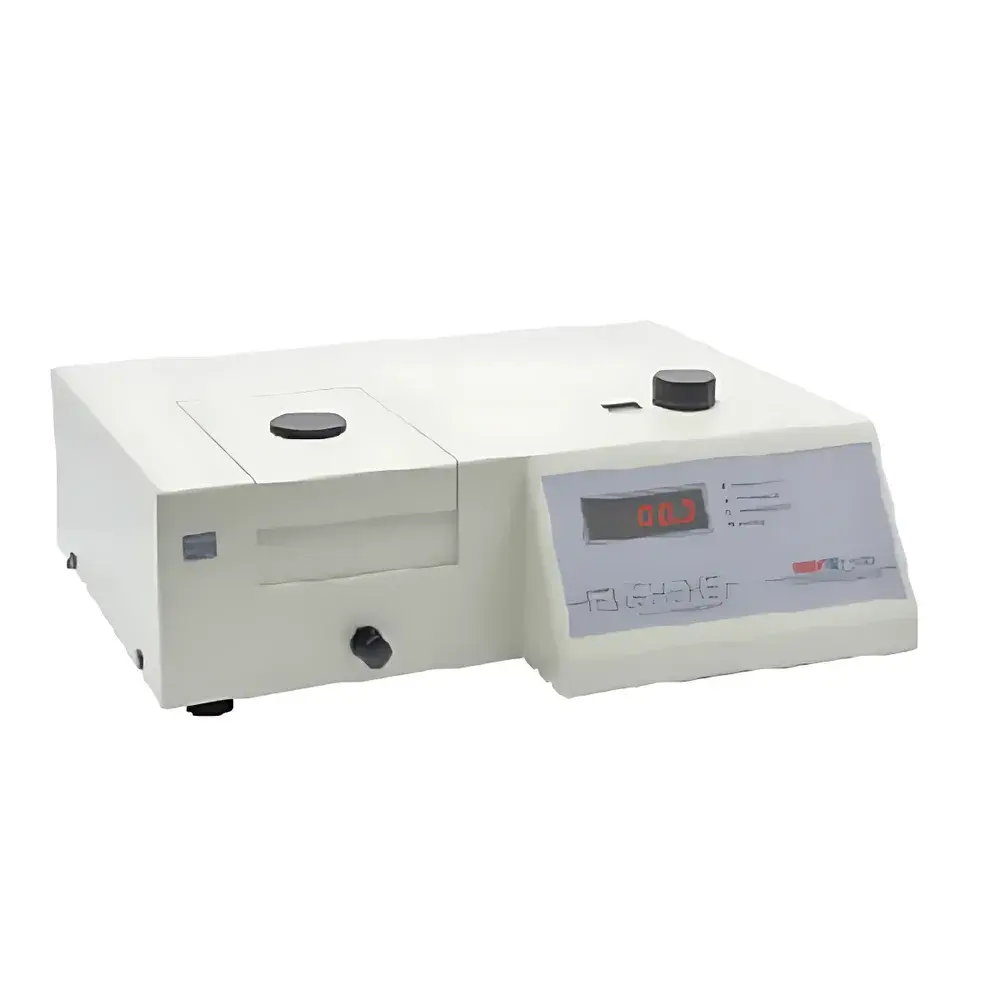
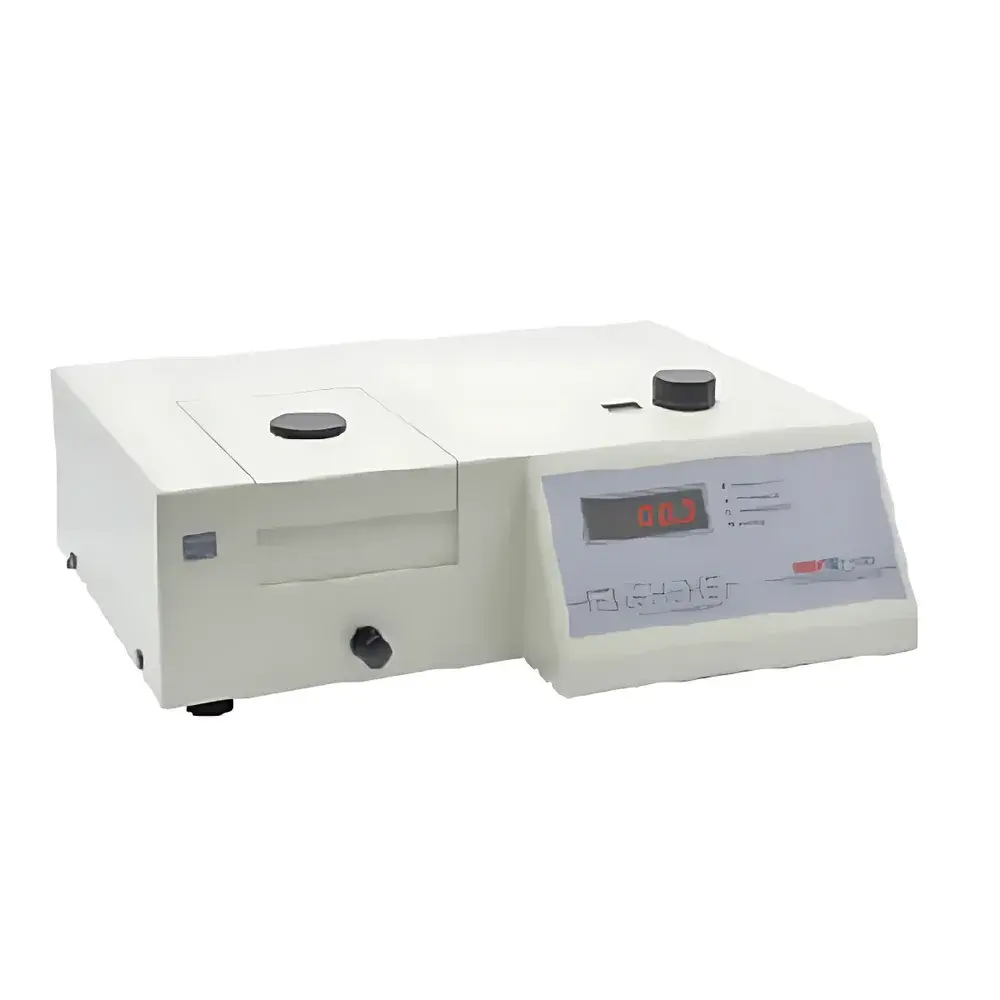
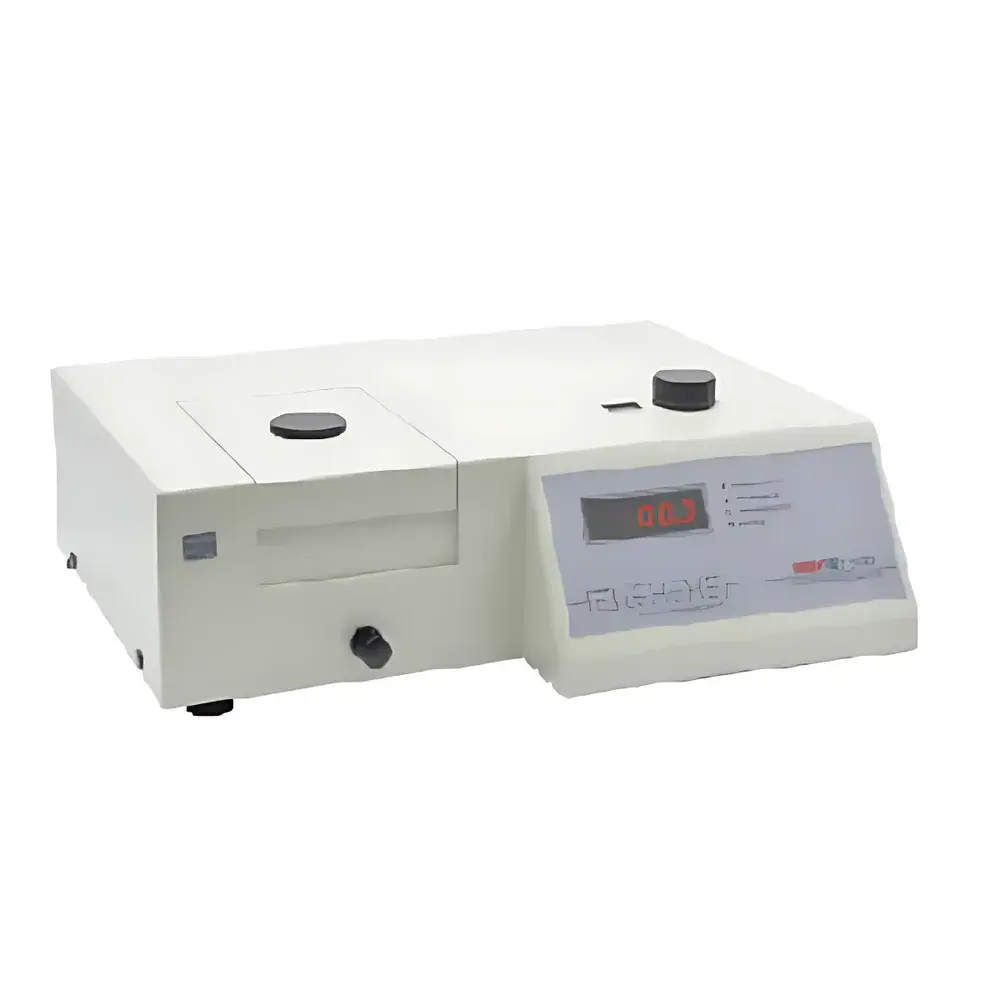
UniCo 7200 Visible Spectrophotometer
| Brand | UniCo |
|---|---|
| Origin | Shanghai, China |
| Model | 7200 |
| Optical System | Single-beam with 1200 lines/mm diffraction grating |
| Wavelength Range | 325–1000 nm |
| Spectral Bandwidth | 5 nm |
| Wavelength Accuracy | ±2.0 nm |
| Wavelength Repeatability | 1 nm |
| Stray Light | ≤0.3% T at 360 nm |
| Photometric Range | 0–125% T, –0.097–1.999 A, 0–1999 C (0–1999 F) |
| Photometric Accuracy | ±0.8% T |
| Baseline Stability | ±0.004 A/h at 500 nm |
| Detector Type | Photodiode Array |
| Wavelength Operation | Manual selection |
| Display | LED digital display |
| Data Interface | RS-232C serial port, parallel printer port |
| Dimensions | 470 × 400 × 140 mm |
| Weight | 9.5 kg |
Overview
The UniCo 7200 Visible Spectrophotometer is a precision single-beam optical instrument engineered for routine quantitative and qualitative analysis in the visible spectral region (325–1000 nm). Based on a fixed-grating monochromator design incorporating a 1200 lines/mm diffraction grating, the system delivers consistent wavelength isolation with a nominal spectral bandwidth of 5 nm—optimized for applications requiring moderate resolution without the complexity or cost of double-beam architectures. Its single-beam configuration ensures mechanical simplicity and long-term optical alignment stability, making it particularly suitable for educational laboratories, quality control environments, and industrial process monitoring where robustness, ease of operation, and reproducible photometric performance are prioritized. The instrument operates under Beer–Lambert law principles, converting sample absorbance (A) or transmittance (%T) into concentration values via calibration curves or direct factor-based calculations. All optical and electronic subsystems—including the photodiode array detector, analog-to-digital conversion circuitry, and microprocessor-based control logic—are calibrated and validated to meet fundamental requirements for traceable spectrophotometric measurement in accordance with ISO/IEC 17025-aligned laboratory practices.
Key Features
- Single-beam optical path with high-stability 1200 lines/mm holographic diffraction grating for reliable wavelength dispersion
- Photodiode array detector enabling rapid signal acquisition and improved signal-to-noise ratio across the visible range
- Manual wavelength selection interface with intuitive front-panel controls—no motorized drive required, minimizing maintenance points and thermal drift sources
- LED digital display showing simultaneous readouts of transmittance (%T), absorbance (A), and concentration (C) or factor (F) units
- Integrated auto-zero (%T = 0) and auto-100% (%T = 100) functions for rapid baseline correction between samples
- RS-232C serial interface compliant with EIA/TIA-232 standards for bidirectional communication with Windows-based PCs
- Parallel printer port supporting standard ESC/P-compatible printers for immediate hardcopy output of spectra, calibration tables, and measurement reports
- Built-in photometric linearity verification routine accessible via service mode for periodic user-level performance checks
Sample Compatibility & Compliance
The UniCo 7200 accommodates standard 10 mm square cuvettes (glass, quartz, or plastic) and supports both transmission and blank-reference measurement modes. It complies with general functional requirements outlined in ASTM E275 (Standard Practices for Describing and Measuring Performance of UV-Visible Spectrophotometers) and aligns with key photometric validation parameters referenced in USP and EP 2.2.25. While not certified for GLP/GMP-regulated workflows out-of-the-box, its RS-232C interface enables integration into validated data acquisition systems when paired with audit-trail-capable third-party software (e.g., UniCo User Application Software). The instrument’s ≤0.3% stray light specification at 360 nm satisfies minimum purity-of-wavelength criteria for most colorimetric assays, including those defined in ISO 7738 (water quality—determination of nitrate by spectrophotometry) and ISO 6060 (determination of chemical oxygen demand).
Software & Data Management
Data exchange is facilitated exclusively through the standard RS-232C serial interface, compatible with Microsoft Windows operating systems (Windows 7 through 11). The optional UniCo User Application Software provides real-time instrument control, multi-point calibration curve generation (linear, quadratic, and cubic regression), kinetic scan logging, and report export in CSV and PDF formats. All exported datasets include embedded metadata: date/time stamp, operator ID (user-defined), wavelength setting, measured parameter type (%T/A/C), and instrument serial number—supporting basic traceability needs. The software does not implement FDA 21 CFR Part 11 electronic signature or audit trail functionality; such capabilities require deployment within a validated LIMS or ELN environment.
Applications
- Quantitative analysis of dyes, pigments, and colored compounds in textile, food, and beverage industries
- Enzyme kinetics monitoring (e.g., NADH/NADPH oxidation at 340 nm) in academic and clinical biochemistry labs
- Water and wastewater testing per APHA Standard Methods (e.g., phosphate, iron, copper determination)
- Pharmaceutical excipient qualification and dissolution testing support (non-GMP use)
- Teaching spectroscopy fundamentals in undergraduate chemistry and life sciences curricula
- Industrial QC for raw material verification (e.g., titanium dioxide whiteness index, ink density)
FAQ
Is the UniCo 7200 compliant with FDA 21 CFR Part 11?
No—the instrument itself does not include electronic signature, audit trail, or role-based access control features required for Part 11 compliance. These must be implemented at the software or enterprise system level.
Can quartz cuvettes be used below 350 nm?
While the specified wavelength range begins at 325 nm, standard quartz cuvettes transmit effectively down to ~190 nm; however, the 7200’s optical design and detector sensitivity are optimized for visible-light performance only.
What is the recommended warm-up time before measurement?
A minimum 15-minute stabilization period is advised after power-on to ensure thermal equilibrium of the optical bench and detector electronics.
Does the instrument support wavelength scanning?
No—this is a fixed-wavelength, manual-selection spectrophotometer; it does not perform continuous spectral scans.
How often should the instrument be recalibrated?
Annual verification against NIST-traceable neutral density filters or holmium oxide reference standards is recommended for laboratories maintaining ISO/IEC 17025 accreditation.





