
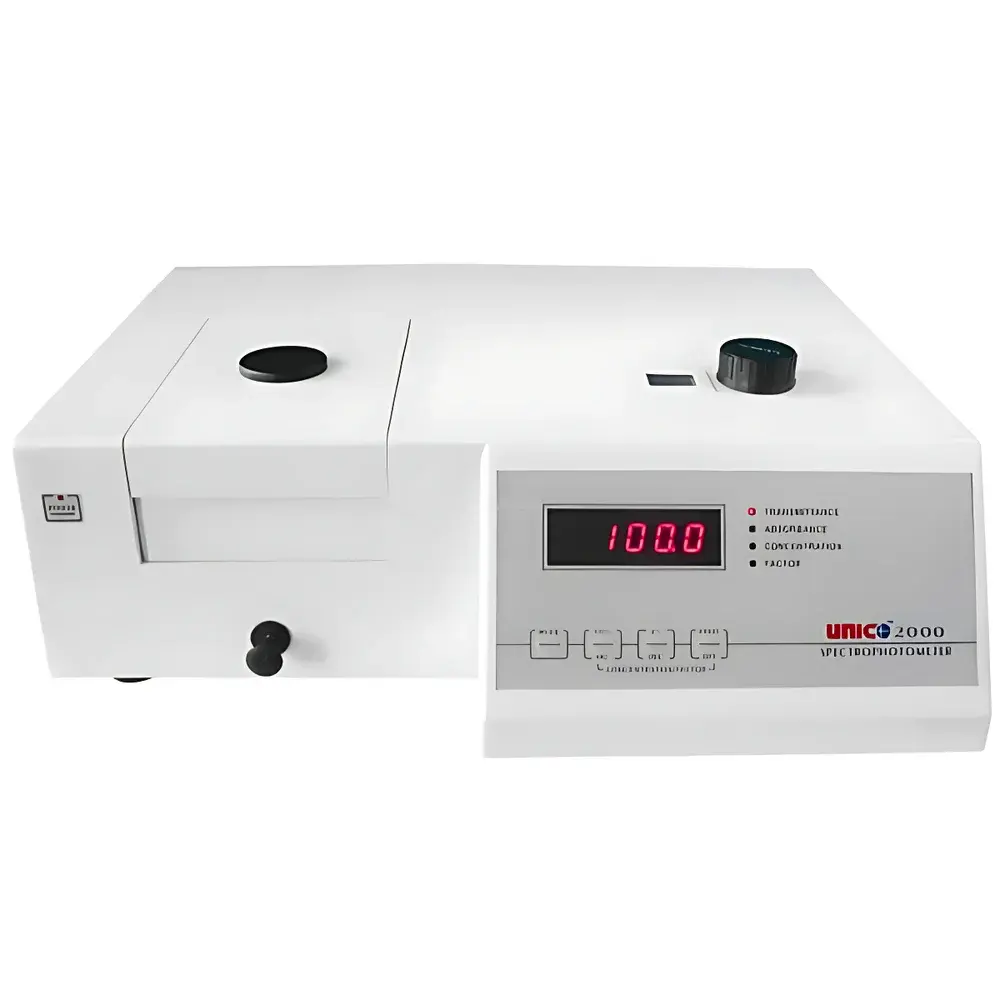
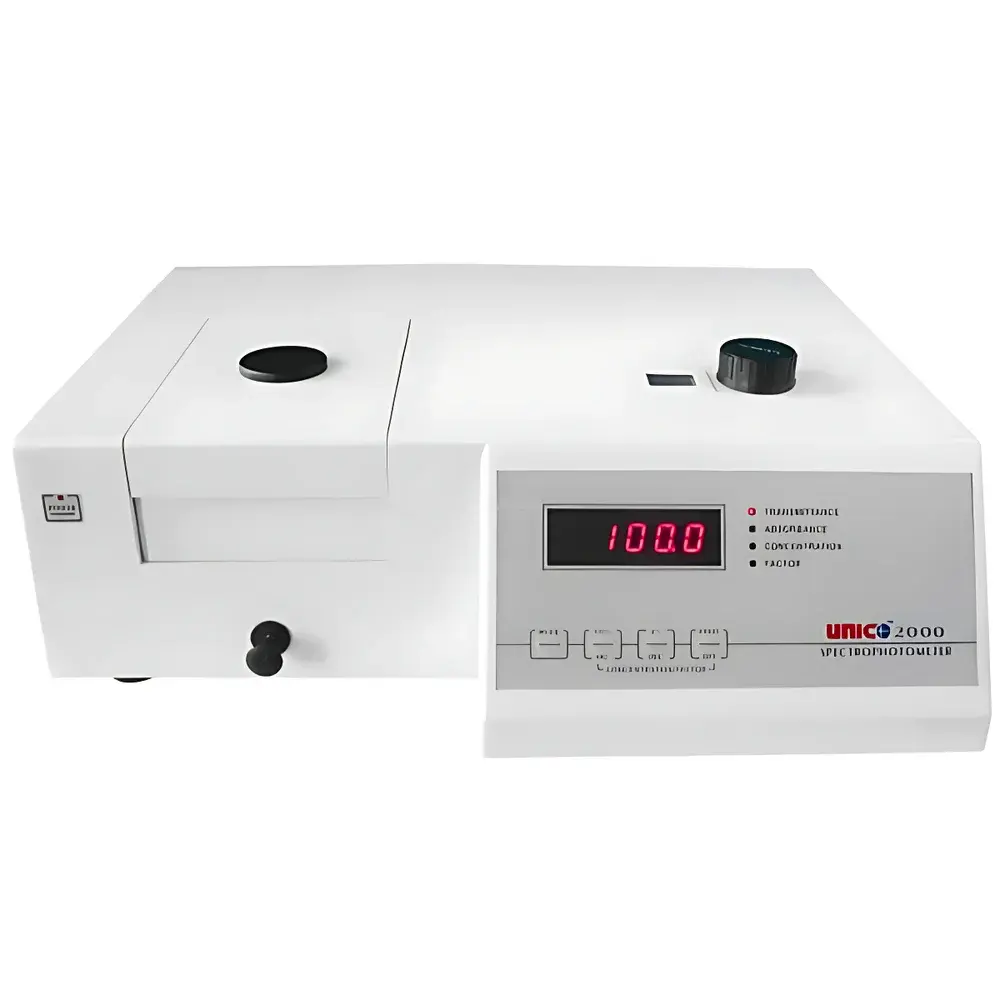
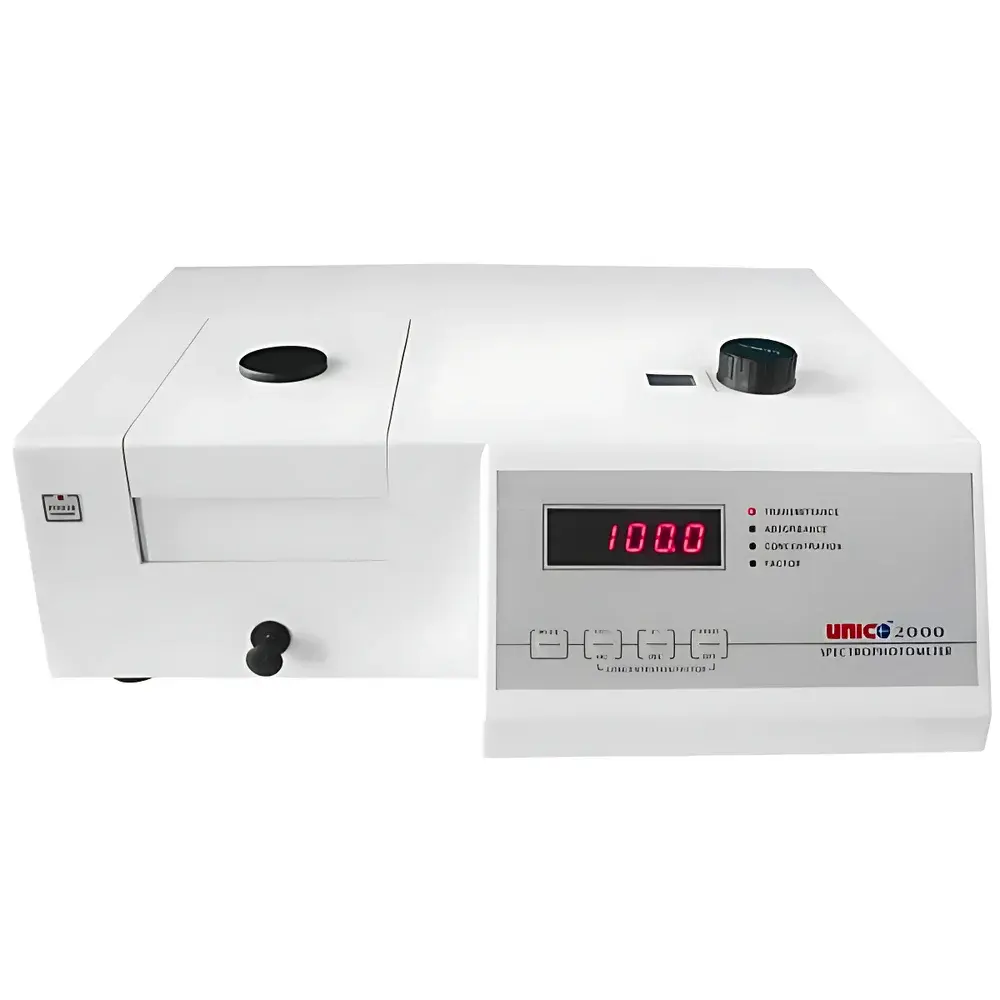
UniCo UV-2000 Visible Spectrophotometer
| Brand | UniCo |
|---|---|
| Origin | Shanghai, China |
| Model | UV-2000 |
| Optical System | Single-beam with 1200 lines/mm diffraction grating |
| Wavelength Range | 325–1000 nm |
| Wavelength Accuracy | ±2 nm |
| Wavelength Repeatability | ±1 nm |
| Spectral Bandwidth | 5 nm |
| Stray Light | ≤0.5% T at 360 nm |
| Photometric Range | 0–125% T, –0.097–1.999 A, 0–1999 C (0–1999 F) |
| Photometric Accuracy | ±0.5% T |
| Baseline Stability | ±0.003 A/h at 500 nm |
| Detector | Photomultiplier Tube (PMT) |
| Wavelength Scanning | Motorized auto-wavelength drive |
| Display | LED digital display |
| Data Interface | RS-232C standard port |
| Printer Interface | Parallel port |
| Dimensions (W×D×H) | 470 × 400 × 140 mm |
| Weight | 9.5 kg |
Overview
The UniCo UV-2000 Visible Spectrophotometer is a precision single-beam optical instrument engineered for quantitative absorbance and transmittance measurements across the visible and near-UV spectral range (325–1000 nm). Built upon a robust optical architecture featuring a 1200 lines/mm holographic diffraction grating and a high-sensitivity photomultiplier tube (PMT) detector, the UV-2000 delivers consistent photometric performance under routine laboratory conditions. Its single-beam design—while requiring manual reference blanking—offers mechanical simplicity, thermal stability, and long-term alignment integrity, making it well-suited for QC applications in educational labs, pharmaceutical manufacturing support, environmental testing facilities, and industrial R&D where cost-effective, reliable endpoint absorbance analysis is required. The instrument operates on fundamental Beer-Lambert law principles, converting light intensity attenuation through sample solutions into calibrated absorbance (A) or percent transmittance (%T) values with traceable accuracy.
Key Features
- Motor-driven automatic wavelength scanning with ±2 nm absolute accuracy and ±1 nm repeatability—ensuring reproducible spectral positioning for method transfer and inter-laboratory comparison.
- 5 nm spectral bandwidth optimized for resolution versus signal-to-noise ratio in routine colorimetric assays (e.g., phosphate, nitrate, protein Bradford, and enzyme kinetics).
- High-stability PMT detector with low dark current, enabling reliable measurement down to –0.097 A and up to 1.999 A—critical for dilute or highly concentrated samples requiring extended dynamic range.
- Digital LED display with real-time readout of %T, A, concentration (C), or factor (F) modes; supports direct entry of calibration factors for rapid quantitative analysis without external software.
- Integrated 0%T and 100%T auto-calibration function reduces operator dependency and minimizes drift-related errors during multi-sample runs.
- RS-232C serial interface compliant with ANSI/IEEE 488.2 standards enables bidirectional communication with PCs running third-party data acquisition software or LIMS platforms.
- Compact footprint (470 × 400 × 140 mm) and lightweight chassis (9.5 kg) facilitate benchtop deployment in space-constrained environments including cleanroom annexes and mobile field labs.
Sample Compatibility & Compliance
The UV-2000 accommodates standard 10 mm pathlength cuvettes—including matched glass, quartz (for extended UV use beyond 325 nm), and disposable plastic variants—via its fixed-position cuvette holder and integrated 1-cm rack. It complies with core international performance criteria defined in ISO 6223:2021 (Spectrophotometers — Performance specifications and verification procedures) and meets essential requirements outlined in ASTM E275-22 (Standard Practices for Describing and Measuring Performance of Ultraviolet-Visible Spectrophotometers). While not inherently 21 CFR Part 11–compliant due to lack of electronic audit trail and user authentication, the instrument may be deployed within GLP/GMP-regulated workflows when paired with validated third-party software (e.g., UniCo User Software v3.x, sold separately) that implements secure login, electronic signatures, and full audit trail generation per FDA guidance.
Software & Data Management
Data export is supported via RS-232C to host computers running terminal emulation (e.g., Tera Term) or custom scripts for CSV log generation. Optional UniCo User Software provides enhanced functionality: wavelength scanning, kinetic time-course plots, multi-point calibration curves (linear, quadratic, cubic), and report generation with embedded metadata (date/time, operator ID, instrument serial number). All exported datasets include timestamped raw absorbance values, wavelength coordinates, and instrument configuration parameters—facilitating traceability in ISO/IEC 17025-accredited testing laboratories. No internal memory or onboard storage is present; data persistence relies entirely on external systems—a design choice aligned with IEC 61508 functional safety principles for deterministic instrument behavior.
Applications
- Quantitative determination of transition metal ions (Fe²⁺/Fe³⁺, Cu²⁺, Cr⁶⁺) using standardized colorimetric reagents per APHA Standard Methods 3111.
- Enzyme activity assays (e.g., LDH, ALP) monitored at 340 nm or 405 nm under controlled temperature conditions.
- Pharmaceutical excipient purity screening via USP absorbance ratio tests in non-sterile dosage form development.
- Water quality monitoring: COD, BOD surrogate indicators, and turbidity correction via dual-wavelength subtraction (e.g., 600 nm/700 nm).
- Educational spectroscopy labs—demonstrating absorption spectra of dyes (methyl orange, bromothymol blue), chlorophyll extracts, and transition metal complexes.
FAQ
Does the UV-2000 support wavelength scanning and spectral acquisition?
Yes—the motorized grating drive enables discrete or stepwise wavelength selection across 325–1000 nm; however, it does not perform continuous scan mode or generate full spectral profiles natively. Spectral mapping requires external software control via RS-232C.
Is quartz cuvette compatibility confirmed for measurements below 340 nm?
The specified 325 nm lower limit assumes use of quartz cuvettes; standard glass cuvettes transmit poorly below ~350 nm and are unsuitable for sub-350 nm work.
Can the instrument be validated per IQ/OQ/PQ protocols?
Yes—performance qualification templates aligned with ASTM E275 and ISO 6223 are available from UniCo’s technical documentation portal; users must supply NIST-traceable neutral density filters and holmium oxide reference standards for full verification.
What is the warm-up time required for photometric stability?
Baseline drift remains within ±0.003 A/h after 20 minutes of continuous operation at 500 nm, meeting typical QC lab acceptance thresholds for daily startup protocols.
Is firmware upgrade capability supported?
No—firmware is factory-programmed and non-upgradable; all functional enhancements are delivered exclusively through optional PC-based software modules.
Related Products





