
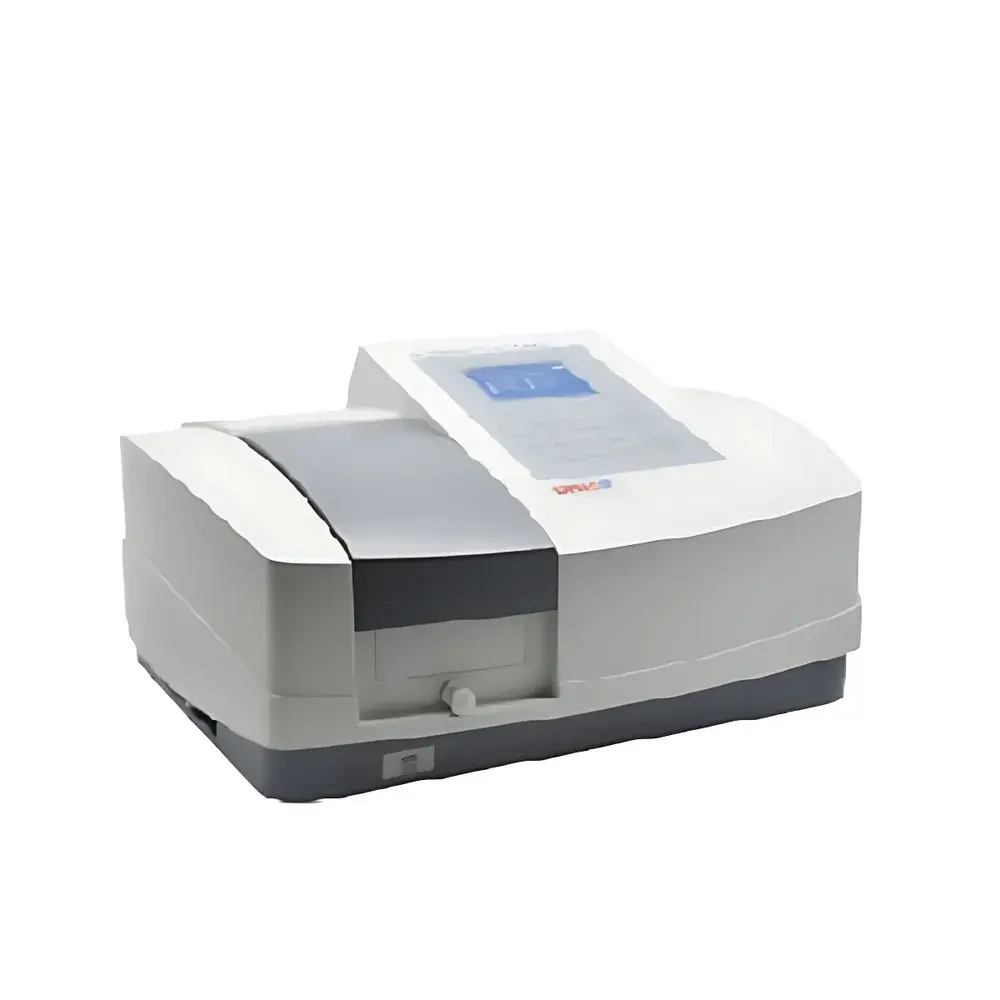
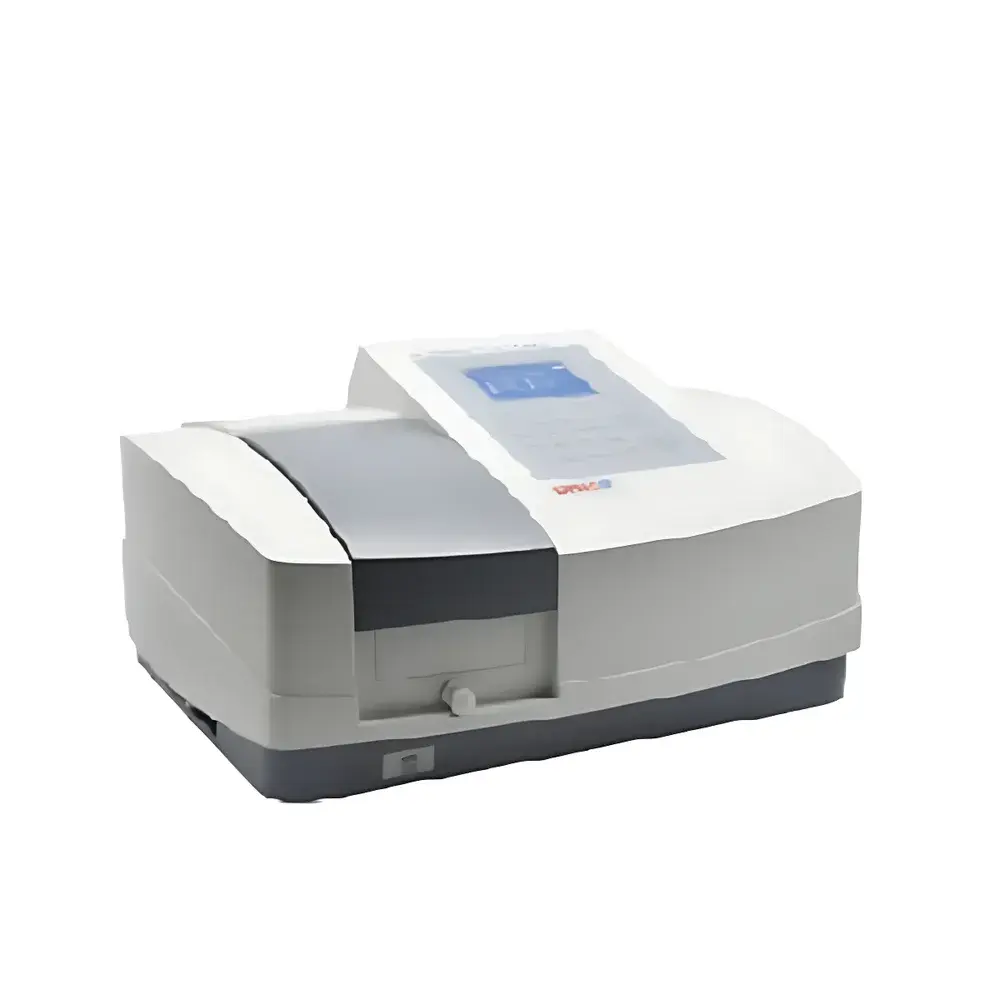
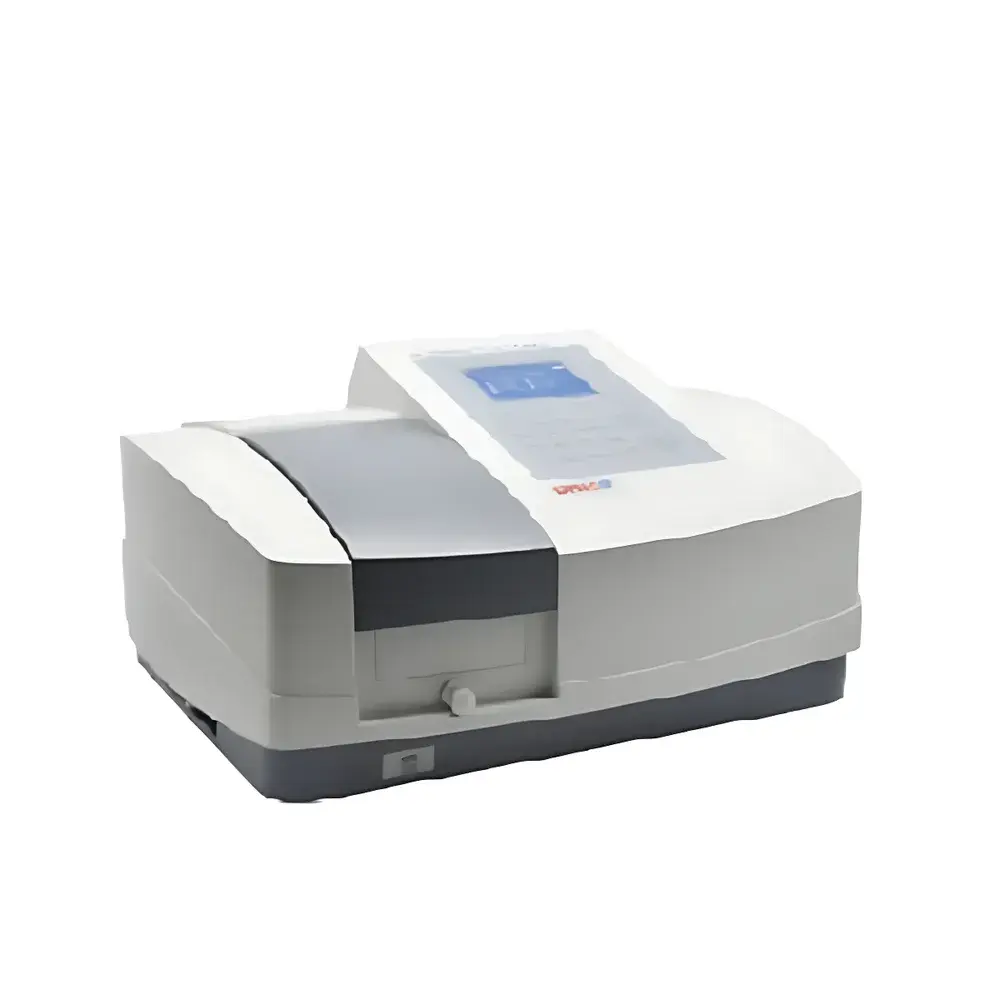
UniCo UV-2800A Single-Beam Ultraviolet-Visible Spectrophotometer
| Brand | UniCo |
|---|---|
| Origin | Shanghai, China |
| Model | UV-2800A |
| Optical System | Single-beam with 1200 lines/mm holographic grating |
| Wavelength Range | 190–1000 nm |
| Spectral Bandwidth | 1.8 nm |
| Wavelength Accuracy | ±0.5 nm |
| Wavelength Repeatability | ≤1 nm |
| Stray Light | ≤0.05% T |
| Detector Type | Photocell |
| Wavelength Scanning Mode | Motorized automatic wavelength drive |
| Display | 320 × 240 graphic LCD |
| Data Interface | USB port for direct data export to USB flash drive |
| Dimensions (W × D × H) | 545 × 245 × 260 mm |
| Weight | 20 kg |
Overview
The UniCo UV-2800A is a precision-engineered single-beam ultraviolet-visible (UV-Vis) spectrophotometer designed for routine and research-grade absorbance, transmittance, and concentration measurements across the 190–1000 nm spectral range. Based on a robust single-beam optical architecture incorporating a 1200 lines/mm holographic grating, the instrument delivers high photometric stability and reliable baseline linearity—critical for quantitative analysis in academic laboratories, quality control environments, and pharmaceutical development workflows. Its motorized automatic wavelength scanning enables reproducible spectral acquisition without manual adjustment, while the integrated photocell detector ensures consistent signal response over extended operational cycles. The UV-2800A complies with fundamental performance expectations outlined in ISO 9001-certified manufacturing practices and aligns with core validation principles referenced in USP and ASTM E275 for UV-Vis instrumentation verification.
Key Features
- Single-beam optical design with high-efficiency 1200 lines/mm holographic grating for optimal spectral resolution and throughput
- Automated wavelength scanning driven by precision stepper motor—enabling programmable spectral acquisition from 190 nm to 1000 nm in 0.1 nm increments
- 1.8 nm spectral bandwidth optimized for balancing resolution and signal-to-noise ratio in routine QC applications
- Graphical 320 × 240 LCD display with intuitive icon-based navigation and real-time spectrum preview
- Dedicated touch-sensitive control panel for rapid method selection, parameter entry, and data recall
- Direct USB interface supporting plug-and-play data export to standard USB flash drives—no proprietary drivers required
- Integrated software suite (UniCo SpectraPro) enabling full spectral processing, kinetic time-scan analysis, multi-point calibration, and DNA/protein quantification using established extinction coefficients
- Comprehensive photometric range: 0–200% T, –0.3 to 3.0 A, and 0–9999 concentration units (C/F), configurable per application
Sample Compatibility & Compliance
The UV-2800A accommodates standard 10 mm pathlength cuvettes—including supplied quartz (for UV region <240 nm) and optical glass cells (for visible/NIR measurements). Its mechanical cuvette holder ensures repeatable positioning, minimizing measurement variance due to alignment drift. The system supports both fixed-wavelength assays and full-spectrum scanning protocols compliant with ISO/IEC 17025 documentation requirements. While not inherently 21 CFR Part 11–compliant out-of-the-box, the instrument’s audit-trail-capable software (v3.2+) supports electronic signature configuration and user-access-level management when deployed on validated Windows OS platforms under GLP/GMP-controlled IT infrastructure. All hardware components meet RoHS Directive 2011/65/EU environmental compliance standards.
Software & Data Management
UniCo SpectraPro software provides a native Windows-based environment for instrument control, data acquisition, and post-processing. Key capabilities include baseline correction, peak identification, derivative spectroscopy, and multi-curve overlay comparison. Quantitative modules support linear, quadratic, and polynomial calibration models with residual error reporting. Kinetic analysis tools allow time-resolved monitoring of reaction progress at up to 60 data points per second. Raw spectral data exports in CSV and JCAMP-DX formats ensure interoperability with third-party analytical platforms such as MATLAB, OriginLab, or LabArchives ELN systems. Encrypted license authentication via included USB dongle enforces authorized usage and version control across shared laboratory networks.
Applications
- Quantitative determination of analyte concentrations via Beer-Lambert law-based calibration curves in environmental water testing (e.g., nitrate, phosphate)
- Routine purity assessment and molar absorptivity verification of synthetic organic compounds and reference standards
- Enzyme kinetics studies requiring time-scan functionality at defined wavelengths (e.g., NADH oxidation at 340 nm)
- DNA and protein quantification using A260/A280 ratios and standard extinction coefficients (e.g., 50 µg/mL for dsDNA, 1.35 mg/mL for BSA)
- Pharmaceutical excipient screening and dissolution profile monitoring per USP
- Educational laboratory instruction for foundational spectroscopic principles including absorption maxima, isosbestic point identification, and solvent effect studies
FAQ
What is the minimum detectable absorbance change supported by the UV-2800A?
The instrument achieves photometric repeatability of ±0.001 Abs in the 0–0.5 A range, enabling reliable detection of sub-millimolar concentration shifts in well-calibrated systems.
Can the UV-2800A perform spectral scanning below 190 nm?
No—the lower limit of the specified wavelength range is 190 nm, constrained by atmospheric oxygen absorption and the transmission cutoff of standard quartz cuvettes; vacuum or purged-path configurations are not supported.
Is the USB data export function compatible with macOS or Linux operating systems?
Yes—data files saved directly to USB storage appear as standard FAT32-formatted text (CSV/JCAMP-DX) and require no platform-specific drivers for reading.
Does the system include validation documentation for GxP environments?
Factory-supplied IQ/OQ documentation templates are provided; however, site-specific PQ execution and electronic record retention policies must be implemented per organizational SOPs and regulatory jurisdiction requirements.
How frequently should wavelength accuracy be verified?
Per ISO/IEC 17025 recommendations, wavelength calibration verification using holmium oxide or didymium filters should be performed prior to each analytical batch or at least daily when operating under regulated conditions.
Related Products







