
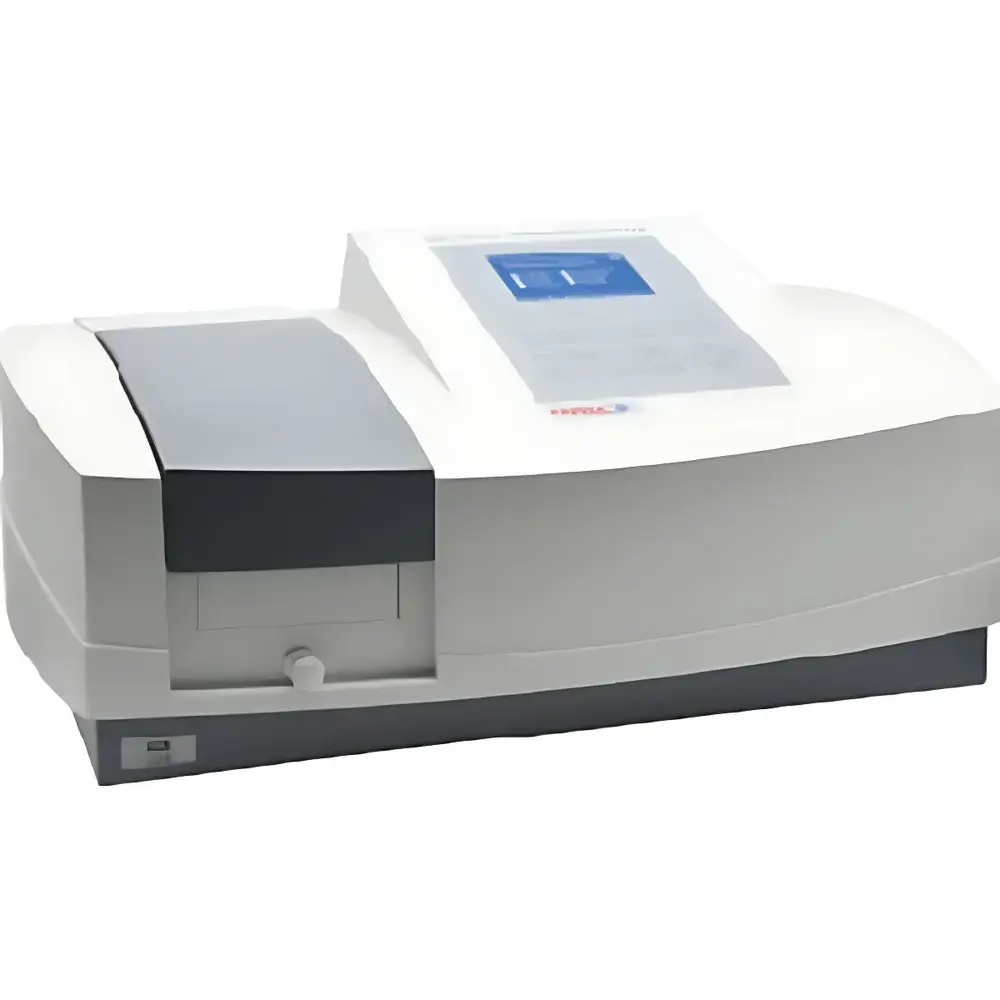
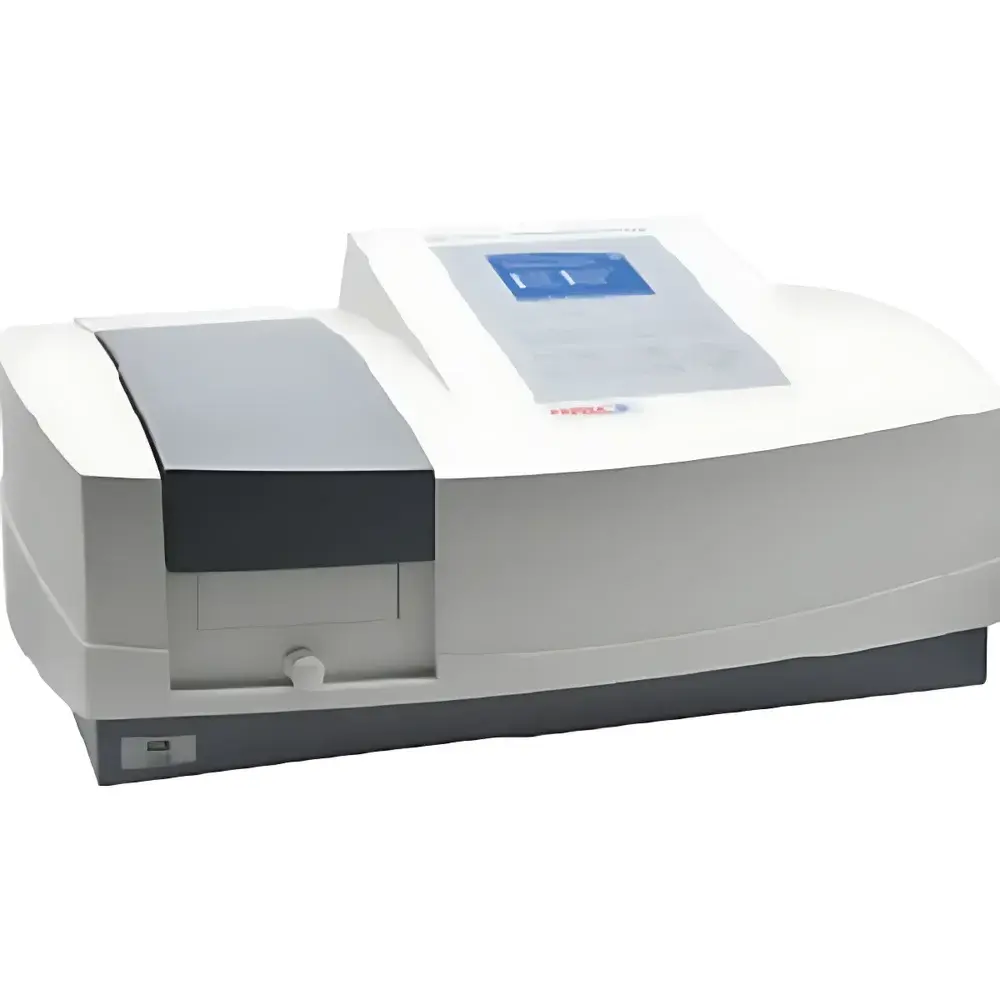
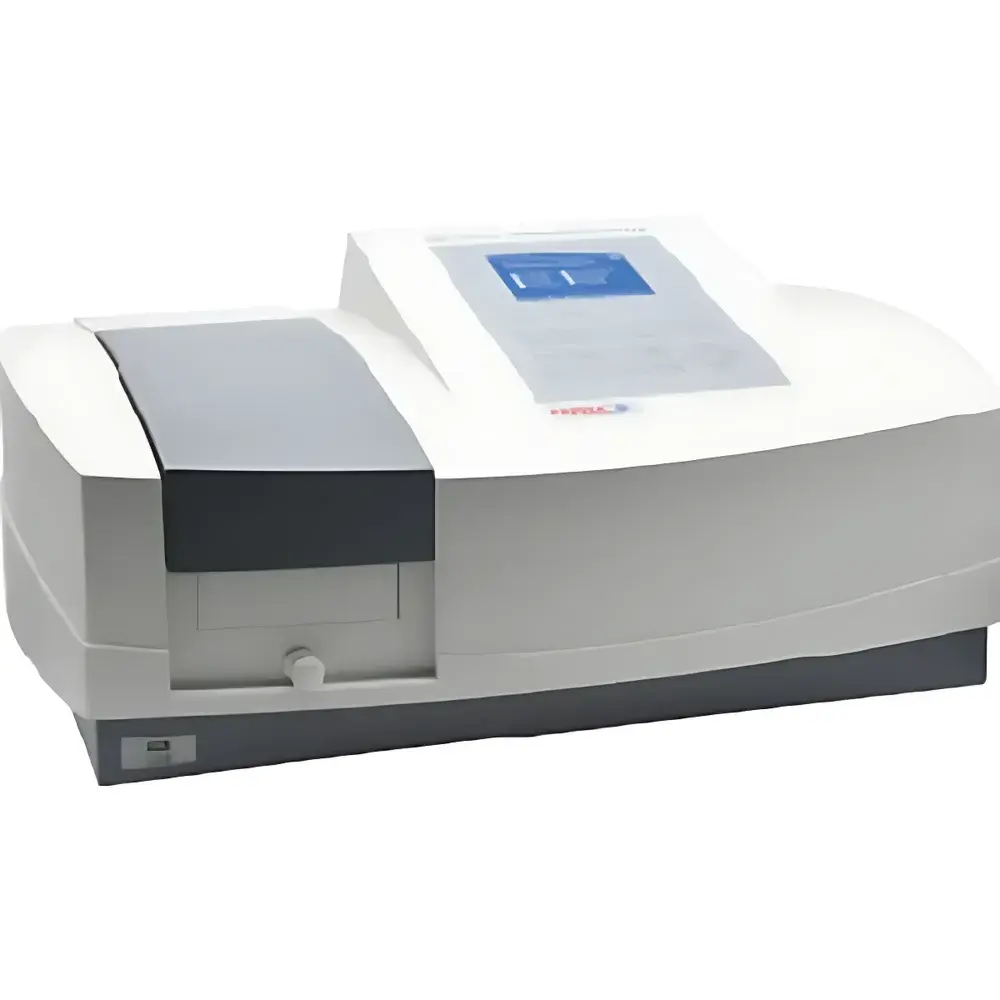
UniCo UV-3802 Advanced Dual-Beam Ultraviolet-Visible Spectrophotometer
| Brand | UniCo |
|---|---|
| Origin | Shanghai, China |
| Model | UV-3802 |
| Optical System | Pseudo-Double-Beam |
| Detector Type | Photocell |
| Wavelength Range | 190–1100 nm |
| Wavelength Accuracy | ±0.3 nm |
| Wavelength Repeatability | ±0.1 nm |
| Spectral Bandwidth | 1.8 nm |
| Stray Light | ≤0.05% T |
| Photometric Accuracy | ±0.004 Abs (0–0.5 Abs), ±0.004 Abs (0.5–1.0 Abs), ±0.5% T |
| Photometric Repeatability | ±0.001 Abs (0–0.5 Abs), ±0.002 Abs (0.5–1.0 Abs), ±0.2% T |
| Baseline Stability | ±0.002 A/h (at 500 nm, after warm-up) |
| Display | 320 × 240 graphical LCD |
| Data Interface | USB port |
| Dimensions (W×D×H) | 625 × 405 × 280 mm |
| Weight | 22 kg |
Overview
The UniCo UV-3802 is a high-performance pseudo-double-beam ultraviolet-visible (UV-Vis) spectrophotometer engineered for precision absorbance, transmittance, and concentration measurements across the full spectral range of 190–1100 nm. Based on a Czerny-Turner optical configuration with a 1200 lines/mm holographic grating, the instrument delivers consistent photometric linearity and wavelength fidelity essential for quantitative analytical workflows in academic research, pharmaceutical quality control, environmental testing, and industrial R&D laboratories. Its pseudo-double-beam architecture—comprising a reference and sample beam path alternately measured via a mechanical chopper—enables real-time correction of source drift and detector instability, significantly improving measurement reproducibility compared to single-beam designs. The system operates without external PC dependency for core functions, supporting standalone operation for routine analysis while retaining full integration capability with laboratory information management systems (LIMS) and regulated environments.
Key Features
- Precision wavelength scanning with 0.1 nm display resolution and ±0.3 nm absolute accuracy, certified per ISO 9001-aligned calibration protocols
- Fixed 1.8 nm spectral bandwidth optimized for balance between resolution and signal-to-noise ratio in compliance with ASTM E275 and USP <857>
- Low stray light performance (≤0.05% T at 220 nm and 340 nm), critical for high-absorbance measurements of biological macromolecules and colored impurities
- Integrated 320 × 240 graphical LCD with intuitive touch-sensitive keypad for rapid method selection, parameter entry, and real-time spectrum visualization
- Onboard data storage and direct USB flash drive support—enabling secure export of spectra, kinetic traces, calibration curves, and audit-ready CSV reports without host software
- Thermally stabilized optical bench and pre-aligned quartz-tungsten/hydrogen-deuterium dual light sources ensure <±0.002 A/h baseline stability after 30-minute warm-up
Sample Compatibility & Compliance
The UV-3802 accommodates standard 10 mm pathlength cuvettes—including supplied quartz (for UV), optical glass (for visible), and optional matched pairs for ratio-based referencing—supporting liquid, solution-phase, and suspended particulate samples. It complies with fundamental requirements of ISO/IEC 17025 for analytical instrument validation and meets key performance criteria referenced in pharmacopeial methods (USP <857>, EP 2.2.25, JP 2.04). While not inherently 21 CFR Part 11 compliant in standalone mode, its optional UniCo SpectraPro software provides electronic signature support, audit trail logging, and user-access controls suitable for GLP/GMP-regulated environments when deployed with validated computer systems.
Software & Data Management
The included UniCo SpectraPro application (Windows-compatible, license-protected via hardware dongle) extends functionality beyond basic instrument control. It supports multi-wavelength kinetics, DNA/protein quantification using built-in extinction coefficients (e.g., A260/A280 ratio analysis), enzyme activity rate calculations, and customizable standard curve fitting (linear, quadratic, cubic, and 4-parameter logistic models). All raw spectral data are stored in vendor-neutral ASCII format; metadata—including date/time stamps, operator ID, instrument serial number, and measurement parameters—is embedded in exported files to satisfy traceability requirements. USB data transfer preserves full timestamp integrity and enables seamless import into Excel, MATLAB, or third-party chemometrics platforms.
Applications
- Quantitative determination of nucleic acids and proteins in molecular biology labs using A260, A280, and A230 endpoints
- Pharmaceutical assay development and dissolution testing per ICH Q2(R2) guidelines
- Water quality monitoring—including nitrate, phosphate, and heavy metal complexation assays—per EPA Method 365.3 and APHA Standard Methods
- Colorimetric enzyme-linked immunosorbent assay (ELISA) endpoint reading at 450 nm and dual-wavelength correction
- Thin-film thickness estimation and bandgap analysis of semiconductor nanomaterials via Tauc plot derivation
- Stability-indicating method development for degradation product profiling under forced degradation conditions
FAQ
What distinguishes pseudo-double-beam from true double-beam optics?
Pseudo-double-beam uses a single detector and time-shared reference/sample beam paths via a rotating mirror or chopper, offering cost-effective drift compensation without the complexity and alignment sensitivity of true dual-detector configurations.
Is the UV-3802 suitable for GMP-compliant QC labs?
Yes—when operated with SpectraPro software under a validated IT infrastructure, it supports 21 CFR Part 11 requirements including role-based access, electronic signatures, and immutable audit trails.
Can the instrument perform kinetic measurements over extended durations?
Yes—it supports time-scan modes up to 9,999 seconds with programmable sampling intervals from 0.1 s to 60 s, ideal for monitoring slow enzymatic reactions or polymerization kinetics.
Does the system require annual recalibration?
While factory calibration is traceable to NIST standards, users should perform periodic verification using certified reference materials (e.g., holmium oxide for wavelength, potassium dichromate for absorbance) per internal SOPs or ISO/IEC 17025 requirements.
What maintenance is recommended for long-term optical stability?
Annual inspection of lamp output intensity, grating alignment verification, and cleaning of cuvette compartment optics with lint-free, solvent-grade wipes are advised; desiccant replacement in the instrument housing prevents moisture-induced grating degradation.






