
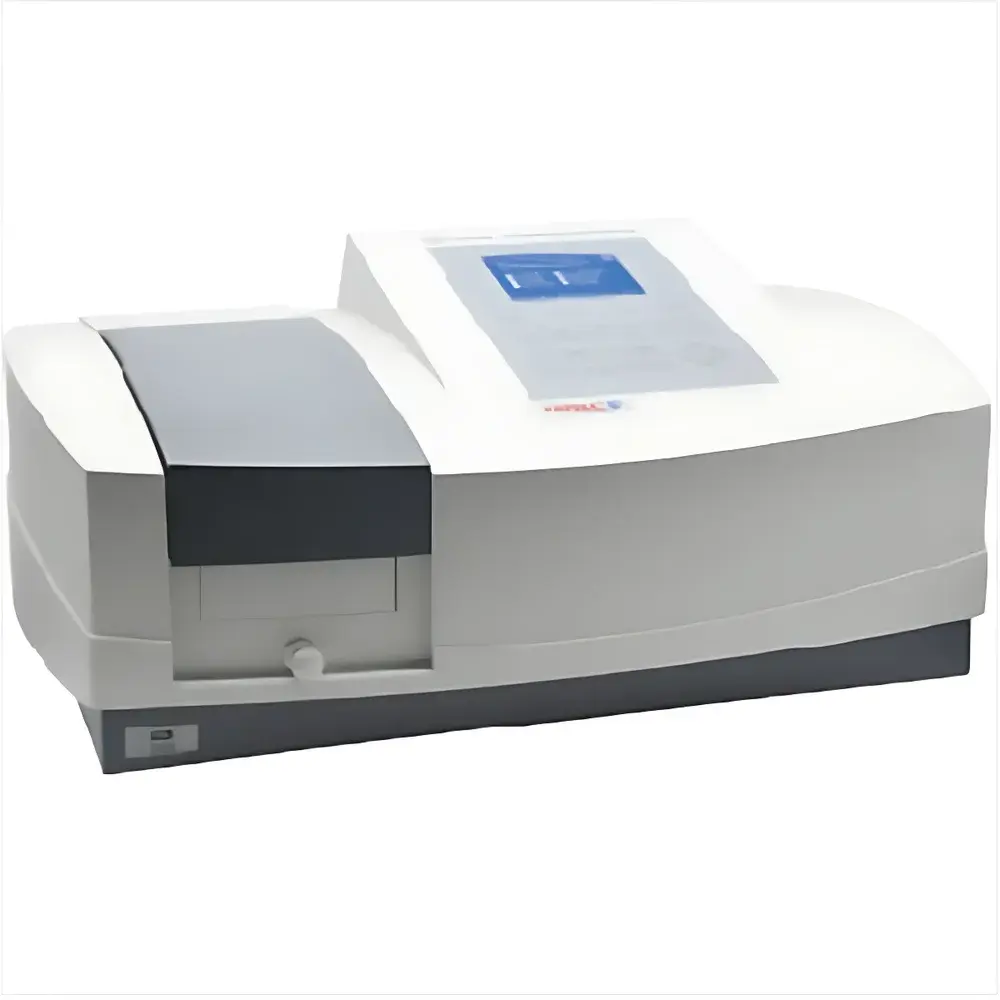
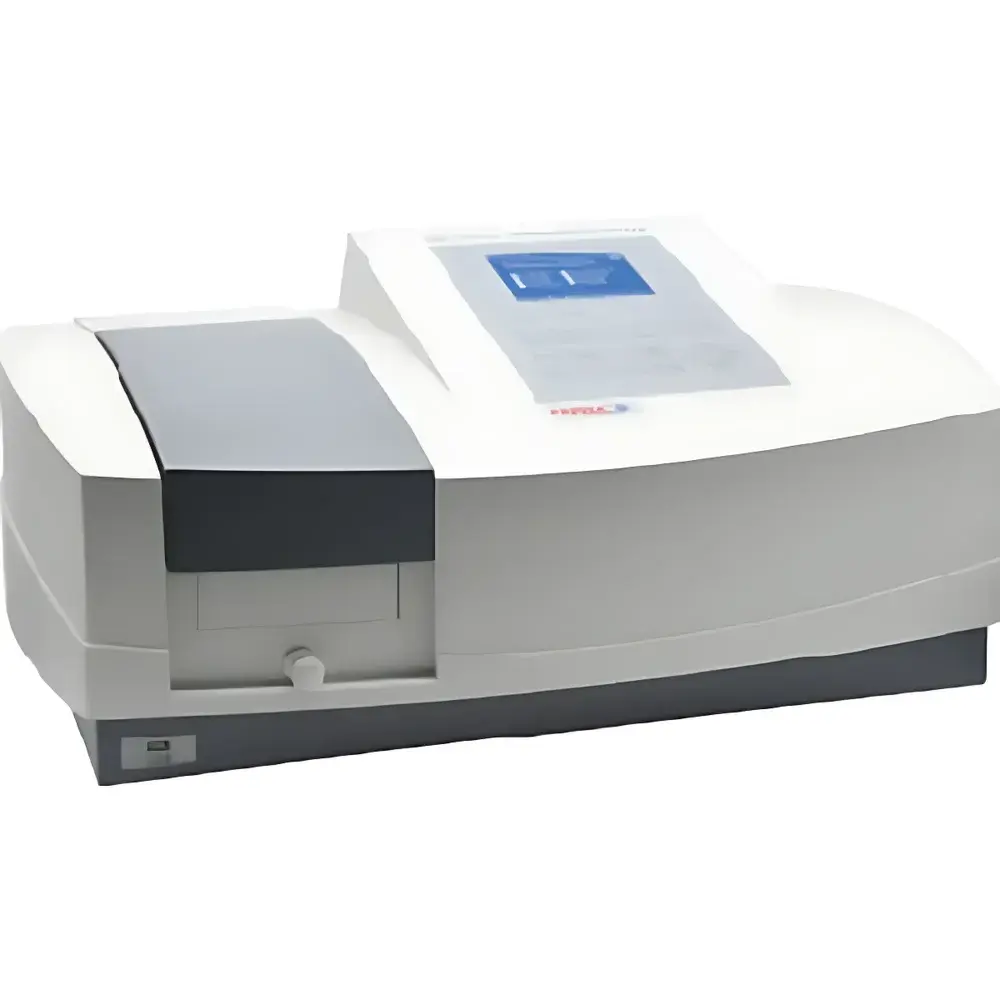
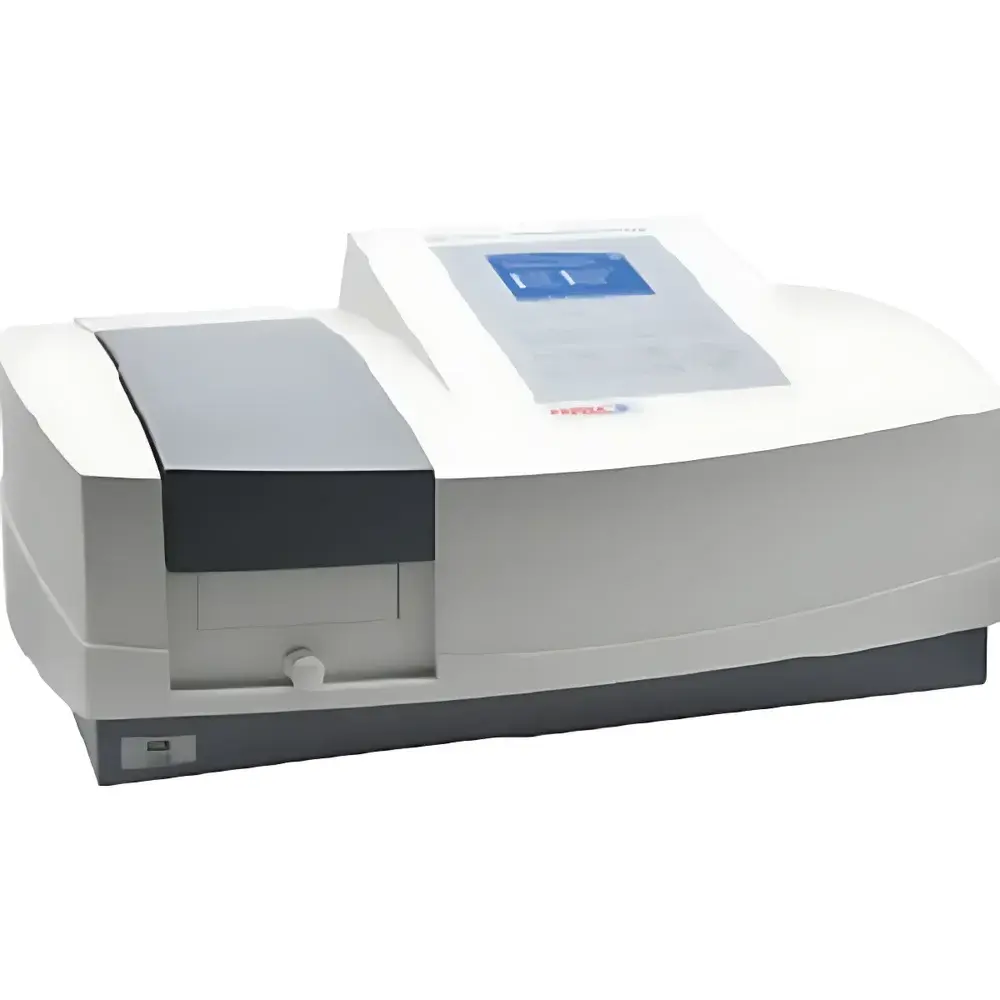
UniCo UV-4802 Dual-Beam Ultraviolet-Visible Spectrophotometer
| Brand | UniCo |
|---|---|
| Origin | Shanghai, China |
| Model | UV-4802 |
| Optical System | Dual-Beam |
| Detector Type | Photodiode Array (PDA) |
| Wavelength Range | 190–1100 nm |
| Wavelength Accuracy | ±0.3 nm |
| Wavelength Repeatability | ±0.1 nm |
| Spectral Bandwidth | 1.8 nm |
| Stray Light | ≤0.05% T |
| Photometric Accuracy | ±0.004 Abs (0–0.5 Abs), ±0.004 Abs (0.5–1.0 Abs), ±0.5% T |
| Photometric Repeatability | ±0.001 Abs (0–0.5 Abs), ±0.002 Abs (0.5–1.0 Abs), ±0.2% T |
| Baseline Drift | ±0.002 A/h (at 500 nm, after warm-up) |
| Display | 320 × 240 graphic LCD |
| Data Interface | USB port |
| Dimensions (W × D × H) | 625 × 405 × 280 mm |
| Weight | 23 kg |
Overview
The UniCo UV-4802 is a dual-beam ultraviolet-visible spectrophotometer engineered for high-precision quantitative and qualitative analysis across research laboratories, quality control environments, and educational institutions. Utilizing a stable dual-beam optical architecture with a 1200 lines/mm holographic grating, the instrument compensates for source intensity fluctuations and detector drift in real time—ensuring exceptional photometric stability and measurement reproducibility. Its wavelength coverage spans 190–1100 nm, enabling full-spectrum characterization of organic compounds, transition metal complexes, biomolecules (e.g., nucleic acids and proteins), and nanomaterials. The system employs a photodiode array (PDA) detector for rapid spectral acquisition without mechanical scanning, supporting both single-point absorbance measurements and full-spectrum scans with 0.1 nm wavelength resolution display. Designed for compliance with routine analytical workflows, the UV-4802 meets fundamental performance criteria aligned with ISO 9001–certified manufacturing practices and supports method validation under GLP and GMP frameworks.
Key Features
- Dual-beam optical design with real-time reference beam correction for enhanced baseline stability and long-term photometric consistency
- Photodiode array (PDA) detection system enabling simultaneous multi-wavelength acquisition and rapid spectral scanning
- 1.8 nm spectral bandwidth optimized for resolution–sensitivity balance in routine UV-Vis applications
- High-accuracy wavelength calibration (±0.3 nm) and repeatability (±0.1 nm), verified against NIST-traceable standards
- Large 320 × 240 graphic LCD display with intuitive touch-sensitive keypad interface for standalone operation
- Integrated USB port for direct data export to USB storage devices—no external PC required for basic reporting or archival
- Comprehensive built-in measurement modes: photometric mode, wavelength scanning, multi-wavelength analysis, kinetic (time-based) assays, and standard curve-based quantitation
- DNA/Protein analysis module with pre-programmed extinction coefficients and concentration calculation algorithms per USP and Bradford/Lowry/Biuret protocols
Sample Compatibility & Compliance
The UV-4802 accommodates standard 10 mm pathlength cuvettes—including quartz (for UV range below 220 nm), optical glass, and disposable plastic—enabling seamless transition between aqueous, organic, and corrosive solvent systems. Its optical alignment and stray light suppression (<0.05% T at 220 nm and 340 nm) meet ASTM E275 and ISO 6059 requirements for spectrophotometric performance verification. The instrument’s photometric accuracy and linearity across the full absorbance range (–0.3 to 3.0 A) support method transfer and inter-laboratory comparability. While not inherently 21 CFR Part 11 compliant in standalone mode, the included UniCo Advanced Software provides audit trail logging, user access control, and electronic signature capability when deployed on validated Windows-based systems—facilitating alignment with FDA-regulated QC environments.
Software & Data Management
UniCo Advanced Software—supplied with hardware encryption dongle—offers full instrument control, spectral processing (baseline correction, peak identification, derivative analysis), and report generation compliant with laboratory documentation standards. Data files are saved in vendor-neutral CSV and XML formats for interoperability with LIMS, ELN, and statistical analysis platforms (e.g., JMP, OriginLab). The software supports method templates, customizable calibration curves (linear, quadratic, cubic), and automated pass/fail evaluation against user-defined specification limits. All instrument events—including parameter changes, measurement triggers, and calibration actions—are timestamped and logged with operator ID, satisfying basic GLP audit requirements. Firmware updates are delivered via USB, ensuring sustained regulatory readiness without service engineer intervention.
Applications
- Quantitative determination of pharmaceutical actives and excipients per USP and EP 2.2.25
- Enzyme kinetics and ligand-binding studies requiring high-temporal-resolution absorbance monitoring
- Water quality analysis (e.g., nitrate, phosphate, COD estimation) per APHA Standard Methods
- Quality assurance of dyes, pigments, and polymer additives in chemical manufacturing
- Educational spectroscopy labs—supporting Beer–Lambert law validation, molar absorptivity determination, and spectral deconvolution exercises
- Research-grade characterization of quantum dots, plasmonic nanoparticles, and conjugated polymers
FAQ
Does the UV-4802 support GLP-compliant data integrity?
Yes—when used with UniCo Advanced Software on a controlled Windows platform, it provides electronic signatures, audit trails, and secure user authentication per ALCOA+ principles.
Can the instrument perform kinetic measurements over extended time periods?
Yes—supports time-scan mode with user-defined interval (100 ms–60 s) and duration (up to 24 hours), with automatic data logging to internal memory or USB drive.
Is quartz cuvette calibration required before each use?
No—baseline correction is performed automatically during startup; however, matched quartz cuvettes are recommended for high-accuracy UV measurements below 220 nm.
What is the minimum detectable absorbance change under optimal conditions?
Photometric repeatability of ±0.001 Abs (0–0.5 A range) enables reliable detection of sub-micromolar concentration changes in well-characterized systems.
How often does the instrument require wavelength calibration verification?
Annual verification using holmium oxide or didymium filters is recommended; factory calibration is traceable to NIST SRM 2034 and 930D.




