
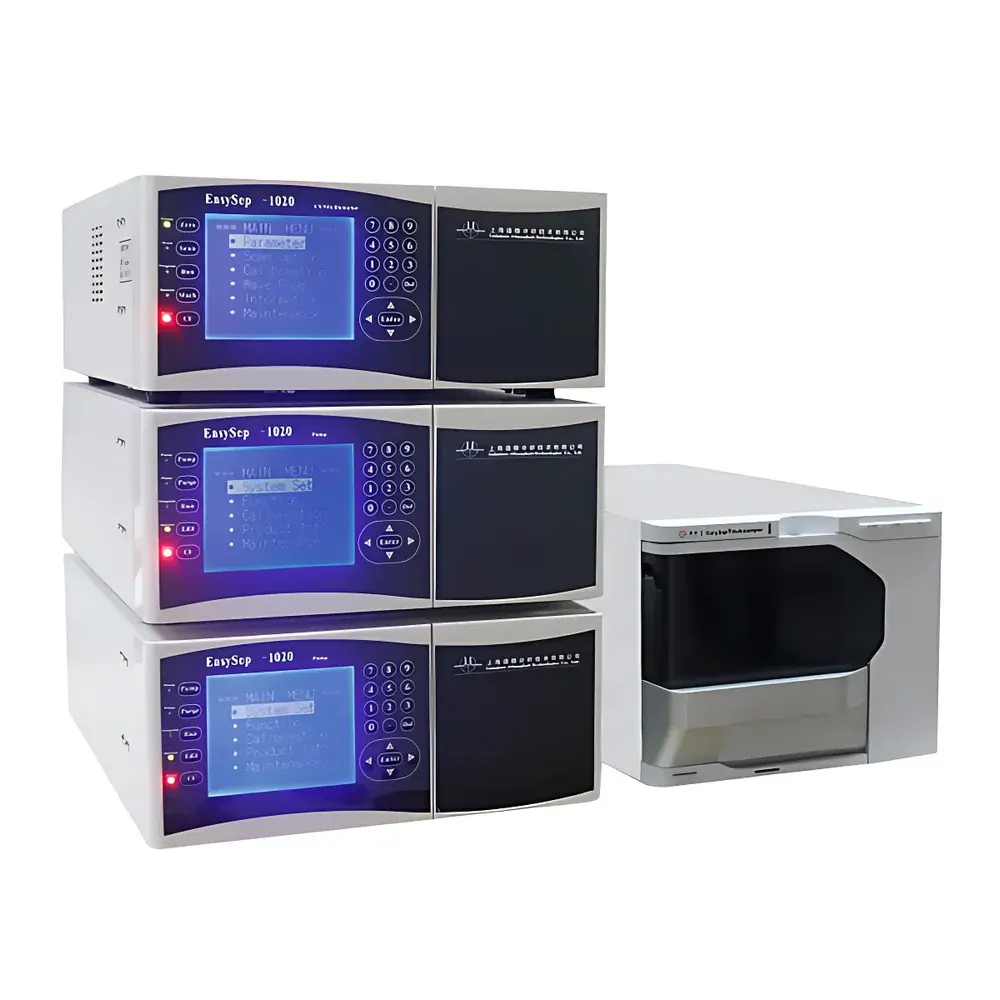
Unimicro EasySep-1020 HPLC System
| Brand | Unimicro Technologies |
|---|---|
| Origin | Shanghai, China |
| Manufacturer Type | OEM Manufacturer |
| Regional Classification | Domestic (China) |
| Model | EasySep-1020 HPLC |
| Instrument Category | Conventional High-Performance Liquid Chromatograph |
| Application Scope | General-Purpose Analytical Use |
| Flow Rate Range | 0.001–9.999 mL/min |
| Maximum Operating Pressure | 42 MPa |
| Flow Accuracy | <0.06% RSD |
| Autosampler Capacity | 120 positions |
| Injection Volume Range | 0.1–250 µL |
| Column Oven Temperature Range | Ambient +10 °C to 60 °C |
| UV/Vis Wavelength Range | 190–600 nm |
| Data Acquisition Rate | 100 Hz |
Overview
The Unimicro EasySep-1020 HPLC System is a modular, high-reliability high-performance liquid chromatograph engineered for routine analytical laboratories requiring robustness, long-term operational stability, and compliance-ready data integrity. Based on classical reversed-phase and normal-phase separation principles, the system employs isocratic or gradient elution via dual-piston high-pressure reciprocating pumps, delivering precise solvent delivery under pressures up to 42 MPa. Its design emphasizes mechanical durability—featuring a floating plunger assembly and short-stroke cam-driven pump architecture—to minimize pulsation, extend seal and plunger lifetime, and maintain flow stability over extended run sequences. The integrated UV/Vis detector utilizes digital signal filtering, thermally stabilized deuterium lamp optics, and dynamic baseline correction algorithms to ensure low-noise, high-fidelity absorbance detection across 190–600 nm. As a fully self-contained analytical platform, the EasySep-1020 supports method development, quality control, and regulatory-compliant testing in pharmaceutical, food safety, agrochemical, and environmental laboratories.
Key Features
- High-precision binary or quaternary gradient pumping system with flow accuracy <0.06% RSD and pulse dampening optimized for reproducible retention time stability
- 120-position autosampler with programmable injection volumes (0.1–250 µL), needle wash capability, and temperature-controlled sample tray (4–40 °C optional)
- Column oven with PID-controlled heating and cooling, maintaining temperature uniformity ±0.3 °C across 10–60 °C range
- UV/Vis detector featuring real-time wavelength programming, static spectral scanning (190–600 nm), automatic zero-baseline adjustment, and lamp usage tracking per GLP requirements
- Modular architecture enabling seamless integration of optional detectors—including ELSD, RI, and fluorescence—without hardware retrofitting
- Digital signal output interface eliminating analog noise sources; baseline drift <0.5 mAU/h at 254 nm (typical)
Sample Compatibility & Compliance
The EasySep-1020 accommodates standard 2.1–4.6 mm ID analytical columns (up to 250 mm length) and is compatible with C18, C8, phenyl-hexyl, HILIC, and amino-silica stationary phases. It supports aqueous-organic mobile phases (e.g., water/acetonitrile, water/methanol), buffers (e.g., phosphate, acetate, ammonium formate), and ion-pairing reagents. System validation protocols align with ICH Q2(R2) guidelines for precision, linearity, and robustness assessment. Firmware and software support audit trails, electronic signatures, and instrument parameter change logging—fully compliant with FDA 21 CFR Part 11, EU Annex 11, and GLP/GMP documentation standards. All detector modules meet ISO/IEC 17025 traceability requirements when calibrated using NIST-traceable standards.
Software & Data Management
The EasySep Control Suite is a Windows-based chromatography data system (CDS) supporting full instrument control, real-time monitoring, peak integration, and quantitative reporting. It implements intelligent peak detection with adjustable slope sensitivity, width threshold, and valley-to-valley deconvolution. Users may overlay multiple chromatograms, perform spectral library matching (for UV spectra), and apply calibration curves using external standard, internal standard, normalization, or response factor methods. Raw data files (.raw) are stored in vendor-neutral format with embedded metadata (method parameters, instrument configuration, operator ID, timestamp). Audit trail logs record all user actions—including method edits, sequence changes, and report exports—with immutable timestamps and operator authentication. Data backups and export options include CSV, PDF, and XML formats suitable for LIMS integration.
Applications
The EasySep-1020 is routinely deployed in feed additive analysis—quantifying 20 underivatized amino acids without pre-column derivatization, resolving complex vitamin mixtures (e.g., B-complex, A, D, E, K), and detecting unauthorized dyes such as Sudan Red I–IV at sub-ppm levels. In pharmaceutical QC, it validates assay purity of APIs per USP , monitors degradation products under stress conditions, and verifies excipient composition in oral solid dosage forms. Environmental labs use it for PAHs, phthalates, and pesticide residue screening in water and soil extracts. Its gradient flexibility, low carryover (<0.01%), and wide linear dynamic range (up to 3 orders of magnitude) make it equally suitable for natural product profiling, polymer additive analysis, and clinical biomarker quantification in plasma or urine matrices.
FAQ
Does the EasySep-1020 support method transfer from other HPLC platforms?
Yes—its pressure and flow calibration protocols, dwell volume characterization, and gradient delay compensation enable direct migration of methods from Agilent 1260, Waters e2695, or Shimadzu Nexera systems with minimal re-optimization.
Is the UV/Vis detector compliant with pharmacopeial wavelength accuracy requirements?
Yes—the detector undergoes factory calibration using holmium oxide and didymium filters; wavelength accuracy is verified to ±1 nm per USP and EP 2.2.25 specifications.
Can the system be operated unattended overnight?
Yes—the autosampler supports full sequence scheduling, column oven thermal stabilization, and automatic shutdown routines; system status and error alerts are logged and optionally emailed via SMTP integration.
What validation documentation is provided with the instrument?
Each unit ships with Factory Acceptance Test (FAT) report, IQ/OQ protocol templates, and a Certificate of Conformance referencing ISO 9001:2015 and IEC 61010-1 safety standards.
Is remote access and monitoring supported?
Yes—the CDS includes secure HTTPS-enabled web interface for real-time status viewing, queue management, and alarm notification—compatible with enterprise IT infrastructure and firewall policies.




