
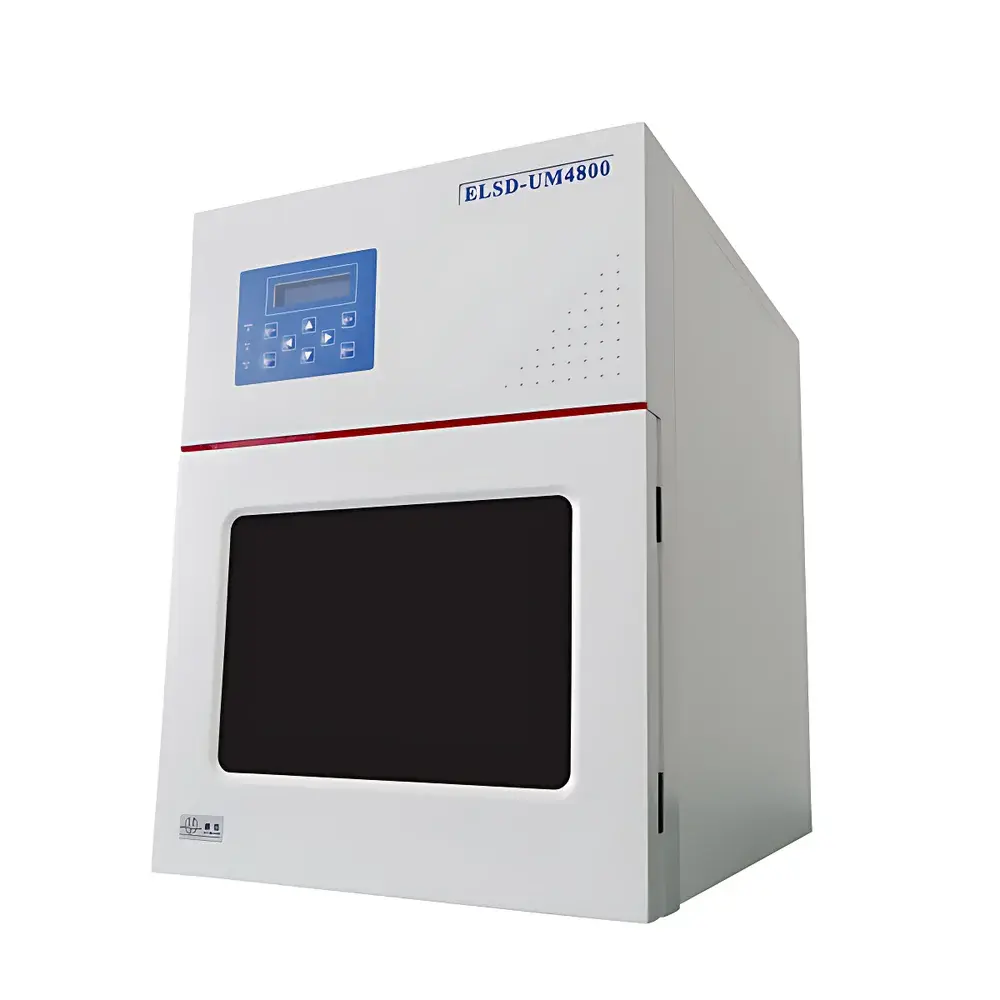

Unimicro Technologies ELSD-UM4800 Evaporative Light-Scattering Detector
| Brand | Unimicro Technologies |
|---|---|
| Origin | Shanghai, China |
| Manufacturer Type | Original Equipment Manufacturer (OEM) |
| Product Category | Domestic |
| Model | ELSD-UM4800 |
| Price Range | USD 7,000–14,000 (FOB Shanghai) |
| Compatible Systems | HPLC (all major brands) |
| Detector Type | Evaporative Light-Scattering Detector (ELSD) |
Overview
The Unimicro Technologies ELSD-UM4800 is a benchtop evaporative light-scattering detector engineered for universal detection in high-performance liquid chromatography (HPLC) applications. Operating on the principle of nebulization, solvent evaporation, and light scattering measurement, the ELSD-UM4800 detects analytes based on their non-volatility relative to the mobile phase—irrespective of UV absorbance, fluorescence, or electrochemical activity. This makes it particularly valuable for compounds lacking chromophores, including carbohydrates, phospholipids, glycosides, free fatty acids, amino acids, saponins, and natural product extracts. Unlike UV detectors, the ELSD-UM4800 delivers mass-sensitive response (approximately logarithmic correlation with analyte mass), enabling semi-quantitative analysis of unknowns and facilitating method development for complex botanical matrices such as traditional Chinese medicine (TCM) extracts and herbal formulations.
Key Features
- Optimized low-noise optical design with high-gain photomultiplier tube (PMT) for enhanced signal-to-noise ratio and improved baseline stability
- Programmable nebulizer gas flow control (N₂ or compressed air) with digital pressure regulation for reproducible droplet formation
- Stable, digitally controlled evaporation chamber operating up to 130 °C—enabling robust performance across volatile and semi-volatile solvent systems (e.g., acetonitrile/water, methanol/water, THF, IPA)
- Integrated temperature-compensated light-scattering cell with automatic background subtraction algorithm to minimize drift during gradient elution
- Compact, modular architecture designed for seamless integration with all commercial HPLC systems—including Agilent, Waters, Shimadzu, Thermo Fisher, and国产 HPLC platforms—via standard analog voltage output (0–1 V) and RS-232/USB interface
- Economical ownership model: factory-calibrated at production; no consumable lamps or deuterium sources; minimal maintenance requirements
Sample Compatibility & Compliance
The ELSD-UM4800 supports broad mobile-phase compatibility, including gradients containing volatile modifiers such as ammonium acetate, formic acid, trifluoroacetic acid (TFA), acetic acid, ammonia solution, and triethylamine—without generating solvent front interference or baseline discontinuities. It complies with core regulatory expectations for analytical instrumentation used in QC laboratories: data integrity support via audit-trail-enabled software (see Software section), adherence to GLP/GMP documentation practices, and compatibility with laboratory workflows aligned with USP , ICH Q2(R2), and ISO/IEC 17025 requirements. While not certified to FDA 21 CFR Part 11 out-of-the-box, its software architecture supports configuration for electronic signature and audit trail functionality required for regulated environments.
Software & Data Management
The included Unimicro ChromaView™ workstation software provides full instrument control, real-time signal monitoring, peak integration, calibration curve generation (linear/log-log), and report export in PDF, CSV, and XML formats. Raw data files are stored in vendor-neutral, timestamped binary format with embedded metadata (method parameters, instrument ID, operator ID, acquisition time). The software supports multi-user login, configurable access levels, and optional audit trail logging—enabling traceability per ALCOA+ principles. Exported chromatograms are compatible with third-party CDS platforms (e.g., Empower, Chromeleon, OpenLab) via AIA/ANDI standards.
Applications
- Quantification of non-UV-absorbing natural products in TCM quality control (e.g., ginsenosides, astragalosides, puerarin)
- Analysis of lipid classes (phosphatidylcholine, triglycerides) in food and pharmaceutical liposome characterization
- Method development for oligosaccharide profiling in prebiotic research and infant formula testing
- Stability-indicating assays for APIs without chromophores (e.g., certain peptides, cyclodextrin complexes)
- Supporting orthogonal detection in multi-detector HPLC systems (e.g., ELSD + CAD + MS)
- Academic and industrial QC labs requiring cost-effective, reliable universal detection without derivatization
FAQ
Does the ELSD-UM4800 require column derivatization for amino acid analysis?
No. ELSD detection is inherently label-free and does not require pre- or post-column derivatization.
Can it be used with non-volatile buffers such as phosphate or citrate?
No—non-volatile salts must be avoided, as they accumulate in the drift tube and cause signal suppression or clogging. Volatile buffers only.
What is the typical detection limit for sucrose under standard HPLC-ELSD conditions?
Approximately 10–50 ng on-column, depending on mobile phase composition, flow rate, and nebulizer gas pressure.
Is nitrogen gas mandatory, or can compressed air be used?
Compressed air is fully supported and commonly used; nitrogen may improve sensitivity in some low-background applications.
How often does the evaporator tube require cleaning?
Under normal operation with volatile mobile phases, cleaning is recommended every 2–3 months or after 200–300 injections of high-boiling solvents.






