
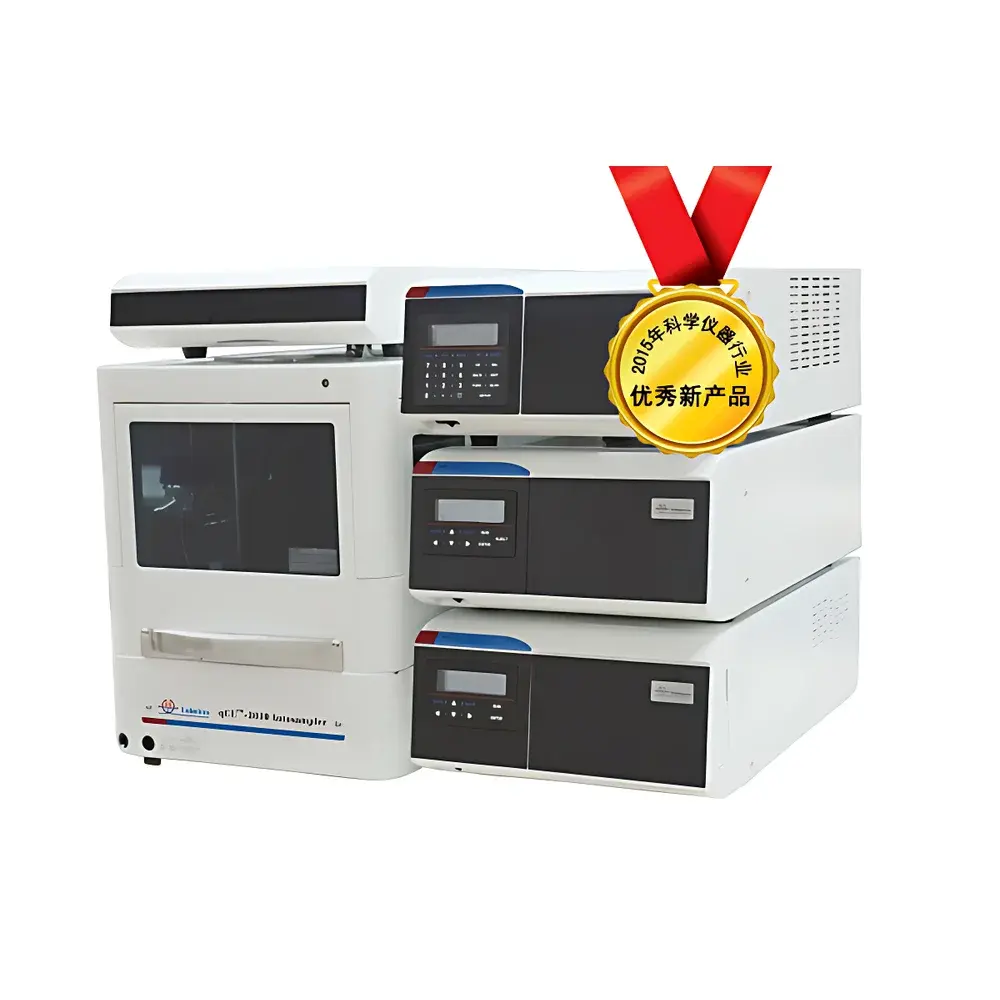
Unimicro Technologies qCE®-3010 Fully Automated Quantitative Capillary Electrophoresis System
| Brand | Unimicro Technologies |
|---|---|
| Origin | USA |
| Manufacturer Type | Manufacturer |
| Origin Category | Imported |
| Model | qCE®-3010 |
| Instrument Type | Capillary Electrophoresis (CE) |
| Sample Analysis | Organic Analysis |
| Voltage Range | 0 to ±30 kV |
| Cooling Method | Liquid Cooling |
| Capillary Temperature Control | Semiconductor-Based Thermostatic Control (4–50 °C) |
| Detector Options | UV/Vis, μLIF, μELSD, μECD, MS-Compatible Interface |
| Injection Mode | Pressure- and Electrokinetic-Driven |
| Injection Volume Precision | 4 nL or 10 nL via Patented Valve Loop Injector |
| Injection System | Integrated 4-port High-Pressure Valve with Electric Field Isolation Chamber |
| Thermal Stability | ±0.1 °C over 24 h at setpoint |
Overview
The Unimicro Technologies qCE®-3010 Fully Automated Quantitative Capillary Electrophoresis System represents a paradigm shift in capillary electrophoresis instrumentation—engineered to resolve long-standing limitations in quantitative reproducibility, sample carryover, and operational robustness. Unlike conventional CE systems relying on hydrodynamic or electrokinetic injection—both of which require electric field interruption, exhibit viscosity- and mobility-dependent bias, and lack volumetric precision—the qCE®-3010 implements a patented high-precision valve-based loop injection mechanism. This architecture enables true volumetric sampling (4 nL or 10 nL) under continuous high-voltage conditions (up to ±30 kV), eliminating the need to interrupt electrophoretic equilibrium during injection. The system operates on the fundamental principle of electrophoretic mobility-driven separation within fused-silica capillaries (e.g., 50 µm i.d., 40 cm effective length), where analytes migrate under controlled electric fields in precisely buffered electrolyte media (e.g., borate or borosilicate buffers, pH 9.2–9.4). Its design conforms to the physical constraints of CE theory—including Joule heating management, electroosmotic flow (EOF) stabilization, and analyte stacking—while delivering analytical performance metrics required for regulated environments.
Key Features
- Patented 4-port high-pressure valve injector with fixed-volume loops (4 nL or 10 nL), enabling repeatable, discrimination-free volumetric injection without electric field interruption.
- Liquid-cooled, semiconductor-based capillary thermostatic chamber (4–50 °C, ±0.1 °C stability), utilizing sealed DS18B20 digital temperature sensors and circulating coolant medium for thermal homogeneity across the separation column.
- Integrated electric field isolation chamber (“conductive-but-non-wetting” four-way junction), decoupling the valve actuation zone from high-voltage domains while maintaining uninterrupted current path through the capillary.
- Modular detector compatibility: native support for UV/Vis (220 nm, 254 nm), micro-LIF, micro-ELSD, micro-ECD, and LC-CE-MS hyphenation interfaces with low-dead-volume transfer lines.
- Automated sample handling: computer-controlled syringe pump, capillary rinsing protocol, buffer replenishment, and sequential multi-sample analysis without manual intervention.
Sample Compatibility & Compliance
The qCE®-3010 is validated for organic small-molecule analysis—including nucleobases, nucleosides, preservatives (e.g., parabens, benzoic acid), pharmaceutical actives, and ionic metabolites—across diverse matrices such as cosmetics, biological fluids, and synthetic reaction mixtures. Its valve-based injection eliminates viscosity-induced bias observed in pressure-driven methods and avoids electrophoretic mobility discrimination inherent to electrokinetic injection. The system meets core requirements for GLP-compliant laboratories: full audit trail logging, electronic signatures, method version control, and secure user access levels. All temperature, voltage, injection timing, and detection parameters are digitally recorded with timestamps compliant with FDA 21 CFR Part 11 Annex 11 expectations. Column temperature stability (±0.1 °C) and injection volume precision (RSD < 0.8% intra-day, < 1.2% inter-day across 4 days) satisfy ISO/IEC 17025 validation criteria for quantitative CE methods.
Software & Data Management
The qCE Control & Data Processing Software is a unified platform integrating instrument control, real-time data acquisition, peak integration, and quantitative reporting. It supports time-programmed gradient elution (voltage ramping), dynamic baseline correction, and adaptive peak detection algorithms optimized for narrow CE peaks (typical width < 5 s). Users may overlay up to eight electropherograms on a single view for comparative assessment; spectral subtraction, derivative plotting, and spectral alignment tools facilitate method development. Quantitation modules include external standard, internal standard, normalization, and response factor-based calculations—with automatic calibration curve generation (linear, quadratic, weighted least-squares). Raw data files adhere to ASTM E1946-20 standards for chromatographic data exchange and are exportable in .cdf, .csv, and .pdf formats. Audit trails record all parameter changes, method executions, and report generations with immutable timestamps and operator IDs.
Applications
The qCE®-3010 has demonstrated robust performance in multiple regulatory- and research-grade applications. Published studies include quantitative analysis of five preservatives (methylparaben, ethylparaben, propylparaben, butylparaben, benzoic acid) in cosmetic formulations using micellar electrokinetic capillary chromatography (MEKC) with 15 mM borate + 100 mM SDS (pH 9.3), achieving LODs < 0.05 µg/mL and inter-day RSDs < 1.5%. In nucleoside analysis, six compounds (cytosine, 5-fluoro-2′-deoxyuridine, adenosine, uracil, uridine, inosine) were baseline-resolved in 12 min under 15 kV in 30 mM borate (pH 9.4), with migration time RSD < 0.3% and peak area RSD < 1.0% (n = 6). Additional validated use cases include chiral separations using cyclodextrin-modified buffers, peptide purity assessment, and charged polymer characterization—each leveraging the system’s precise thermal control, low-volume injection fidelity, and detector modularity.
FAQ
How does the valve-based injection eliminate sample discrimination?
It physically isolates sample loading from the electrophoretic circuit, enabling fixed-volume aspiration independent of analyte mobility or buffer viscosity—unlike electrokinetic injection, which favors highly charged or low-MW species.
Is the system compatible with mass spectrometry?
Yes—via a dedicated CE-MS interface module featuring low-dead-volume sheathless or sheath-flow couplings, optimized for nanoelectrospray ionization and minimal band broadening.
What is the minimum detectable concentration for UV detection?
At 220 nm and 10 nL injection, typical LODs range from 0.1–1.0 µg/mL for aromatic analytes under optimal stacking conditions—dependent on capillary dimensions, buffer composition, and detector pathlength.
Can the column temperature be ramped during a run?
No—temperature is held constant per run to maintain EOF stability and migration time reproducibility; however, discrete temperature steps between injections are fully programmable.
Does the software support 21 CFR Part 11 compliance out-of-the-box?
Yes—role-based access control, electronic signatures, audit trail archiving, and data integrity safeguards are enabled by default and configurable per laboratory SOP requirements.





