
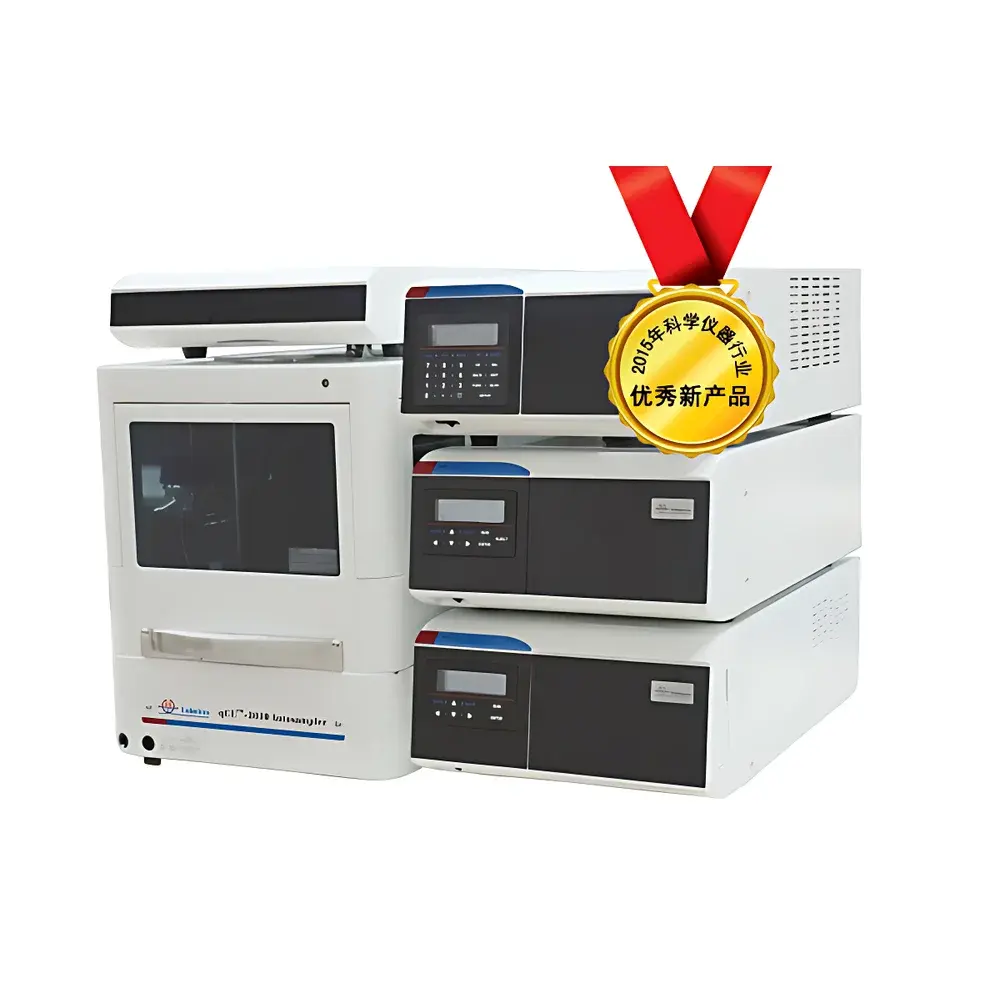
Unimicro Technologies qSep™-3010 Fully Automated Quantitative Capillary Electrophoresis System
| Brand | Unimicro Technologies |
|---|---|
| Origin | USA |
| Manufacturer Type | Original Equipment Manufacturer (OEM) |
| Origin Category | Imported |
| Model | qSep™-3010 |
| Instrument Type | Capillary Electrophoresis (CE) System |
| Sample Application | Organic Analysis |
| Voltage Range | 0 to ±30 kV |
| Cooling Method | Liquid Cooling |
| Capillary Temperature Control | Semiconductor-Based Peltier |
| Detector Options | UV/Vis (μUV/Vis), Laser-Induced Fluorescence (μLIF), Evaporative Light Scattering (μELSD), Electrochemical (μECD), Mass Spectrometry (MS) Interface |
| Injection Mode | Pressure- or Electrokinetic-Driven |
| Injection Volume Precision | 4 nL or 10 nL via Patented Loop Valve |
| Pressure Range | Low-Pressure Pneumatic |
| Column Oven Temperature Range | 4–50 °C |
| Compliance | GLP-ready software with audit trail, 21 CFR Part 11–compatible configuration available |
Overview
The Unimicro Technologies qSep™-3010 Fully Automated Quantitative Capillary Electrophoresis System represents a paradigm shift in capillary electrophoresis (CE) instrumentation. Unlike conventional CE platforms that rely on hydrodynamic or electrokinetic injection—both of which interrupt the electric field, introduce sample discrimination, and compromise quantitative reproducibility—the qSep™-3010 implements a patented, externally isolated valve-based injection architecture. This design enables precise, field-sustained nanoliter-scale sample introduction (4 nL or 10 nL) without electric field interruption, eliminating carryover, minimizing matrix-dependent bias, and supporting true quantitative analysis under electrophoretic equilibrium. The system operates on the fundamental principle of electrophoretic mobility separation in fused-silica capillaries under high-voltage DC fields (up to ±30 kV), with resolution governed by analyte charge-to-size ratio, buffer composition, pH, and thermal management. Its integration of liquid-cooled column temperature control (4–50 °C), semiconductor-based thermal regulation, and multi-detector compatibility positions it for rigorous applications in pharmaceutical QC, cosmetic preservative profiling, nucleotide analysis, and regulatory-compliant method development.
Key Features
- Patented external-loop valve injection system enabling field-sustained, discrimination-free quantitation at 4 nL or 10 nL volumes with RSD < 1.2% (inter-day, DMSO/benzoic acid validation)
- Liquid-cooled capillary oven with Peltier-driven semiconductor thermoregulation (4–50 °C), using sealed DS18B20 digital sensors and dielectric coolant for ±0.1 °C stability
- Electrically isolated four-way injection manifold: conductive but fluid-isolated design prevents high-voltage coupling into the autosampler while maintaining capillary voltage integrity
- Modular detector interface supporting μUV/Vis (200–400 nm), μLIF, μELSD, μECD, and MS-coupled configurations via standardized CE-MS interfaces
- Integrated pressure/electrokinetic dual-mode injection control with programmable pneumatic pressure range (low-pressure regime only) and voltage-gated electroosmotic flow synchronization
- GLP-compliant software architecture with full 21 CFR Part 11 readiness: electronic signatures, user-level access controls, immutable audit trails, and versioned method storage
Sample Compatibility & Compliance
The qSep™-3010 accommodates a broad spectrum of organic analytes—including small-molecule acids, bases, zwitterions, surfactants (e.g., SDS-based MEKC), nucleosides, and preservatives—without requiring derivatization or extensive method re-optimization. Its valve-based injection eliminates viscosity-related bias observed in hydrodynamic methods and avoids electrophoretic mobility–driven discrimination inherent in electrokinetic injection. The system has been validated per ICH Q2(R2) guidelines for precision, accuracy, linearity, and robustness in pharmaceutical impurity profiling and cosmetic preservative assays (e.g., parabens, benzoic acid). It supports ASTM D7260-21 (CE method validation), ISO 17025-accredited laboratory workflows, and FDA-aligned data integrity standards when configured with Part 11–enabled software modules. All hardware components comply with UL 61010-1 and IEC 61326-1 for electromagnetic compatibility and electrical safety in analytical laboratories.
Software & Data Management
The qSep™-3010 is controlled by proprietary CEControl™ v4.x software—a unified platform integrating instrument control, real-time data acquisition, peak integration, and quantitative reporting. The software features time-programmed event sequencing (voltage ramping, temperature setpoint transitions, detector wavelength switching), adaptive baseline correction, and customizable peak detection algorithms (threshold, width, symmetry filters). Users may overlay up to 16 electropherograms on a single view for comparative migration time and peak area analysis. Quantitative workflows support internal standard, external standard, normalization, and corrected normalization methods—with calibration curve fitting options including linear, quadratic, and weighted least-squares regression. Raw data are stored in vendor-neutral .cdf format compliant with AIA/ANDI standards; audit logs record all parameter changes, method executions, and user actions with timestamps and operator IDs. Export options include CSV, PDF reports, and direct LIMS integration via ASTM E1467-compliant XML schema.
Applications
- Regulatory quantification of cosmetic preservatives (methylparaben, ethylparaben, propylparaben, butylparaben, benzoic acid) using MEKC mode with SDS-borate buffers (RSD < 1.5% across 5-day validation)
- Separation and quantitation of nucleobases and nucleosides (cytosine, adenosine, uridine, inosine, 5-fluoro-2′-deoxyuridine) in pharmaceutical intermediates at sub-ppm levels
- Stability-indicating assay of degradation products in small-molecule APIs under forced oxidation and hydrolysis conditions
- High-resolution profiling of synthetic oligonucleotides and antisense therapeutics using dynamic coating–enhanced CE-UV
- Method transfer from HPLC to CE for chiral separations and charged metabolite analysis in biofluids (plasma, urine)
FAQ
How does the valve-based injection eliminate sample discrimination?
It decouples sample introduction from the electrophoretic field: the valve loads a fixed-volume loop under pressure while the capillary remains electrically isolated; once loaded, the valve switches to inject the entire loop volume into the capillary without field interruption or mobility-dependent bias.
Is the liquid cooling system compatible with long-term unattended operation?
Yes—the closed-loop dielectric coolant circuit includes level monitoring, overtemperature cutoff, and redundant thermal fusing; continuous 72-hour runs at 15 °C have demonstrated < 0.05 °C drift.
Can the qSep™-3010 be interfaced with a mass spectrometer?
Yes—via a commercially available CE-MS sheathless or sheath-flow interface; the system provides TTL-triggered voltage synchronization and real-time current monitoring for optimal ion transmission.
What validation documentation is supplied with the instrument?
Factory-installed IQ/OQ protocols compliant with ASTM E2500-13; users receive a complete validation toolkit including blank run templates, system suitability test sequences, and raw data traceability reports.
Does the software support multi-user role-based permissions?
Yes—administrator, analyst, reviewer, and auditor roles are preconfigured with granular permissions for method editing, run initiation, result approval, and audit log review.




