
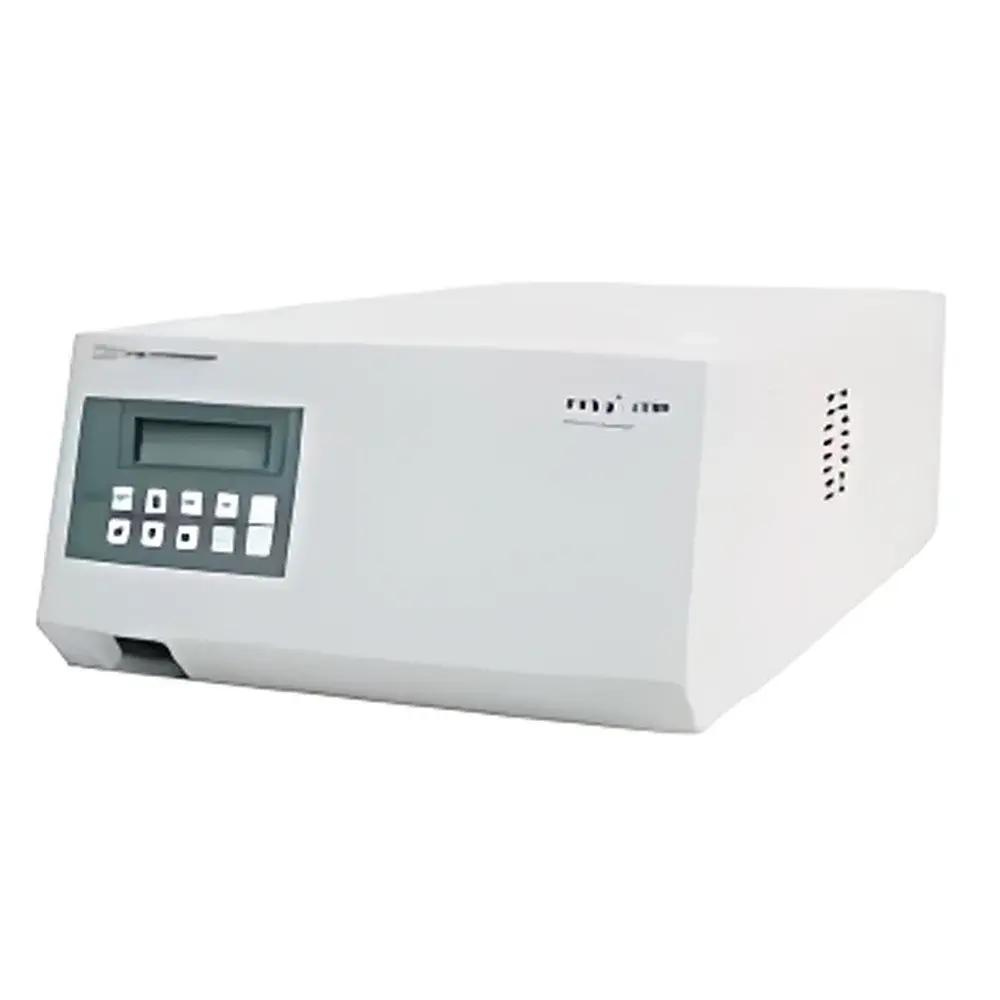
Unimicro Technologies TriSep™-2100 Capillary Electrophoresis High-Voltage Power Supply
| Brand | Unimicro Technologies |
|---|---|
| Origin | USA |
| Manufacturer Type | OEM Manufacturer |
| Product Category | Imported Instrument |
| Model | TriSep™-2100 |
| Instrument Type | High-Voltage Power Supply for Capillary Electrophoresis |
| Output Mode | Bipolar / Positive-only / Negative-only |
| Voltage Range | 0 to ±30 kV |
| Current Range | 0 to 100 µA |
| Max Output Power | 4 W |
| Weight | 12 kg |
| Display | Digital Voltage & Current Readout |
| Control | Front-panel Programmable Timing Ramp & Manual Setpoint |
| Protection | Integrated Overvoltage/Overcurrent Alarm and Shutdown |
Overview
The Unimicro Technologies TriSep™-2100 High-Voltage Power Supply is an engineered component designed exclusively for capillary electrophoresis (CE) and capillary electrochromatography (CEC) systems. It delivers precisely regulated high-voltage DC fields across fused-silica capillaries to drive electrophoretic migration and electroosmotic flow (EOF). In CE, separation relies on the differential mobility of charged analytes under a constant electric field; simultaneously, EOF—generated by the surface charge of the capillary wall interacting with buffer ions—provides bulk fluid transport that carries neutral and oppositely charged species through the detection window. Stable, low-ripple voltage output is essential to maintain consistent EOF velocity, minimize Joule heating-induced band broadening, and ensure reproducible migration times and resolution across repeated runs. The TriSep™-2100 employs digital closed-loop feedback control to sustain voltage accuracy within ±0.1% of setpoint over time, supporting rigorous analytical workflows in regulated environments.
Key Features
- Bipolar, positive-only, and negative-only output modes—configurable via front-panel toggle for flexibility in CE, CEC, and microchip electrophoresis applications
- Digital voltage and current readout with real-time monitoring at 0.1 kV and 1 µA resolution
- Programmable voltage ramping: user-defined time-based voltage profiles (e.g., linear or stepwise increases) to mitigate arcing during capillary conditioning or high-salt sample introduction
- Manual voltage setpoint override for rapid method optimization and troubleshooting
- Integrated hardware-level protection: automatic shutdown upon detection of overvoltage, overcurrent, or arc events—compliant with IEC 61010-1 safety requirements for laboratory electrical equipment
- Rugged aluminum chassis with forced-air cooling and EMI-shielded enclosure to minimize electromagnetic interference with adjacent detectors (e.g., UV-Vis, LIF, or MS interfaces)
Sample Compatibility & Compliance
The TriSep™-2100 supports standard 50–100 µm inner diameter fused-silica capillaries used in CE and CEC, including bare-fused silica, polyacrylamide-coated, and dynamically coated capillaries. Its low-noise output ensures compatibility with sensitive detection modalities such as laser-induced fluorescence (LIF) and mass spectrometry (MS)-coupled CE. The power supply meets applicable sections of ASTM D7849 (Standard Guide for Capillary Electrophoresis Method Development) and ISO/IEC 17025:2017 requirements for equipment calibration traceability. While not FDA 21 CFR Part 11–certified as a standalone device, its programmable parameters and alarm logs support audit-ready documentation when integrated into validated CE platforms operating under GLP or GMP frameworks.
Software & Data Management
The TriSep™-2100 operates as a stand-alone instrument with no external software dependency. All configuration—including mode selection, voltage setpoint, ramp duration, and hold time—is executed via its intuitive membrane keypad and LCD interface. Event-driven status logging (e.g., “Ramp Complete”, “Overcurrent Trip”, “Standby Mode”) is retained in non-volatile memory for post-run review. For laboratories requiring system-level integration, analog voltage/current monitor outputs (0–10 V scaling) enable synchronization with third-party data acquisition systems or chromatography data systems (CDS), facilitating timestamp-aligned recording of power parameters alongside electropherogram data.
Applications
- Capillary zone electrophoresis (CZE) of proteins, peptides, nucleic acids, and small-molecule pharmaceuticals
- Micellar electrokinetic chromatography (MEKC) for neutral compound separations
- Cationic and anionic capillary gel electrophoresis (CGE) for sizing DNA fragments and monoclonal antibody charge variants
- Capillary electrochromatography (CEC) using packed or monolithic stationary phases
- Method development and transfer in QC/QA labs supporting USP , EP 2.2.46, and ICH Q5A/Q5B guidelines
FAQ
What output modes does the TriSep™-2100 support, and how are they selected?
Bipolar (±30 kV), positive-only (+30 kV), and negative-only (–30 kV) modes are selected via a dedicated front-panel switch—no firmware update or external software required.
Is the TriSep™-2100 compatible with CE systems from other manufacturers?
Yes—it features industry-standard BNC high-voltage output connectors and complies with CE instrument interface voltage specifications per IEC 61000-4-2, enabling integration with Agilent, Beckman Coulter, and custom-built CE platforms.
How does the ramp programming function improve method robustness?
Gradual voltage ramping reduces transient current spikes during capillary equilibration, minimizing bubble formation and improving inter-run reproducibility—particularly critical for high-conductivity buffers or viscous polymer solutions.
Does the unit include calibration documentation?
Each TriSep™-2100 ships with a NIST-traceable factory calibration certificate covering full-scale voltage and current output verification at three points across the operating range.
Can the alarm logs be exported for audit purposes?
Logs are viewable on-screen and persist through power cycles; export requires manual transcription or integration via analog monitoring outputs into a compliant LIMS or CDS environment.





