
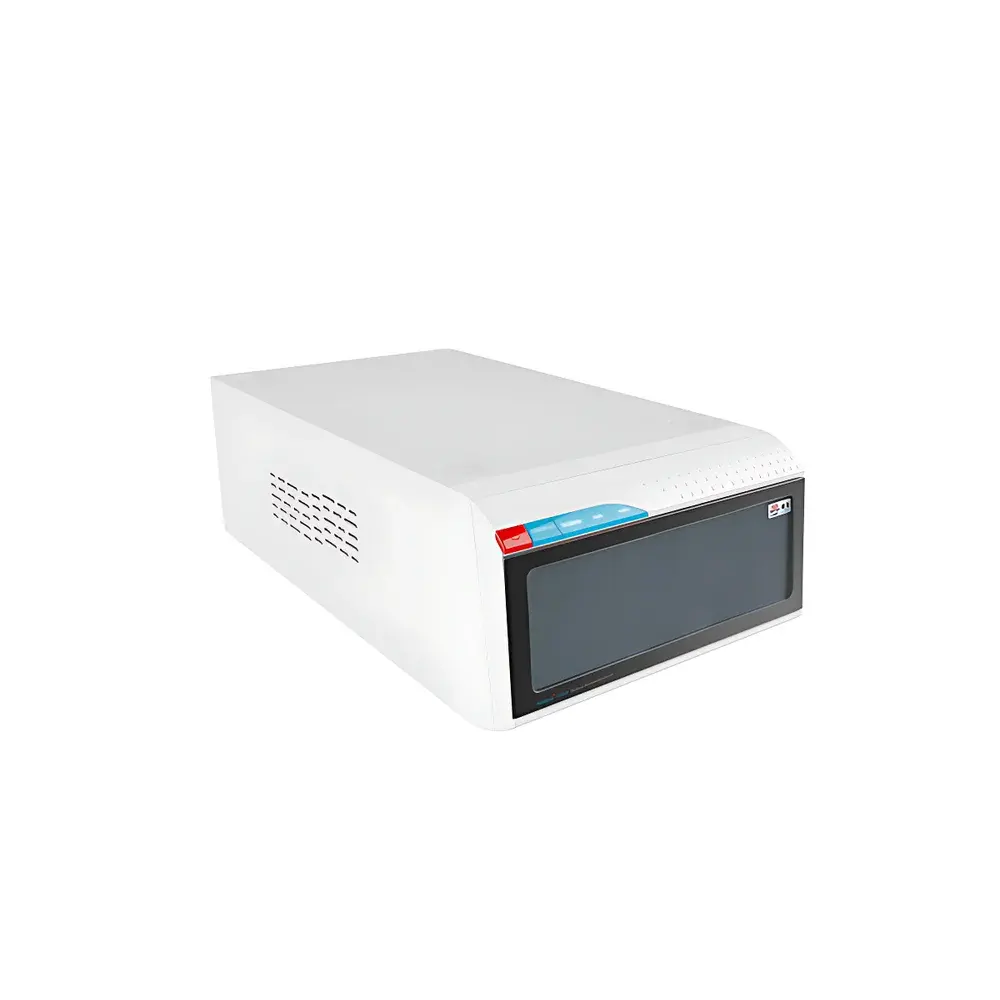
Unimicro Technologies TriSep®-3000LIF Laser-Induced Fluorescence Detector
| Brand | Unimicro Technologies |
|---|---|
| Origin | USA |
| Manufacturer Type | Original Equipment Manufacturer (OEM) |
| Product Category | Imported Instrument |
| Model | TriSep®-3000LIF |
| Detection Principle | Laser-Induced Fluorescence (LIF) |
| Excitation Wavelengths | 375 nm, 488 nm, 532 nm, 638 nm (custom wavelengths available) |
| Detection Mode | Dual-Beam |
| Light Source | Semiconductor Laser Diode |
| Compatible Systems | Capillary Electrophoresis (CE), Capillary Electrochromatography (CEC), Microbore HPLC, Capillary LC, Microfluidic Chips, Conventional HPLC |
Overview
The Unimicro Technologies TriSep®-3000LIF is a high-performance laser-induced fluorescence (LIF) detector engineered for ultra-trace quantification and high-resolution detection in separation science. Based on the fundamental photophysical principle of selective excitation and subsequent emission measurement, the TriSep®-3000LIF employs monochromatic semiconductor laser sources to induce fluorescence in analytes possessing native or derivatized fluorophores. Its dual-beam optical architecture actively compensates for source intensity fluctuations and thermal drift, enabling exceptional baseline stability and signal-to-noise ratio (S/N > 1,000:1 at 1×10⁻¹¹ M). Designed specifically for integration with capillary-scale separation platforms—including capillary electrophoresis (CE), capillary electrochromatography (CEC), and microfluidic chip-based systems—the detector delivers sub-picomolar detection limits without compromising reproducibility or long-term operational robustness.
Key Features
- Four standard excitation wavelengths (375 nm, 488 nm, 532 nm, 638 nm) with optional custom laser modules to match diverse fluorophore absorption profiles
- Dual-beam optical path with real-time reference channel correction, minimizing baseline drift and enhancing quantitative accuracy
- High-gain, low-noise photomultiplier tube (PMT) detector capable of single-photon counting mode and offering >6-decade linear dynamic range (10⁶)
- Modular flow cell design featuring precision-machined quartz cuvettes and kinematic alignment fixtures for sub-micron repeatability in optical window positioning
- Integrated laser safety interlock system compliant with IEC 60825-1 Class 3R requirements, including shutter control, beam containment, and status monitoring
- Rapid thermal stabilization (<5 min warm-up to operational stability) and passive thermal management for consistent performance across ambient temperature variations
Sample Compatibility & Compliance
The TriSep®-3000LIF supports direct coupling to a broad spectrum of separation instruments: capillary electrophoresis systems (e.g., Beckman PA 800+, Agilent CE), microbore and capillary liquid chromatography platforms (e.g., Thermo Scientific UltiMate 3000 nano/micro systems), and lab-on-a-chip devices with integrated optical interfaces. It is routinely deployed in regulated environments where trace-level detection is mandated—such as forensic toxicology screening per ISO/IEC 17025, pharmaceutical impurity profiling under ICH Q2(R2), and oligonucleotide purity assessment aligned with USP . The detector’s firmware and data acquisition software support audit trail generation, electronic signatures, and secure user access control—fully compliant with FDA 21 CFR Part 11 and GLP/GMP documentation requirements.
Software & Data Management
The TriSep®-3000LIF is controlled via Unimicro’s proprietary ChromaView™ LIF Control Suite, a Windows-based application supporting real-time spectral preview, wavelength switching synchronization, and automated gain optimization. Raw fluorescence intensity data are acquired at up to 100 Hz sampling rate and exported in vendor-neutral formats (e.g., .csv, .mzML-compatible metadata tagging). Seamless integration with third-party chromatography data systems (CDS) such as Thermo Chromeleon, Waters Empower, and Agilent OpenLab is achieved through standardized ASCII protocol drivers and OPC UA connectivity. All acquisition parameters—including PMT voltage, laser power, dwell time, and background subtraction coefficients—are logged with timestamped metadata and retained for full traceability during regulatory audits.
Applications
The TriSep®-3000LIF is extensively applied in life science research and quality control laboratories for: quantitative analysis of unlabeled and derivatized amino acids and peptides; high-sensitivity detection of PCR amplicons and synthetic oligonucleotides in gene editing validation workflows; pharmacokinetic profiling of fluorescently tagged biologics and small-molecule drug candidates; neurochemical monitoring of catecholamines and indoleamines in cerebrospinal fluid; environmental detection of polycyclic aromatic hydrocarbons (PAHs) and mycotoxins in food matrices; and doping agent screening in sports medicine using CE-LIF hyphenated methods. Its compatibility with sub-50 µm internal diameter capillaries enables efficient coupling with nanoscale separation techniques requiring minimal sample consumption.
FAQ
What separation techniques is the TriSep®-3000LIF optimized for?
It is primarily designed for capillary electrophoresis (CE), capillary electrochromatography (CEC), and micro/nano-liquid chromatography, with mechanical and optical interfaces validated for commercial CE and HPLC platforms.
Can excitation wavelengths be changed during a single run?
Yes—wavelength switching is programmable within method sequences, enabling multi-fluorophore detection in a single injection when coupled with appropriate derivatization strategies.
Does the detector support compliance with 21 CFR Part 11?
Yes—ChromaView™ LIF Control Suite includes role-based user authentication, electronic signature capture, and immutable audit trails for all acquisition and processing events.
Is the flow cell compatible with non-aqueous solvents?
The standard fused-silica flow cell is chemically resistant to common HPLC solvents (acetonitrile, methanol, buffer solutions); extended solvent compatibility (e.g., THF, DMSO) requires optional chemically inert quartz variants.
What is the typical detection limit for fluorescein under standard CE-LIF conditions?
Under optimized CE-LIF configuration (50 µm ID capillary, 10 kV, 488 nm excitation), the instrument achieves a practical LOD of ≤5 × 10⁻¹² M (S/N = 3), consistent with published literature benchmarks for commercial LIF detectors.
Related Products




