
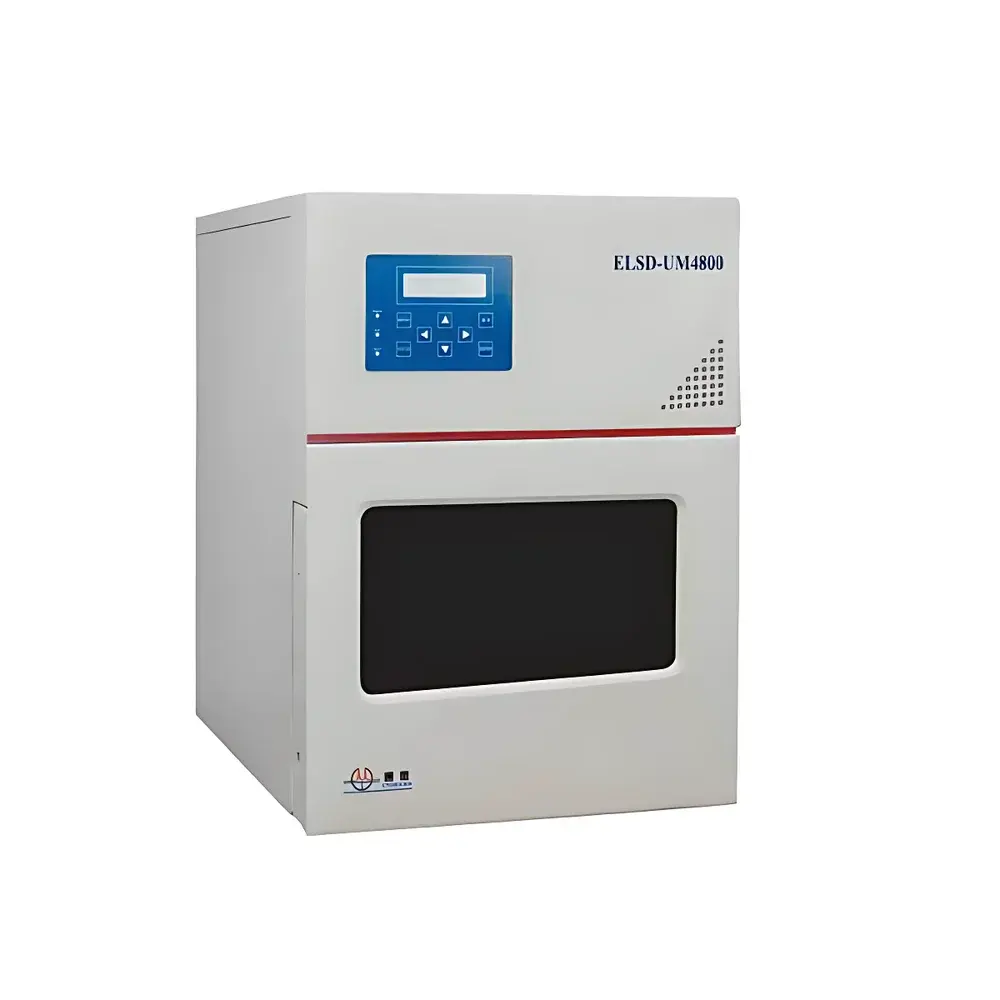
Unimicro Technologies UM4800 Evaporative Light Scattering Detector (ELSD)
| Brand | Unimicro Technologies |
|---|---|
| Origin | Shanghai, China |
| Manufacturer Type | Original Equipment Manufacturer (OEM) |
| Instrument Type | Evaporative Light Scattering Detector (ELSD) |
| Model | UM4800 |
| Evaporation Zone Temperature Range | Ambient to 130 °C |
| Nebulizing Gas | Nitrogen or Compressed Air |
| Gas Flow Rate | 1–4 L/min |
| Baseline Drift | <1.0 mV/h (under specified conditions: 1 mL/min flow, 10% methanol mobile phase, 40 °C evaporation temperature, 3 L/min gas flow) |
Overview
The Unimicro Technologies UM4800 Evaporative Light Scattering Detector (ELSD) is a compact, cost-optimized analytical detector engineered for integration with high-performance liquid chromatography (HPLC), ultra-high-performance liquid chromatography (UHPLC), and preparative chromatography systems. Operating on the principle of nebulization, solvent evaporation, and light scattering detection, the UM4800 enables universal, non-destructive quantification of non-volatile and semi-volatile analytes lacking strong chromophores—such as carbohydrates, lipids, glycosides, saponins, polymers, and natural product isolates. Unlike UV-Vis or fluorescence detectors, ELSD response is largely independent of molecular structure and functional group absorption, making it particularly valuable for herbal medicine analysis, quality control of traditional Chinese medicine (TCM) formulations, and excipient characterization in pharmaceutical development.
Key Features
- Low-temperature evaporation design with precise digital temperature control (ambient to 130 °C), minimizing thermal degradation of thermolabile compounds
- Flexible gas source compatibility—supports both nitrogen (recommended for reproducibility) and filtered compressed air (for cost-sensitive laboratories)
- Adjustable nebulizing gas flow (1–4 L/min) with integrated mass-flow sensor feedback for consistent droplet formation and signal stability
- Optimized optical path with high-sensitivity photodiode detector and low-noise analog signal processing circuitry
- Robust architecture compliant with ISO 9001 manufacturing standards; designed for continuous operation in regulated QC/QA environments
- Compact footprint (W × D × H: 280 × 450 × 220 mm) and low power consumption (<120 W), suitable for benchtop deployment in shared analytical labs
Sample Compatibility & Compliance
The UM4800 is compatible with reversed-phase, normal-phase, HILIC, and aqueous mobile phases containing volatile solvents (e.g., acetonitrile, methanol, ethanol, water, ammonium acetate/formate buffers). It is not recommended for use with non-volatile salts (e.g., phosphate buffers) or high-boiling-point solvents (e.g., DMSO, DMF) without prior method optimization and system flushing. The detector meets essential requirements for GLP-compliant laboratories, supporting audit-ready operation when paired with chromatography data systems (CDS) that provide electronic signatures, user access control, and 21 CFR Part 11–compliant audit trails. While the UM4800 itself does not carry CE or FDA 510(k) certification, its design adheres to IEC 61010-1 safety standards for laboratory electrical equipment and supports method validation per ICH Q2(R2) guidelines for detection of non-UV-absorbing compounds.
Software & Data Management
The UM4800 interfaces seamlessly via RS-232 or USB-to-serial protocols with industry-standard CDS platforms—including Empower, Chromeleon, OpenLAB CDS, and Unimicro’s proprietary EasySep Control Suite. Raw detector output is delivered as analog voltage (0–1 V) or digital TTL-compatible signal, enabling synchronization with pump and autosampler timing events. The included configuration utility allows users to define temperature setpoints, gas flow presets, gain calibration factors, and baseline correction algorithms. All operational parameters are logged with timestamps and stored alongside chromatographic runs, facilitating full traceability during regulatory submissions. Firmware updates are delivered via secure HTTPS download and validated checksum verification to ensure integrity and version control.
Applications
- Quantitative analysis of polysaccharides and oligosaccharides in botanical extracts and functional foods
- Stability-indicating assays for lipid-based drug delivery systems (e.g., liposomes, micelles, nanoemulsions)
- Method development for QC release testing of TCM injections, granules, and decoctions per Chinese Pharmacopoeia (ChP) monographs
- Characterization of synthetic and natural polymers (e.g., PEG, dextran, chitosan) using size-exclusion chromatography (SEC)
- Residual solvent and excipient profiling in generic drug product development
- Complementary detection in multi-detector HPLC setups—paired with UV, CAD, or MS for orthogonal compound identification and quantification
FAQ
What detection principle does the UM4800 employ?
The UM4800 operates on evaporative light scattering detection: the column effluent is nebulized into fine droplets, solvent is evaporated in a heated drift tube, and remaining non-volatile analyte particles scatter incident light from a focused LED source; scattered intensity is proportional to analyte mass.
Is the UM4800 compatible with gradient elution methods?
Yes—the detector maintains stable baseline performance across common solvent gradients (e.g., water/acetonitrile, water/methanol) when operated with appropriate evaporation temperature and gas flow optimization.
Does the UM4800 require routine maintenance beyond standard cleaning?
Routine maintenance includes periodic cleaning of the nebulizer capillary and drift tube using methanol or isopropanol; no consumable parts (e.g., lamps, electrodes) require scheduled replacement.
Can the UM4800 be used in GMP-regulated environments?
When integrated into a validated chromatographic system with 21 CFR Part 11–enabled software and documented SOPs, the UM4800 supports GMP data integrity requirements for batch release testing.
What is the typical minimum detectable mass for common analytes?
Detection limits vary by compound volatility and nebulization efficiency; under optimized conditions, typical LODs range from 10–100 ng on-column for sucrose, cholesterol, and sodium taurocholate—subject to method-specific validation.





