
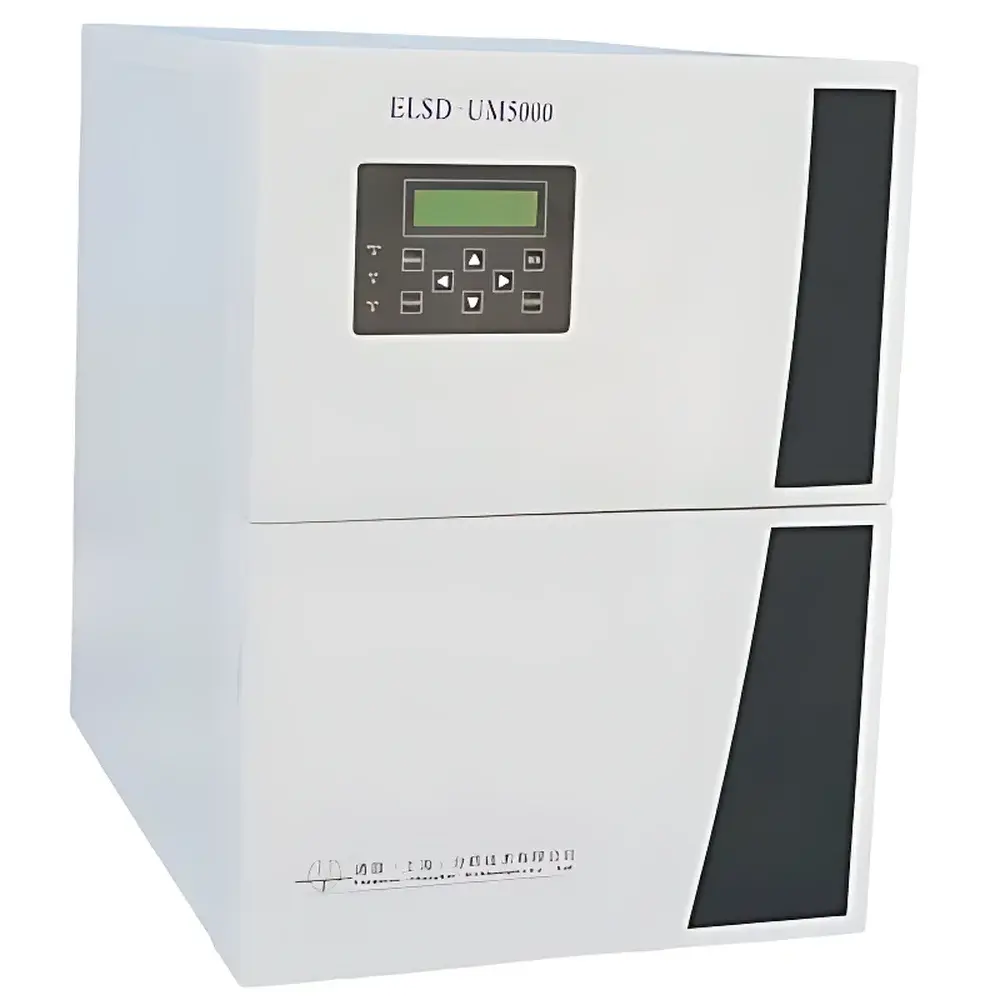
Unimicro Technologies UM5000 Evaporative Light-Scattering Detector (ELSD)
| Brand | Unimicro Technologies |
|---|---|
| Origin | Shanghai, China |
| Manufacturer Type | Original Equipment Manufacturer (OEM) |
| Product Category | Domestic |
| Model | UM5000 |
| Price Range | USD 7,000 – 14,000 (FOB Shanghai) |
| Compatible Instrument | High-Performance Liquid Chromatography (HPLC) Systems |
| Detector Type | Evaporative Light-Scattering Detector (ELSD) |
| Light Source | Laser Diode |
| Wavelength | 650 nm |
| Detection Principle | Light Scattering of Nebulized and Evaporated Analyte Particles |
| Operating Mode | Beam Transmission Method |
| Evaporation Temperature Range | Up to 130 °C (adjustable, low-temperature optimized) |
Overview
The Unimicro Technologies UM5000 Evaporative Light-Scattering Detector (ELSD) is a high-performance, universal HPLC detector engineered for the quantitative analysis of non-volatile and semi-volatile compounds lacking chromophores. Unlike UV-Vis or fluorescence detectors, the UM5000 operates on the principle of nebulization, solvent evaporation, and light scattering detection: the column effluent is atomized into fine droplets using a controlled stream of compressed air; volatile mobile phase components are removed in a heated evaporator chamber; non-volatile analytes precipitate as dry particles, which are then illuminated by a stable 650 nm laser diode; scattered light intensity—proportional to analyte mass—is measured via a photomultiplier tube (PMT). This physical detection mechanism ensures consistent response across compound classes independent of optical properties, making the UM5000 particularly suited for carbohydrates, lipids, phospholipids, amino acids, natural product glycosides, polymers, and underivatized pharmaceutical actives—especially in herbal medicine QC where UV-inactive constituents dominate.
Key Features
- Patented detection light-cone optical design enhancing signal-to-noise ratio and improving baseline stability
- Low-temperature nebulization and evaporation architecture (up to 130 °C, precisely regulated) preserving thermolabile analytes while enabling robust detection of semi-volatiles
- Coated auxiliary carrier gas system minimizing particle deposition in the detection cell and extending maintenance intervals
- Integrated closed-loop control of nebulizer gas flow, evaporator temperature, and PMT voltage—ensuring method reproducibility across instruments and laboratories
- Optimized electronic architecture with low-noise analog signal conditioning and high-resolution digital acquisition (16-bit ADC), delivering 10⁴ dynamic range
- Modular, tool-free雾化器 (nebulizer) assembly enabling rapid disassembly, cleaning, and reinstallation without calibration loss
- Compact, EMI-shielded mechanical layout reducing electromagnetic interference and improving long-term signal fidelity
Sample Compatibility & Compliance
The UM5000 supports gradient elution with a broad range of HPLC-compatible solvents—including water, acetonitrile, methanol, THF, and chloroform—and tolerates common volatile modifiers (e.g., 0.1% formic acid, 0.1% TFA, 10 mM ammonium acetate, 0.1% triethylamine, 0.1% ammonia). It complies with general requirements for analytical instrumentation per ISO/IEC 17025:2017 for testing laboratories and supports GLP/GMP workflows through audit-trail-capable software logging (see Software section). While not certified to FDA 21 CFR Part 11 out-of-the-box, its data acquisition and processing modules are structured to support validation protocols required for regulated environments, including traceable parameter history, user-access controls, and electronic signature readiness.
Software & Data Management
The UM5000 is operated via Unimicro’s ELSD Control Station v3.x—a Windows-based application supporting real-time monitoring, method setup, and post-run integration. Key capabilities include: temperature ramping profiles with hold steps; gas flow setpoint scheduling synchronized with gradient programs; automatic baseline correction algorithms; peak area/height quantitation with internal standard support; export of raw .dat files (ASCII) and processed results in CSV, PDF, and AIA (.cdf) formats compliant with Chromatography Data Systems (CDS) such as Empower, Chromeleon, and OpenLab. All instrument parameters (evaporator temp, gas pressure, PMT gain, integration time) are logged with timestamps and user IDs, fulfilling ALCOA+ data integrity principles.
Applications
The UM5000 has been validated in multiple pharmacopeial and industrial applications: quantification of 20 proteinogenic amino acids (e.g., glycine, lysine, tryptophan) without derivatization; assay of kanamycin and other aminoglycoside antibiotics in bulk drug substance; profiling of saponins and flavonoid glycosides in traditional Chinese medicinal extracts (e.g., Ginseng, Astragalus); determination of phospholipid composition in lipidomics workflows; and residual polymer analysis in biopharmaceutical excipient characterization. Its compatibility with reversed-phase, HILIC, and normal-phase separations enables method transfer flexibility across R&D, QC, and stability-indicating studies.
FAQ
What types of compounds can the UM5000 detect?
Compounds with lower volatility than the mobile phase—such as sugars, lipids, surfactants, polymers, and non-UV-absorbing pharmaceuticals—provided they form stable particles upon solvent removal.
Is the UM5000 compatible with UHPLC systems?
Yes, when coupled via low-dead-volume connections and operated with appropriate nebulizer gas flow optimization; maximum recommended flow rate is 2.0 mL/min for standard bore columns.
Does the UM5000 require daily calibration?
No—response is inherently semi-quantitative and mass-dependent; calibration curves using reference standards are recommended per application but no hardware calibration is needed between runs.
Can it be used with non-volatile buffers like phosphate or sulfate salts?
No—non-volatile additives cause severe baseline drift and detector fouling; only volatile buffers (e.g., ammonium formate, ammonium acetate, formic acid) are permitted.
How is data integrity ensured during regulatory audits?
Through full parameter logging, electronic user authentication, and exportable audit trails—enabling alignment with FDA, EMA, and NMPA expectations for chromatographic detector validation.



