
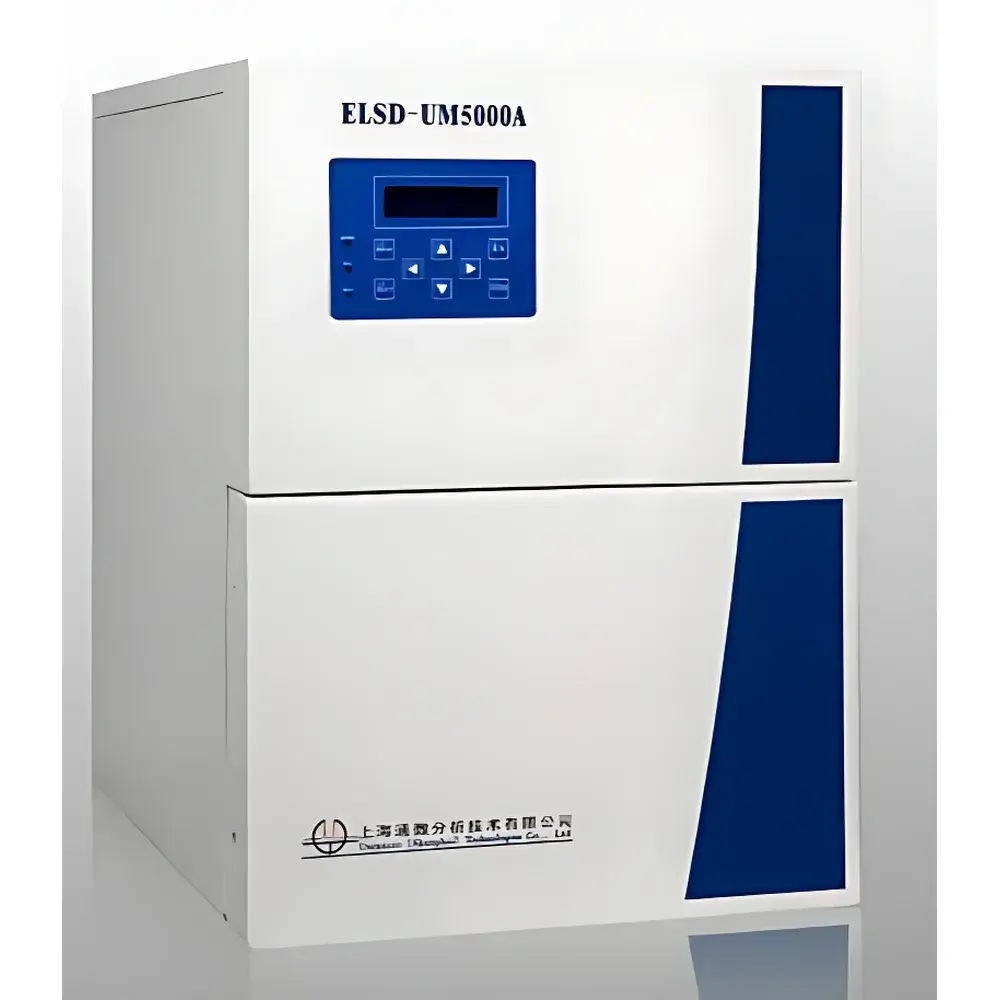
Unimicro Technologies UM5000A Evaporative Light-Scattering Detector (ELSD)
| Brand | Unimicro Technologies |
|---|---|
| Origin | Shanghai, China |
| Manufacturer | Yes |
| Instrument Type | Evaporative Light-Scattering Detector (ELSD) |
| Model | UM5000A |
| Detection Principle | Nebulization–evaporation–light scattering |
| Light Source | 650 nm semiconductor laser diode |
| Detector | Photomultiplier tube (PMT) |
| Evaporation Zone Temperature Range | Ambient to 130 °C (±1 °C control accuracy) |
| Nebulizing Gas | Nitrogen or compressed air (2–5 bar, ±0.01 bar pressure accuracy |
| Solvent Flow Rate Compatibility | 10 µL/min – 3 mL/min |
| Detection Limit | <1 ng (glucose, direct injection) |
| Baseline Noise | <0.05 mV (at 1 mL/min) |
| Baseline Drift | <0.5 mV (at 1 mL/min) |
| Quantitative Range | 0.1–30 µg (glucose, HPLC) |
| Quantitative Repeatability | RSD₆ < 2% (glucose, 1 mL/min) |
| Signal Output | 0–10 mV DC or 0–1 V DC |
| Interface | RS232 |
| Compliance | Designed for GLP/GMP environments with audit-trail-capable software logging |
Overview
The Unimicro Technologies UM5000A Evaporative Light-Scattering Detector (ELSD) is a high-performance, fully integrated universal detector engineered for compatibility with high-performance liquid chromatography (HPLC), ultra-high-performance liquid chromatography (UHPLC), and preparative LC systems. Unlike UV-Vis or fluorescence detectors, the UM5000A operates on the principle of nebulization, solvent evaporation, and light scattering—enabling quantitative detection of non-chromophoric, semi-volatile, and thermally labile analytes without derivatization. This makes it particularly valuable in natural product analysis, pharmaceutical quality control, polymer characterization, and traditional Chinese medicine (TCM) research where UV-inactive compounds—including carbohydrates, phospholipids, glycosides, free fatty acids, amino acids, and unmodified peptides—must be resolved and quantified with high reproducibility.
Key Features
- Patented optical detection architecture integrating a 650 nm semiconductor laser diode with a high-gain photomultiplier tube (PMT), delivering superior signal-to-noise ratio and extended dynamic range
- Low-temperature nebulization and precisely controlled evaporation zone (ambient to 130 °C, ±1 °C stability) optimized for thermal sensitivity preservation of labile biomolecules
- Closed-loop gas flow control system with real-time pressure monitoring (0.01 bar resolution) and mass-flow accuracy (±0.02 L/min), minimizing baseline drift across gradient elution
- Optimized aerosol optics featuring a proprietary light-cone detection geometry that enhances scattering efficiency and reduces particulate deposition on optical surfaces
- Modular, tool-free nebulizer assembly enabling rapid disassembly, cleaning, and reinstallation—critical for routine maintenance in regulated laboratories
- Robust electromagnetic interference (EMI) shielding and low-noise circuit design achieving baseline noise <0.05 mV (1 mL/min, acetonitrile/water)
- Full RS232 interface supporting bidirectional communication with third-party chromatography data systems (CDS) and native EasySep-1020 integration
Sample Compatibility & Compliance
The UM5000A is compatible with a broad spectrum of mobile phases—including aqueous buffers (e.g., ammonium acetate, formic acid, trifluoroacetic acid, triethylamine, ammonia) and organic modifiers (acetonitrile, methanol, isopropanol)—without generating solvent front artifacts or baseline discontinuities during gradient elution. Its universal response is proportional to analyte mass, not optical properties, enabling relative quantitation of unknown or structurally diverse compounds. The instrument meets essential design criteria for use in GLP-compliant laboratories and supports 21 CFR Part 11-ready software configurations when paired with validated acquisition platforms. It has been successfully deployed in method development per USP , EP 2.2.46, and Chinese Pharmacopoeia monographs requiring ELSD-based assay of polysaccharides, saponins, and alkaloid glycosides.
Software & Data Management
The bundled acquisition and control software provides comprehensive instrument parameter management—including real-time temperature profiling, gas pressure/flow calibration curves, PMT voltage optimization, and baseline subtraction algorithms. All operational parameters, method files, and raw signal traces are timestamped and stored with immutable metadata, satisfying audit-trail requirements under ISO/IEC 17025 and FDA guidance. Data export conforms to AIA (.cdf) and ASCII formats for seamless import into ChemStation, Empower, Chromeleon, or open-source analysis tools such as OpenChrom. Remote diagnostics and firmware updates are supported via secure serial protocol—no internet connectivity required during routine operation.
Applications
- Quantitative analysis of free amino acids in biological matrices without pre-column derivatization
- Stability-indicating assays of aminoglycoside antibiotics (e.g., kanamycin, gentamicin) in dosage forms
- Profiling of oligosaccharide distribution in hydrolyzed starch or fungal polysaccharide extracts
- Residual solvent and excipient quantification in lyophilized biopharmaceutical formulations
- Method transfer from research-grade to QC-laboratory HPLC systems with consistent ELSD response characteristics
- Supporting ICH Q5C stability studies for protein therapeutics where UV-absorbing impurities may co-elute
FAQ
Is the UM5000A compatible with UHPLC systems operating at >600 bar?
Yes—the nebulizer and evaporator modules are rated for continuous operation with flow rates down to 10 µL/min and backpressures typical of sub-2-µm particle columns.
Can the UM5000A be used with corrosive mobile phase additives such as TFA or HCl?
Yes—wetted components are constructed from chemically resistant stainless steel, PEEK, and fused silica; however, post-run flushing with water/methanol is recommended to prevent salt crystallization.
Does the UM5000A support multi-wavelength or dual-detector workflows?
No—it is a dedicated ELSD platform; however, its analog output (0–10 mV) can be synchronized with UV or MS detectors via external trigger signals for parallel data acquisition.
What is the typical maintenance interval for the PMT and laser diode?
Under normal usage (8 h/day, 5 days/week), the laser diode lifetime exceeds 10,000 hours; PMT gain stability is verified annually during IQ/OQ protocols.
Is method validation documentation available for regulatory submissions?
Yes—Unimicro provides instrument qualification templates (IQ/OQ/PQ), performance verification reports per ASTM E2656-19, and application notes aligned with ICH Q2(R2) guidelines.
Related Products





