
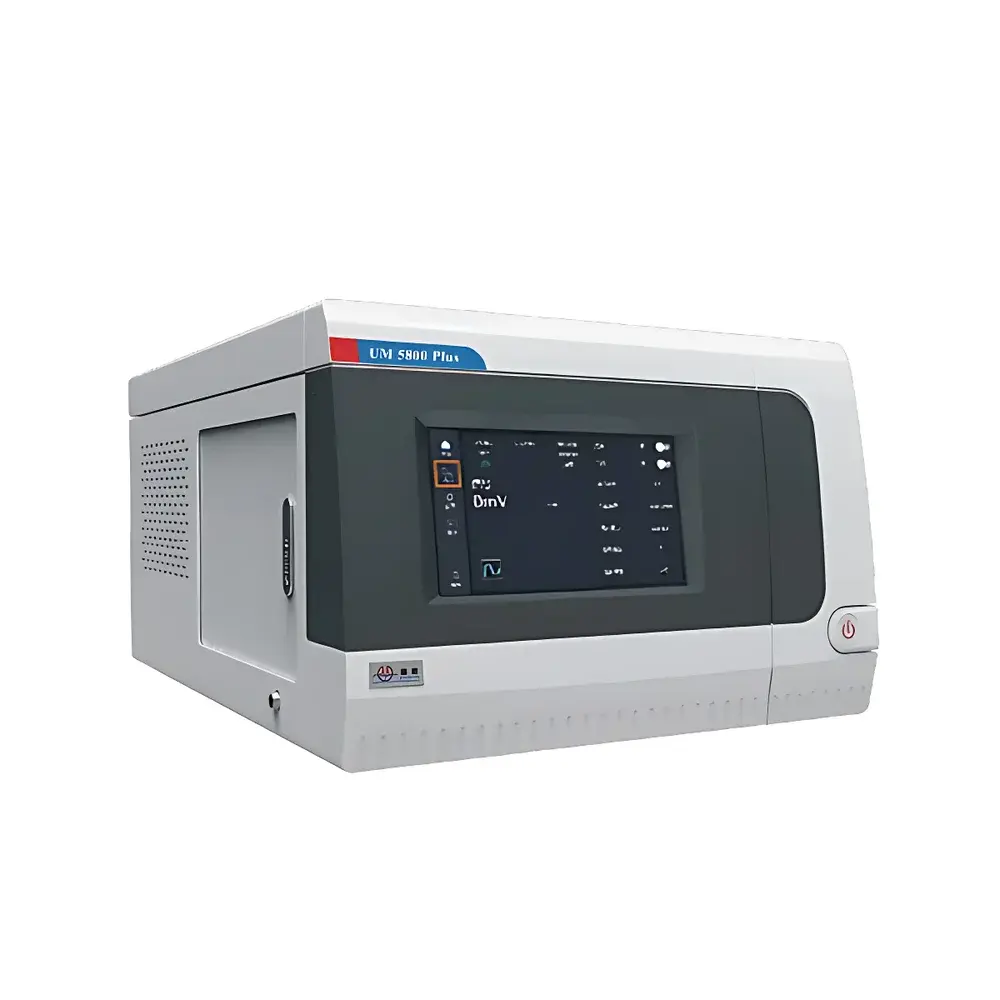
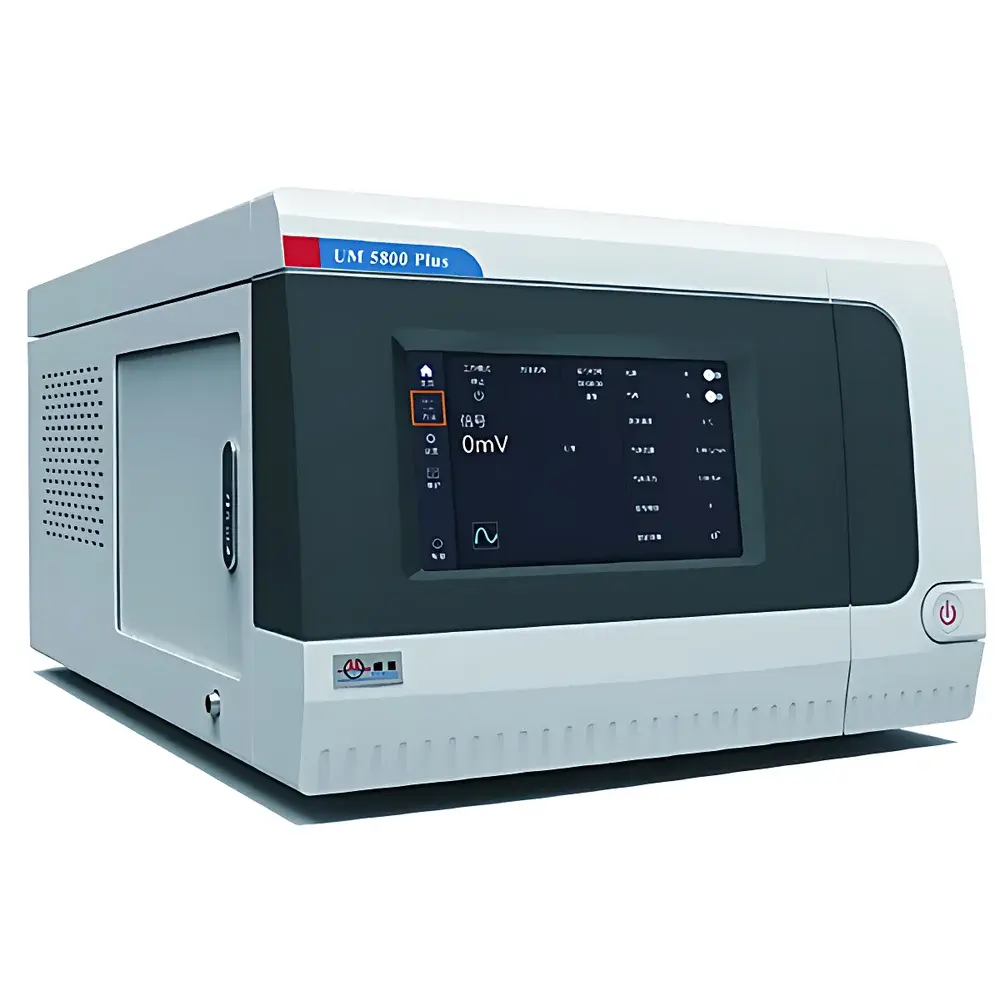
Unimicro Technologies UM5800Plus Evaporative Light Scattering Detector
| Brand | Unimicro Technologies |
|---|---|
| Origin | Shanghai, China |
| Manufacturer Type | Original Equipment Manufacturer (OEM) |
| Model | UM5800Plus |
| Instrument Type | Evaporative Light Scattering Detector (ELSD) |
| Light Source | Solid-State Laser |
| Detection Principle | Light Scattering of Nebulized and Dried Analyte Particles |
| Wavelength | Fixed-Wavelength Laser (Typical 650 nm) |
| Signal Output | Dual-Mode — Digital (USB/RS-232) and Analog (±2.4 V DC) |
| Gain Adjustment | 7-Step Programmable Gain Control |
| Method Storage Capacity | 100 Predefined Methods |
| Display | Integrated High-Resolution TFT Screen with Real-Time Chromatogram Rendering |
| Control Architecture | Fully Software-Reverse-Controlled (Temperature, Nebulizer Gas Flow, Gain, Detection Threshold) |
| Compliance | GLP-Ready with Audit Trail Logging, Password-Protected Access, Error Log Archiving |
Overview
The Unimicro Technologies UM5800Plus Evaporative Light Scattering Detector (ELSD) is a high-performance, universal detection solution engineered for liquid chromatography systems where analytes lack chromophores or UV absorbance. Unlike UV-Vis or fluorescence detectors, the UM5800Plus operates on the physical principle of nebulization, solvent evaporation, and light scattering: samples eluting from the column are mixed with a controlled stream of inert gas (typically nitrogen), atomized into fine droplets, and passed through a heated drift tube to remove volatile mobile phase components. Non-volatile analytes precipitate as dry microparticles; these particles are then illuminated by a stable solid-state laser (650 nm), and the intensity of scattered light—proportional to analyte mass—is captured by a photodiode detector. This mass-sensitive, gradient-compatible detection mechanism enables quantitative analysis of carbohydrates, lipids, surfactants, polymers, natural products, and pharmaceutical excipients—regardless of optical properties.
Key Features
- Universal detection capability for non-UV-absorbing compounds, including saccharides, glycosides, terpenoids, and synthetic polymers.
- Dual-signal output architecture: simultaneous analog (±2.4 V DC) and digital (USB 2.0 & RS-232) interfaces ensure seamless integration with legacy and modern HPLC, preparative LC, and flash chromatography systems from Agilent, Waters, Shimadzu, Thermo Fisher, and others.
- Seven-step programmable signal gain control allows precise optimization of detector response across wide dynamic concentration ranges—from trace-level impurity quantification to high-concentration fraction collection.
- On-device 4.3-inch TFT display with real-time chromatogram rendering supports rapid method verification, baseline assessment, and pre-run diagnostics without external software dependency.
- Comprehensive self-diagnostic startup sequence verifies nebulizer pressure, drift tube temperature stability, laser alignment, and detector baseline integrity prior to operation.
- Multi-level safety architecture includes real-time monitoring of gas flow rate, drift tube temperature, and chamber pressure, with audible/visual alarms and automatic shutdown upon deviation beyond preset thresholds.
- Energy-efficient operational modes—including standby, idle, and active acquisition—reduce power consumption by up to 40% during extended unattended runs.
Sample Compatibility & Compliance
The UM5800Plus is compatible with reversed-phase, normal-phase, HILIC, and aqueous mobile phases containing volatile solvents (e.g., acetonitrile, methanol, ethanol, THF, ethyl acetate) and volatile buffers (e.g., ammonium acetate, ammonium formate, TFA). It is not suitable for non-volatile salts (e.g., phosphate buffers) or highly viscous solvents. The instrument meets core requirements for Good Laboratory Practice (GLP) environments: password-protected parameter modification, time-stamped audit trail logging for all configuration changes, error event archiving with severity classification, and user-access level management. While not FDA 21 CFR Part 11–certified out-of-the-box, its software architecture supports electronic signature implementation and data integrity controls when deployed with validated third-party LIMS or CDS platforms compliant with ISO/IEC 17025 and ICH-GCP guidelines.
Software & Data Management
The UM5800Plus operates under Unimicro’s proprietary ELSD Control Suite v3.2, a Windows-based application supporting full reverse control of all hardware parameters—including drift tube temperature (range: 30–100 °C, ±0.5 °C accuracy), nebulizer gas flow (0–3.0 L/min, adjustable in 0.1 L/min increments), and gain staging. Method files (.UMD) store complete acquisition protocols, including integration settings, baseline correction algorithms, and alarm thresholds. Up to 100 methods can be stored locally on the instrument’s internal flash memory and recalled directly via front-panel navigation. Raw signal data is exported in ASCII-compatible .CSV format with millisecond timestamp resolution, enabling post-acquisition processing in MATLAB, Python (NumPy/Pandas), or commercial chromatography data systems (CDS) such as Empower, Chromeleon, or OpenLab.
Applications
- Quantitative analysis of herbal extracts and traditional Chinese medicine formulations per Chinese Pharmacopoeia (ChP) monographs requiring ELSD detection.
- Stability-indicating assays for non-UV-active degradation products in biologics and peptide therapeutics.
- Method development support for preparative purification of oligosaccharides and glycolipids in natural product isolation workflows.
- Quality control of excipients (e.g., polysorbates, PEGs, cyclodextrins) in generic drug product development.
- Academic research in polymer chemistry, where molar mass distributions of non-fluorescent synthetic macromolecules are assessed via SEC-ELSD coupling.
FAQ
What types of mobile phases are compatible with the UM5800Plus?
Only volatile mobile phases are suitable—methanol, acetonitrile, ethanol, tetrahydrofuran, and ethyl acetate, combined with volatile buffers such as ammonium acetate or trifluoroacetic acid. Phosphate, sulfate, or borate buffers will cause rapid nozzle clogging and signal drift.
Does the UM5800Plus support gradient elution?
Yes—the detector maintains consistent response across gradient programs due to its solvent-tolerant nebulization and thermal desolvation design, provided the gradient remains within volatility constraints.
Is the instrument compatible with UHPLC systems?
It is fully compatible with standard HPLC and preparative LC flow rates (0.2–5.0 mL/min); for UHPLC applications, a low-dead-volume splitter or micro-flow nebulizer option is recommended to preserve peak fidelity.
How is calibration performed?
The UM5800Plus does not require absolute calibration; relative response is established using reference standards of known mass (e.g., sucrose, sodium taurocholate) under identical operational conditions. Response factors are compound-specific and must be determined empirically.
Can raw ELSD data be imported into third-party CDS platforms?
Yes—ASCII-formatted .CSV output files contain time, voltage, and gain metadata, and are natively ingestible by Empower, Chromeleon, and OpenLab after minor formatting alignment.




