
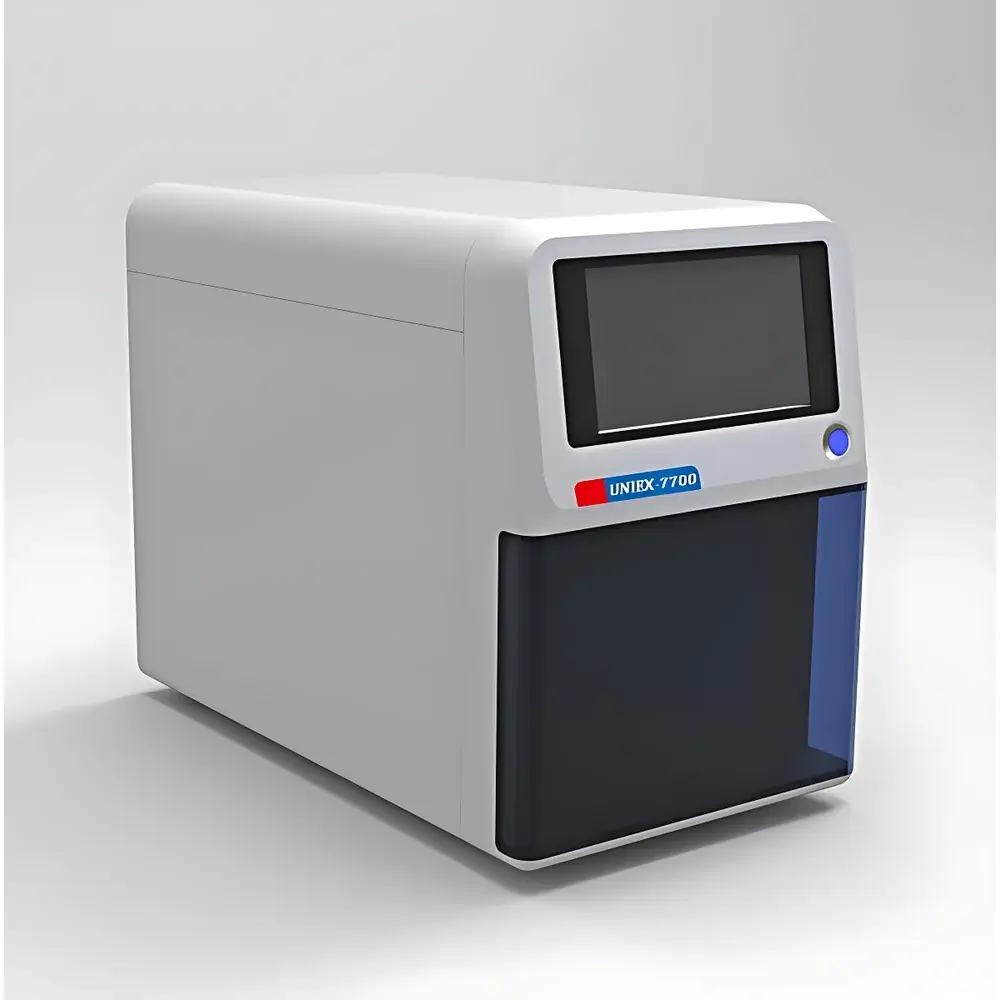
Unimicro Technologies UNIEX-7700 Evaporative Light Scattering Detector
| Brand | Unimicro Technologies |
|---|---|
| Origin | USA |
| Manufacturer Type | Original Equipment Manufacturer (OEM) |
| Product Category | Imported Instrument |
| Model | UNIEX-7700 |
| Compatible Instrument | Liquid Chromatography (LC) Systems |
| Detector Type | Evaporative Light Scattering Detector (ELSD) |
| Wavelength | 650 nm |
| Detection Mode | Dual-Beam |
| Light Source | Semiconductor Laser Diode |
Overview
The Unimicro Technologies UNIEX-7700 Evaporative Light Scattering Detector (ELSD) is a high-performance, universal detection system engineered for integration with liquid chromatography platforms. Operating on the fundamental principle of nebulization, solvent evaporation, and light scattering measurement, the UNIEX-7700 detects analytes based on their physical particulate mass rather than optical absorbance or fluorescence. This enables quantitative analysis of non-chromophoric compounds—including carbohydrates, lipids, fatty acids, amino acids, natural product glycosides, synthetic polymers, and thermally labile pharmaceuticals—that lack UV-Vis chromophores or exhibit weak native fluorescence. Unlike refractive index (RI) detectors, the UNIEX-7700 delivers superior sensitivity, minimal baseline drift under gradient elution conditions, and insensitivity to mobile phase composition changes or ambient temperature fluctuations—making it especially suitable for method development in natural product analysis, QC of herbal medicines, and polymer characterization.
Key Features
- High-sensitivity dual-beam optical architecture utilizing a 650 nm semiconductor laser and low-noise photomultiplier tube (PMT), optimized for signal-to-noise ratio across wide dynamic ranges.
- Low-temperature nebulization and controlled evaporation chamber design preserves structural integrity of semi-volatile and thermally sensitive analytes without decomposition.
- Three-level programmable gain selection allows precise adaptation to diverse sample concentrations—from trace-level natural product markers to high-abundance excipients—without hardware reconfiguration.
- Patented heated雾化 chamber (nebulizer chamber) prevents condensation on internal surfaces, ensuring consistent aerosol generation and long-term operational stability.
- Robust mechanical construction with precision-machined stainless-steel flow paths and sealed optical housing supports continuous operation in regulated laboratory environments.
- Integrated real-time monitoring of critical parameters including nebulizer gas pressure, drift tube temperature, and solvent flow rate, with configurable alarm thresholds and automatic shutdown safeguards.
Sample Compatibility & Compliance
The UNIEX-7700 accommodates a broad spectrum of LC-compatible solvents (e.g., water, methanol, acetonitrile, THF, chloroform) and supports both isocratic and multi-step gradient elution programs. It is routinely deployed in applications requiring compliance with pharmacopeial monographs (USP , EP 2.2.29), GLP/GMP-regulated workflows, and FDA 21 CFR Part 11–aligned data integrity requirements. Its embedded chromatographic data system includes role-based user authentication, electronic signatures, full audit trail logging, and immutable raw data archiving—ensuring traceability and regulatory readiness for submissions to health authorities.
Software & Data Management
Controlled via the dedicated UNIEX-7700 operating software, the detector supports full bidirectional communication with major LC systems (including Agilent, Waters, Shimadzu, and Thermo Fisher platforms). The software provides intuitive touchscreen navigation on its integrated color display, real-time chromatogram visualization, peak integration with customizable baseline algorithms, and export compatibility with CSV, ASCII, and CDF formats. All acquisition and processing parameters—including gain setting, temperature ramp profiles, and alarm configurations—are stored with time-stamped metadata. Raw signal files are cryptographically hashed and linked to instrument logs to satisfy ALCOA+ (Attributable, Legible, Contemporaneous, Original, Accurate, Complete, Consistent, Enduring, Available) data governance standards.
Applications
- Quantification of polysaccharides and oligosaccharides in botanical extracts and traditional Chinese medicine formulations.
- Analysis of phospholipids, triglycerides, and free fatty acids in lipidomics workflows.
- Stability-indicating assays for non-UV-absorbing drug substances and degradation products.
- Molecular weight distribution profiling of synthetic and natural polymers using size-exclusion chromatography (SEC).
- Residual solvent and excipient quantitation in pharmaceutical final product release testing.
- Method transfer between R&D and QC laboratories where UV-inactive analytes necessitate orthogonal detection strategies.
FAQ
What types of analytes are best suited for detection with the UNIEX-7700 ELSD?
Compounds with lower volatility than the mobile phase—such as sugars, glycosides, lipids, surfactants, and polymers—that do not require chromophores for detection.
Can the UNIEX-7700 be used with gradient elution methods?
Yes—the detector exhibits exceptional baseline stability during solvent gradient programs due to its dual-beam compensation and temperature-insensitive optical design.
Is the UNIEX-7700 compliant with 21 CFR Part 11 requirements?
Yes—its software implements electronic signature enforcement, audit trail generation, and secure user access controls aligned with FDA’s data integrity expectations.
What maintenance routines are recommended for optimal performance?
Routine cleaning of the nebulizer capillary and drift tube, quarterly calibration verification using standardized sucrose solutions, and annual PM by certified service engineers.
Does the UNIEX-7700 support remote operation and networked data storage?
Yes—via Ethernet connectivity, it integrates into LAN-based LIMS environments and supports centralized data backup through secure FTP/SFTP protocols.






