
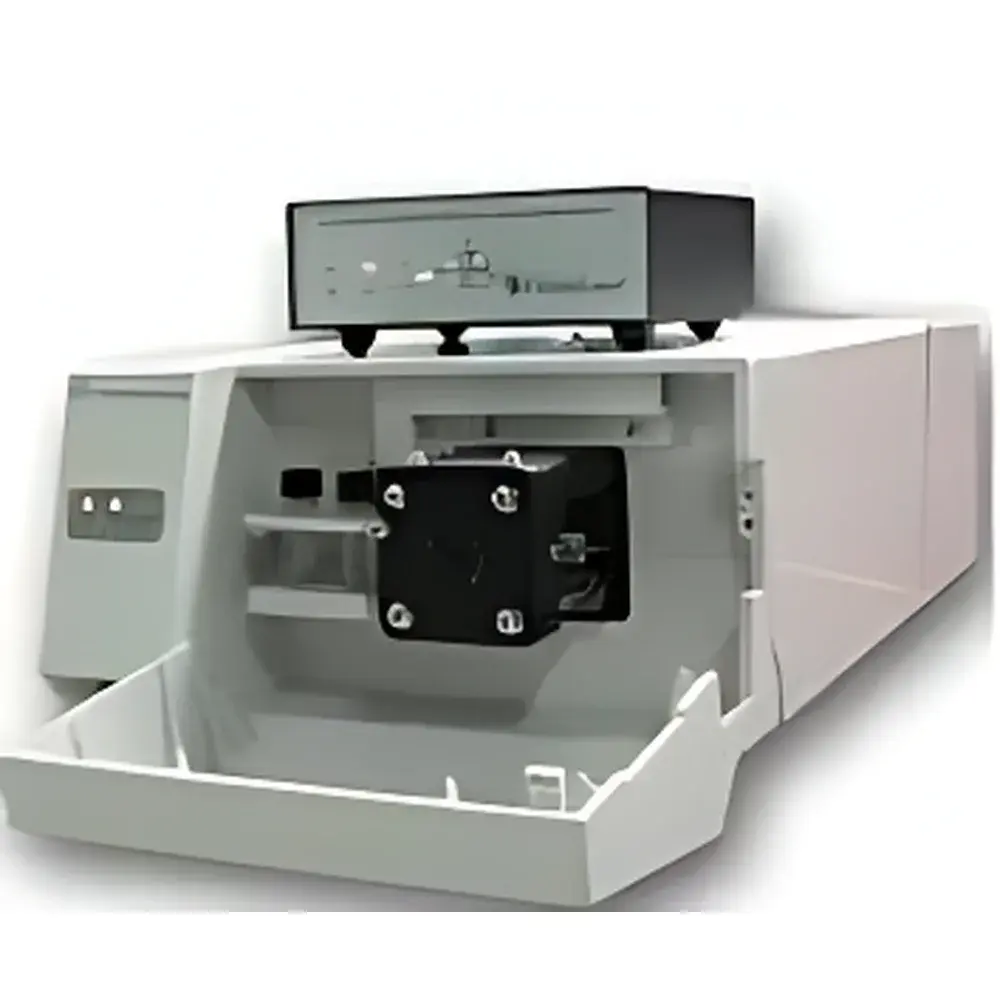
Unimicro TriSep-2100 Laser-Induced Fluorescence Detector
| Brand | Unimicro Technologies |
|---|---|
| Origin | Jiangsu, China |
| Manufacturer Type | OEM Manufacturer |
| Product Origin | Domestic (China) |
| Model | TriSep-2100 |
| Compatible Instrument | HPLC Systems |
| Detector Type | Laser-Induced Fluorescence (LIF) Detector |
| Excitation Wavelength | 488 nm |
| Optical Configuration | Dual-Beam Design |
| Light Source | Solid-State Semiconductor Laser |
| Detection Limit | 1 × 10⁻¹¹ mol/L |
| Photomultiplier Tube (PMT) | High-Sensitivity, Wide Dynamic Range, Single-Photon Counting Capable |
| Optical Path Design | Patented Modular Flow Cell with Precision Window Positioning Mechanism |
| Software | Integrated Data Acquisition and Quantitative Analysis Suite Supporting Baseline Correction, Peak Integration, Calibration Curve Fitting, and Audit-Trail Logging |
Overview
The Unimicro TriSep-2100 Laser-Induced Fluorescence (LIF) Detector is a high-sensitivity, laboratory-grade detection module engineered for integration with high-performance liquid chromatography (HPLC) systems. It operates on the principle of selective molecular excitation using monochromatic 488 nm light from a solid-state semiconductor laser, followed by collection and quantification of emitted fluorescence photons via a low-noise, wide-dynamic-range photomultiplier tube (PMT). This optical architecture—featuring a dual-beam reference path—actively compensates for source intensity drift and environmental fluctuations, resulting in exceptional baseline stability and signal reproducibility. Designed for trace-level analysis in complex biological and environmental matrices, the TriSep-2100 achieves a validated detection limit of 1 × 10⁻¹¹ mol/L under optimized chromatographic conditions, making it suitable for applications where conventional UV-Vis or electrochemical detectors lack sufficient sensitivity.
Key Features
- Stable 488 nm solid-state laser source with >10,000-hour operational lifetime and <0.5% RMS intensity fluctuation over 8 hours
- Dual-beam optical configuration with real-time reference subtraction to minimize baseline drift and thermal noise
- Patented modular flow cell design enabling rapid exchange without optical realignment; certified to IEC 60825-1:2014 Class 1 laser safety requirements
- Precision-machined detection window positioning mechanism ensuring sub-5 µm repeatability across repeated installations
- High-gain, low-dark-current PMT detector with single-photon counting capability and linear dynamic range spanning six orders of magnitude (10⁰–10⁶ photons per second)
- Integrated temperature-stabilized optical housing maintaining ±0.1 °C thermal control of critical components
Sample Compatibility & Compliance
The TriSep-2100 is compatible with standard 2.1 mm and 4.6 mm I.D. HPLC columns and supports both reversed-phase and hydrophilic interaction liquid chromatography (HILIC) separations. It detects native or derivatized analytes exhibiting fluorescence at emission wavelengths >510 nm—including amino acids (e.g., tryptophan, tyrosine), nucleotides, catecholamines, porphyrins, and labeled oligonucleotides. The system complies with key regulatory frameworks for analytical instrumentation: data integrity features meet FDA 21 CFR Part 11 requirements for electronic records and signatures; audit-trail functionality logs all user actions, parameter changes, and calibration events; and hardware design adheres to ISO/IEC 17025:2017 guidelines for testing and calibration laboratories. All optical components are RoHS-compliant and CE-marked for EMC and LVD directives.
Software & Data Management
The TriSep-2100 is operated via Unimicro ChromaView™ v3.2 software—a Windows-based platform supporting instrument control, real-time spectral monitoring, and post-run quantitative analysis. Key capabilities include automated peak detection with adaptive thresholding, multi-point calibration curve generation (linear, quadratic, and weighted least-squares), batch processing with customizable report templates (PDF/CSV/XLSX export), and secure user-role management (administrator, analyst, reviewer). Raw data files are stored in vendor-neutral .CDF format compliant with ASTM E1947-20 standards for chromatographic data exchange. Full audit-trail records—including timestamps, operator ID, method version, and raw detector output—are encrypted and tamper-evident, supporting GLP and GMP compliance workflows.
Applications
- Quantitative analysis of underivatized amino acids in clinical serum samples (ASTM D6580-22)
- Single-base resolution detection of fluorescently labeled DNA fragments in capillary electrophoresis–HPLC hybrid platforms
- Pharmacokinetic studies of fluorescent-tagged therapeutic proteins and antibody–drug conjugates
- Trace-level detection of neuroactive compounds (e.g., serotonin, dopamine metabolites) in cerebrospinal fluid
- Screening of illicit stimulants and their metabolites in forensic toxicology workflows per ISO 17025-accredited protocols
- Environmental monitoring of polycyclic aromatic hydrocarbons (PAHs) in water extracts following EPA Method 8310
FAQ
What is the typical response time and dwell time setting for kinetic fluorescence measurements?
The detector supports programmable dwell times from 10 ms to 5 s per data point, with default acquisition rate set to 20 Hz for standard HPLC applications.
Is the flow cell compatible with high-pressure UHPLC systems?
Yes—the quartz flow cell is rated to 600 bar and features zero-dead-volume fittings compatible with 0.12 mm ID capillaries and 2.1 mm I.D. columns.
Does the system support external triggering from third-party HPLC controllers?
Yes—TTL-compatible start/stop triggers and analog voltage output (0–10 V) for synchronous data acquisition are provided via DB9 I/O port.
Can the software generate 21 CFR Part 11-compliant electronic signatures?
Yes—ChromaView™ implements role-based digital signature workflows with biometric or PKI certificate options, fully traceable through the audit trail.
What maintenance intervals are recommended for optimal PMT performance?
Annual verification of PMT gain stability and dark current is recommended; laser output power calibration is advised every 6 months using the built-in reference photodiode.





