
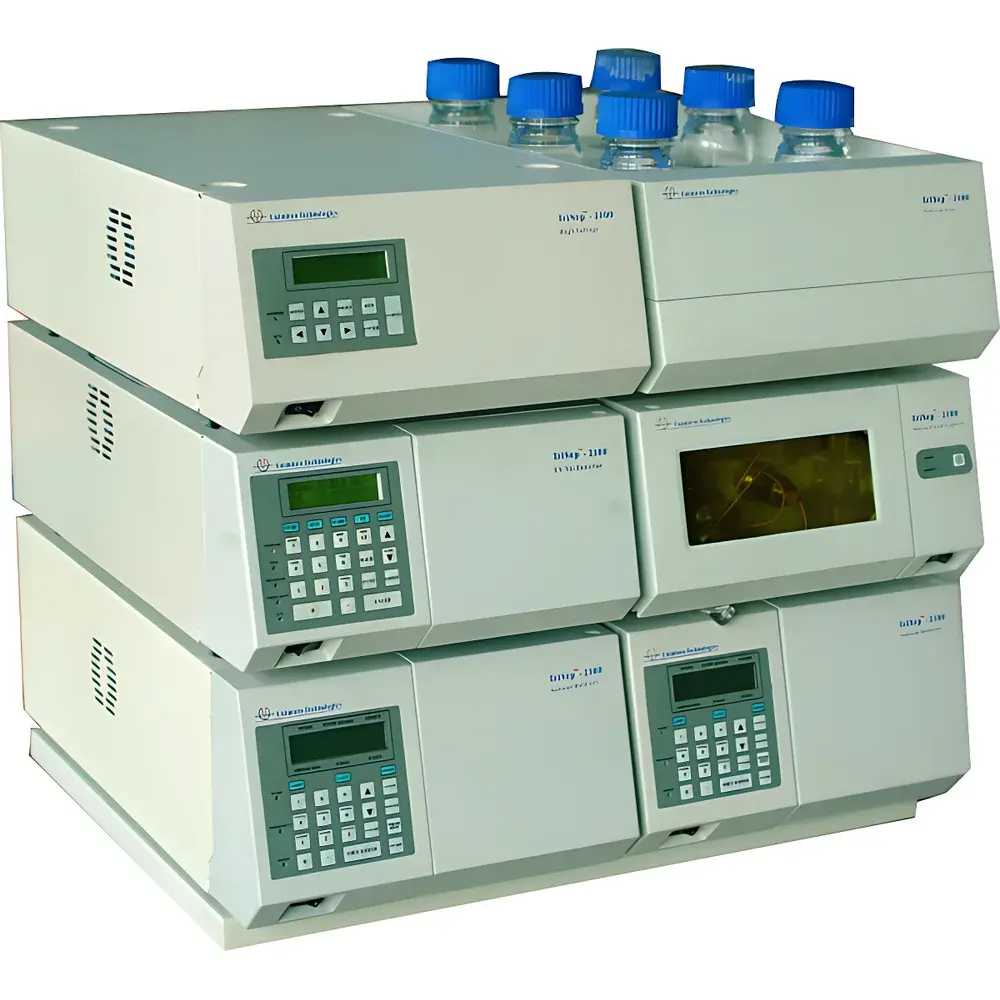
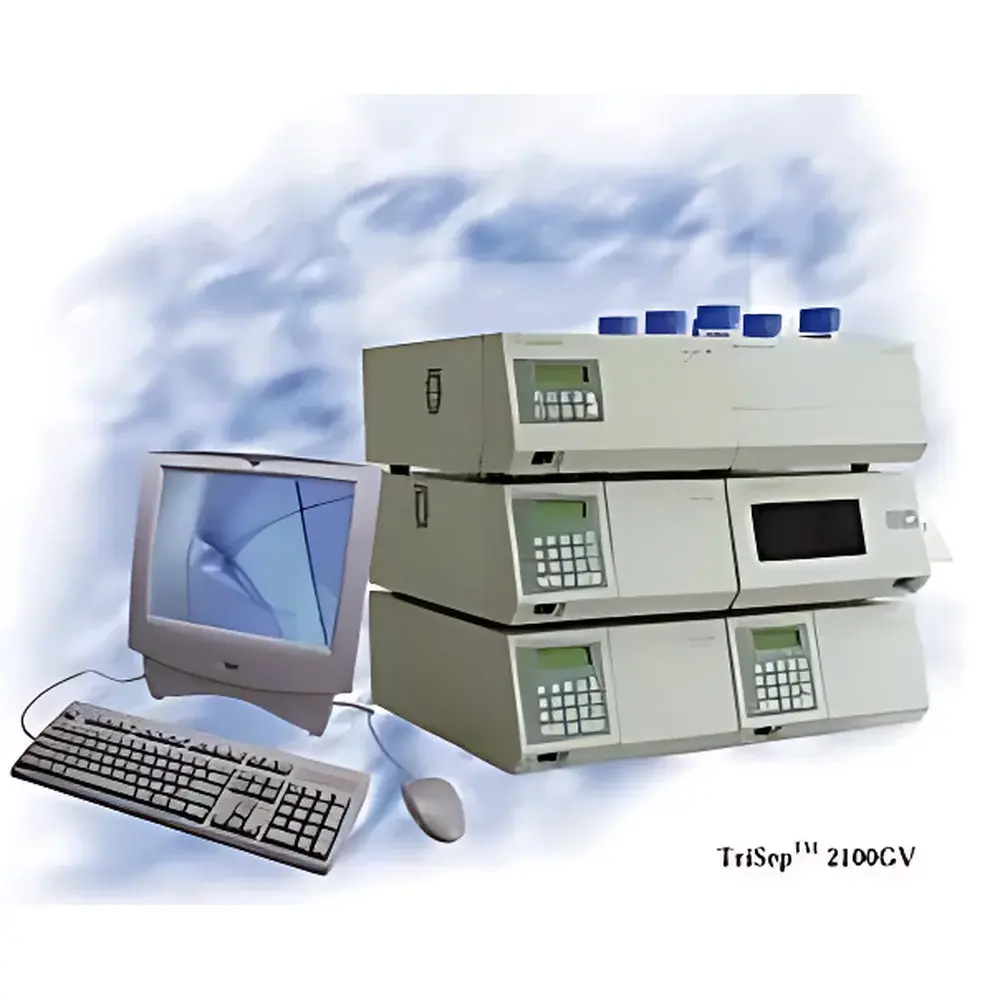
Unimicro TriSep-2100 Pressurized Capillary Electrochromatography System
| Brand | Unimicro Technologies |
|---|---|
| Origin | USA |
| Manufacturer Type | Original Equipment Manufacturer (OEM) |
| Category | Imported Instrument |
| Model | 2100 |
| Instrument Type | Conventional High-Performance Liquid Chromatograph (HPLC)-compatible pCEC System |
| Flow Rate Range | 0.001–9.999 mL/min |
| Maximum Operating Pressure | 42 MPa |
| Autosampler Capacity | 120 positions |
| Injection Volume Range | 0.1–250 µL |
| Column Oven Temperature Range | Ambient to 60 °C |
| UV-Vis Detection Wavelength Range | 190–600 nm |
| Data Acquisition Frequency | 100 Hz |
Overview
The Unimicro TriSep-2100 Pressurized Capillary Electrochromatography (pCEC) System represents a paradigm shift in microscale separation science, integrating the electrophoretic mobility control of capillary electrophoresis (CE) with the selective partitioning mechanism of high-performance liquid chromatography (HPLC). Unlike conventional HPLC—where mobile phase transport relies solely on hydraulic pressure—the TriSep-2100 applies a programmable high-voltage electric field across a packed capillary column, inducing electroosmotic flow (EOF) that synergizes with pressure-driven flow. This dual-force propulsion enables stable, low-backpressure operation even with sub-2-µm particle-packed columns (e.g., 1.5 µm ElectroPak™ C18), delivering >250,000 theoretical plates per meter and significantly enhanced peak capacity—up to threefold greater than standard HPLC. The system operates at nanoliter-scale sample consumption (as low as 0.1 µL), making it uniquely suited for limited-biomass applications including single-cell analysis, microdialysate profiling, and in vivo sampling where volume conservation is critical.
Key Features
- Integrated binary nanoflow solvent delivery system capable of stable gradient elution from 1 nL/min to 10 mL/min, with <1% RSD injection precision and <2% RSD accuracy via VICI–Unimicro co-developed rotary nano-injection valve
- Patented microfluidic module featuring split-flow regulation, back-pressure control, low-dead-volume (<50 nL) binary solvent mixing valve, and PEEK-compatible 100-µm ID capillary interfacing
- Programmable high-voltage power supply (±30 kV, 0.1% stability, short-circuit protected) with real-time current monitoring and electromagnetic shielding compliant with IEC 61326-1
- Column oven with PID-controlled temperature regulation (ambient to 60 °C, ±0.2 °C stability) supporting thermal optimization of selectivity and efficiency
- Dual-detection readiness: Standard UV-Vis detector (190–600 nm, D₂ lamp, 2000-h lifetime) and optional LIF detector (LOD: 10⁻¹³ mol/L; single-molecule sensitivity demonstrated)
- ElectroPak™ capillary columns (50–320 µm ID, customizable length) manufactured via proprietary electro-filling technology; available in C18, C8, silica, CN, NH₂, ion-exchange, chiral, and affinity chemistries
Sample Compatibility & Compliance
The TriSep-2100 supports broad analyte classes—including peptides, oligonucleotides, glycoproteins, natural product alkaloids, and environmental micropollutants—without requiring derivatization. Its low-flow, low-sample-consumption architecture meets stringent requirements for GLP-compliant bioanalysis and regulated QC workflows. The system’s data acquisition software includes full audit trail functionality aligned with FDA 21 CFR Part 11, enabling electronic signatures, user access controls, and immutable record retention. All hardware modules conform to CE marking directives (2014/30/EU EMC, 2014/35/EU LVD) and UL 61010-1 safety standards. Column performance validation adheres to ASTM E2784 (chromatographic column efficiency testing) and ISO 17025 traceability protocols when used with certified reference materials.
Software & Data Management
Unimicro Workstation 2003 provides integrated instrument control, method development, real-time chromatogram visualization, and quantitative reporting. The software supports multi-dimensional method programming—including simultaneous voltage ramping, pressure gradient scheduling, and temperature profiling—enabling complex pCEC separations unattainable with conventional HPLC controllers. Raw data are stored in vendor-neutral .cdf format (compatible with AIA/ANDI standards) and support post-run reintegration using peak width, asymmetry, and resolution algorithms per USP . Export options include CSV, PDF, and XML for LIMS integration. Method transfer validation packages include system suitability test (SST) templates aligned with ICH Q2(R2) guidelines.
Applications
The TriSep-2100 serves as a core platform in proteomics (intact protein and peptide mapping), metabolomics (polar and non-polar small molecules), traditional Chinese medicine fingerprinting (multi-component quantitation), pharmaceutical impurity profiling (ICH Q3B), and environmental analysis (PAHs, pesticides, endocrine disruptors). Its compatibility with mass spectrometry—via sheathless or coaxial nanospray interfaces—facilitates direct coupling to Q-TOF, Orbitrap, and triple-quadrupole instruments. In neuroscience research, the system enables rapid, reproducible separation of neurotransmitter metabolites from cerebrospinal fluid microsamples (<5 µL). For regulatory submissions, its documented linearity (r² ≥ 0.999 over 4 orders of magnitude), intermediate precision (<3% RSD), and robustness under variable pH/ionic strength conditions meet ICH Q5C requirements.
FAQ
What distinguishes pCEC from conventional HPLC or CE?
pCEC combines pressure-driven flow and electroosmotic flow in a single packed capillary column, achieving higher resolution and peak capacity than either technique alone—while avoiding the high backpressures typical of sub-2-µm HPLC columns.
Can the TriSep-2100 be interfaced with a mass spectrometer?
Yes—its low-flow design and modular detection interface support direct nanospray coupling without flow splitting; application notes for Thermo, Sciex, and Waters MS platforms are available upon request.
Is method transfer from HPLC to pCEC feasible?
Method translation is supported through Unimicro’s pCEC Optimization Toolkit, which calculates equivalent electric field strength and pressure ratios based on analyte pKa, EOF mobility, and stationary phase chemistry.
What maintenance is required for long-term stability?
Routine maintenance includes quarterly calibration of high-voltage output and UV lamp intensity, biannual replacement of D₂ lamp and pump seals, and daily flushing with aqueous/organic gradients to prevent capillary clogging.
Does the system comply with 21 CFR Part 11 for regulated laboratories?
Yes—Unimicro Workstation 2003 includes role-based access control, electronic signature capture, automated audit trail generation, and data integrity validation reports per ALCOA+ principles.





