
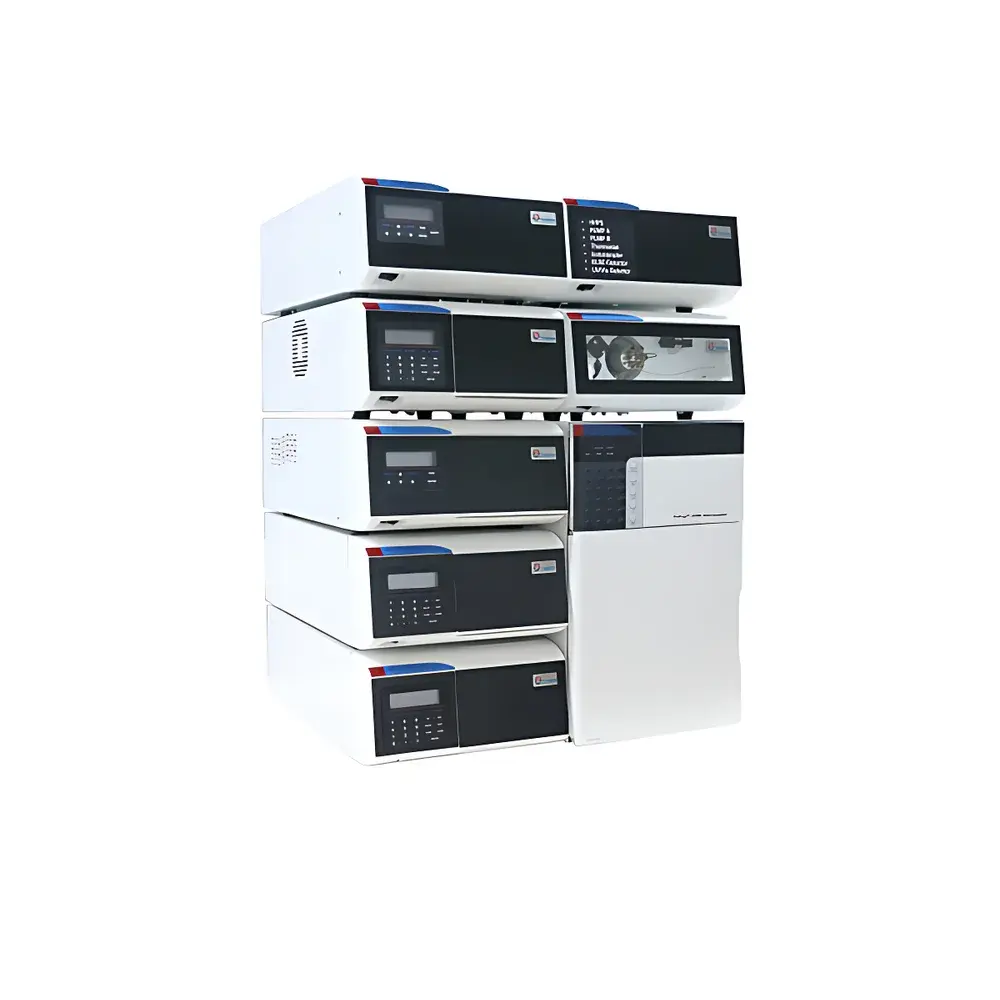
Unimicro TriSep®-3000 High-Efficiency Microfluidic Electro-HPLC System
| Brand | Unimicro Technologies |
|---|---|
| Origin | USA |
| Manufacturer Type | Original Equipment Manufacturer (OEM) |
| Product Category | Imported Instrument |
| Model | TriSep®-3000 High-Efficiency Microfluidic Electro-HPLC System |
| Instrument Type | Nanoflow Liquid Chromatograph |
| Application Profile | Specialized Analytical Instrument |
| Flow Rate Range | 0.001–10.00 mL/min |
| Maximum Pressure | 40 MPa |
| Flow Precision | <0.06% RSD |
| Sample Tray Capacity | 1.5 mL vials (105 positions) or 5 mL vials (10 positions) |
| Injection Volume Range | 20 nL, 50 nL |
| Column Oven Temperature Range | Ambient to 60 °C |
| UV-Vis Wavelength Range | 190–700 nm |
| Data Acquisition Rate | 100 Hz |
Overview
The Unimicro TriSep®-3000 is a high-efficiency microfluidic electro-hybrid liquid chromatography (eHPLC) system engineered for ultra-sensitive, high-resolution separation of complex biomolecular mixtures. It integrates capillary electrochromatography (CEC) and nanoflow liquid chromatography (nanoLC) within a single platform, leveraging dual separation mechanisms: chromatographic partitioning on stationary phases and electrophoretic mobility under an applied electric field. This hybrid principle—driven by both electroosmotic flow (EOF) and hydraulic pressure—produces plug-like flow profiles, minimizing band broadening and enabling exceptional column efficiency (>300,000 plates/m typical for 75 µm ID columns). Designed for applications demanding minimal sample consumption and maximal analytical information density, the TriSep®-3000 operates across nanoliter-to-milliliter flow regimes, supporting method development from discovery-scale proteomics to regulated QC workflows.
Key Features
- Dual-Mode Separation Architecture: Switchable between pressurized capillary electrochromatography (pCEC), nanoflow LC, and conventional HPLC via software-configurable fluidic routing and voltage control.
- Sub-Microliter Flow Control: Integrated piezoelectric-driven microfluidic pumps deliver stable flow from 0.001 mL/min to 10 mL/min with <0.06% RSD precision—critical for gradient reproducibility in low-volume separations.
- Modular Detection Interface: Native compatibility with capillary-compatible detectors including UV-Vis (190–700 nm), µLIF, µEC, µELSD, and ESI-MS sources—enabling orthogonal detection strategies without hardware modification.
- Patented Valve-Based Nanoinjection: Fixed-loop injection mechanism supports precise, repeatable delivery of 20 nL and 50 nL volumes with <1.2% injection-to-injection variability (n = 50).
- Low-Dead-Volume Gradient System: On-chip mixing and minimized inter-component volume (<1.2 µL) permit steep, reproducible gradients at pressures up to 40 MPa.
- Thermostatically Controlled Column Compartment: Maintains temperature stability ±0.2 °C from ambient to 60 °C, ensuring retention time reproducibility across multi-day runs.
Sample Compatibility & Compliance
The TriSep®-3000 accommodates a broad range of analytes—from intact proteins and post-translationally modified peptides to small-molecule metabolites, chiral pharmaceuticals, and environmental contaminants. Its microfluidic architecture enables direct coupling to electrospray ionization sources for bottom-up proteomics workflows, while its robust pressure rating supports sub-2 µm particle-packed columns and monolithic phases. The system complies with key regulatory frameworks for analytical instrument qualification: it supports audit-trail-enabled operation per FDA 21 CFR Part 11 when used with validated software; meets ISO/IEC 17025 requirements for method validation; and facilitates GLP/GMP-compliant documentation through configurable electronic lab notebook (ELN) integration. All optical and electronic subsystems are CE-marked and RoHS-compliant.
Software & Data Management
Control and data acquisition are managed via TriSep™ Control Suite v4.x—a Windows-based application supporting real-time monitoring, method templating, and automated sequence execution. The software provides full traceability: each run logs operator ID, instrument configuration, calibration history, and raw detector output with timestamped metadata. Dual-wavelength UV detection supports simultaneous acquisition at user-defined wavelengths (e.g., 214 nm + 280 nm for peptide/protein quantitation), while full-spectrum scanning (190–700 nm at 1 nm resolution) enables post-acquisition peak purity assessment. Data files conform to open-standard formats (mzML, ANDI-NetCDF), ensuring interoperability with third-party processing tools such as MaxQuant, Skyline, or OpenMS. System diagnostics—including lamp usage tracking, pump wear estimation, and valve cycle logging—are embedded for preventive maintenance scheduling.
Applications
- Proteomics & Biomarker Discovery: High-sensitivity identification of low-abundance phosphopeptides and glycopeptides from limited clinical samples (e.g., <1 µg tryptic digest).
- Biopharmaceutical Characterization: Resolving charge variants, deamidation products, and oxidation forms of monoclonal antibodies using mixed-mode pCEC columns.
- Chiral Separations: Baseline resolution of enantiomers in pharmaceutical intermediates using chiral stationary phases under combined EOF/hydraulic flow.
- Environmental & Food Safety Screening: Multi-residue analysis of pesticides and mycotoxins in complex matrices with µLIF or µELSD detection.
- Academic & Method Development Labs: Platform for exploring novel stationary phases, electric field modulation effects, and multi-dimensional coupling strategies (e.g., 2D-pCEC × nanoLC).
FAQ
What distinguishes eHPLC from conventional HPLC or CE?
eHPLC combines the selectivity of liquid-phase partitioning with electrophoretic mobility differences—yielding orthogonal resolution mechanisms unattainable by either technique alone. Unlike CE, it avoids current-induced Joule heating limitations; unlike HPLC, it eliminates parabolic flow profiles that degrade efficiency.
Can the TriSep®-3000 be used for regulated QC testing?
Yes—when deployed with validated methods and TriSep™ Control Suite configured for 21 CFR Part 11 compliance (including electronic signatures, audit trails, and role-based access), it meets ICH Q2(R2) and USP requirements for analytical instrument qualification.
Is column equilibration time reduced compared to standard nanoLC systems?
Yes—due to ultra-low system dead volume (<1.2 µL) and optimized gradient delay compensation algorithms, equilibration after gradient reconditioning typically requires ≤3 column volumes.
Does the UV-Vis detector support kinetic assays or spectral library matching?
Yes—the 100 Hz acquisition rate enables real-time monitoring of reaction progress, and spectral libraries (e.g., NIST, EPA) can be imported for automated peak identification via absorbance fingerprint matching.
How is detector lamp lifetime tracked and managed?
The system automatically records cumulative deuteration hours and displays remaining estimated lamp life in the status panel; lamp replacement requires no optical recalibration due to factory-aligned collimation and fixed-path-length design.
Related Products






