
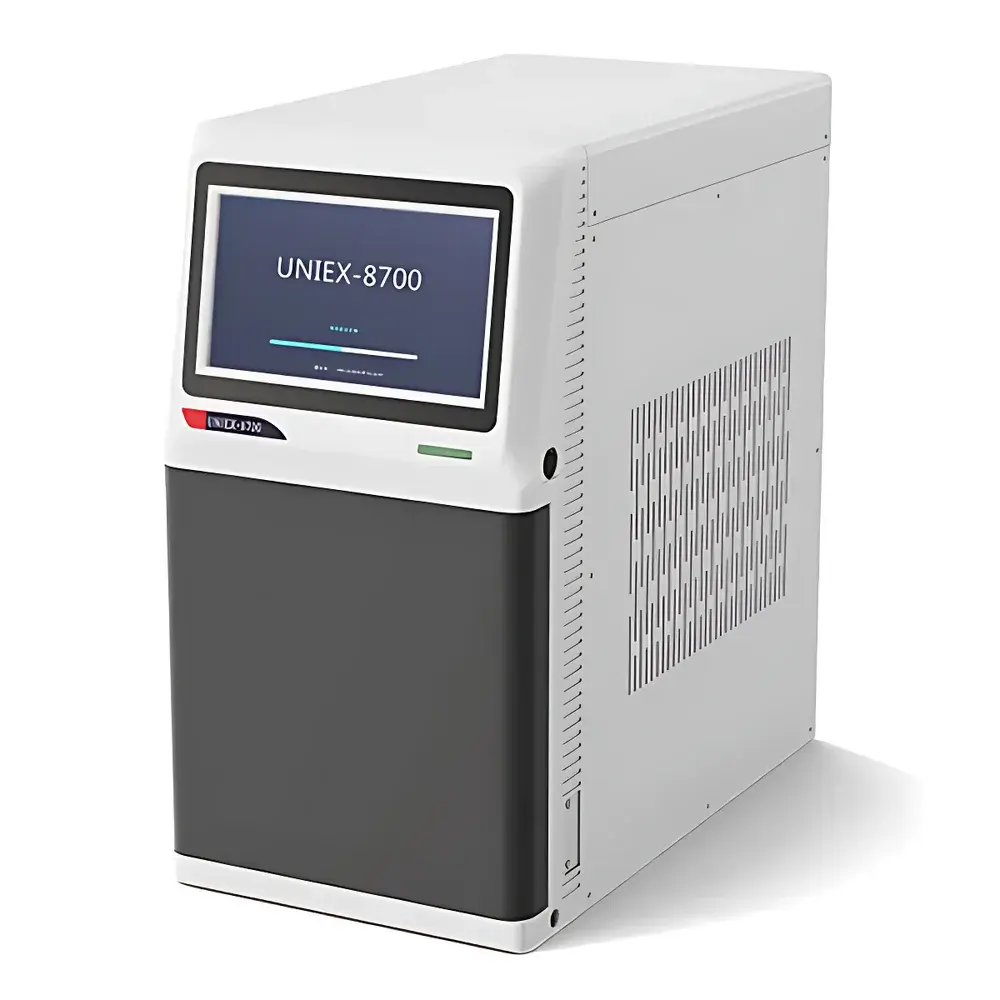
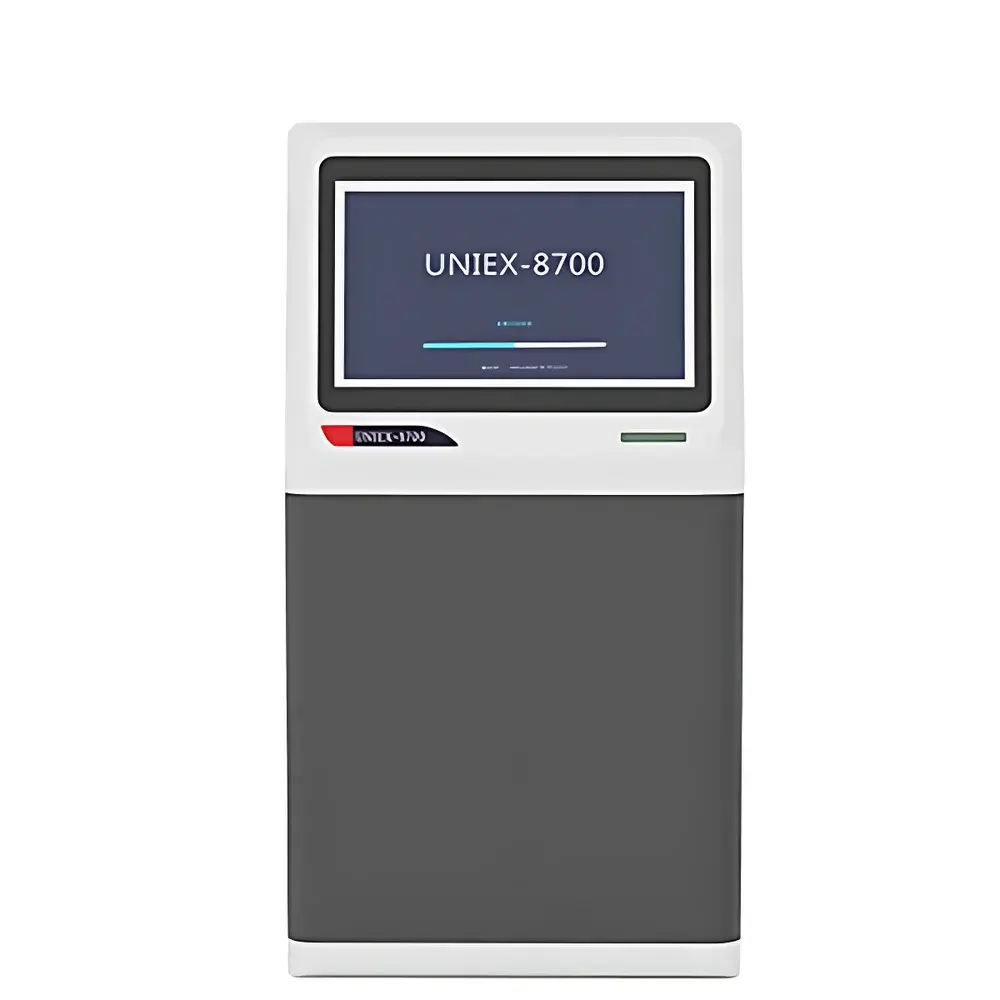
Unimicro UNIEX-8700 Evaporative Light Scattering Detector
| Brand | Unimicro Technologies |
|---|---|
| Origin | Jiangsu, China |
| Manufacturer Type | Direct Manufacturer |
| Instrument Type | Evaporative Light Scattering Detector (ELSD) |
| Compatible System | Liquid Chromatography (HPLC/UHPLC) |
| Light Source | Laser Diode |
| Detection Principle | Laser-based light scattering after nebulization and solvent evaporation |
| Wavelength | Fixed laser wavelength (typical 635–650 nm) |
| Noise Level | < 0.01 mV |
| Baseline Drift | < 0.1 mV |
| Detection Limit (LOD) | < 1 × 10⁻⁷ g on-column (for typical non-volatile analytes) |
| Signal Gain | Multi-step adjustable (6–8 discrete gain levels) |
| Temperature Control | Dual-zone heated drift tube (ambient to 120 °C, ±0.5 °C stability) |
| Operating Modes | High-Temp Mode & Low-Temp Mode (user-selectable) |
Overview
The Unimicro UNIEX-8700 Evaporative Light Scattering Detector (ELSD) is a high-performance, benchtop-compatible detection system engineered for universal, mass-sensitive detection in liquid chromatography applications. Unlike UV-absorbing or fluorescent analytes, the UNIEX-8700 detects non-volatile and semi-volatile compounds—including saponins, terpenoids, glycosides, lipids, alkaloids, carbohydrates, and inorganic salts—by converting eluted analytes into fine aerosol particles via controlled nebulization, followed by complete volatile solvent removal in a precisely regulated heated drift tube. The resulting dry analyte particles are illuminated by a stable laser diode source, and the intensity of scattered light is measured by a high-sensitivity photodetector. This physical detection principle ensures consistent response independent of chromophore presence, making the UNIEX-8700 particularly valuable in natural product analysis, excipient characterization, and impurity profiling where reference standards are unavailable or unstable.
Key Features
- Dual-temperature operating modes: Selectable high-temperature (up to 120 °C) and low-temperature (down to ambient +10 °C) drift tube configurations to optimize sensitivity and peak shape for thermally labile or highly volatile analytes.
- Multi-step signal gain control: Eight discrete gain levels enable precise dynamic range adaptation—from trace-level impurities (<100 pg) to high-concentration formulation components—without hardware recalibration.
- Dual-zone thermal management: Independent heating control of nebulizer chamber and drift tube ensures reproducible droplet desolvation kinetics and minimizes baseline drift (<0.1 mV over 60 min).
- Low-noise optical architecture: Integrated 635 nm laser diode with collimated beam path and low-dark-current photodiode delivers signal noise <0.01 mV (RMS, 1 Hz bandwidth), supporting robust quantitative performance at sub-nanogram levels.
- Touchscreen-integrated front panel: Local operation with real-time parameter monitoring, method storage, and diagnostic status display—no external PC required for routine use.
- Modular HPLC interface: Standard 1/16″ stainless-steel tubing connections, pressure-rated up to 10 MPa, compatible with all major HPLC and UHPLC systems including Agilent, Waters, Shimadzu, and Thermo Fisher platforms.
Sample Compatibility & Compliance
The UNIEX-8700 supports broad-spectrum detection across pharmaceutical, nutraceutical, food safety, and traditional medicine applications. It is routinely deployed in QC laboratories performing analyses per USP , EP 2.2.46, and Chinese Pharmacopoeia methods for herbal extracts, polysaccharide quantification, lipid profiling, and residual solvent assessment. Its mass-proportional response enables accurate relative quantitation without compound-specific calibration—critical for complex matrices such as TCM formula granules, biopharmaceutical excipients (e.g., polysorbates, phospholipids), and low-abundance degradation products. All firmware and operational logic comply with GLP documentation requirements, including full audit trail logging (user actions, parameter changes, calibration events) when integrated with compliant chromatography data systems (CDS).
Software & Data Management
The UNIEX-8700 communicates natively via USB 2.0 and Ethernet (TCP/IP) protocols, enabling seamless integration with third-party CDS platforms—including Empower, Chromeleon, OpenLab CDS, and LabSolutions. Optional Unimicro ELSD Control Suite provides instrument remote configuration, real-time signal visualization, gain optimization wizards, and automated baseline correction algorithms. Raw analog output (0–1 V DC) and digital signal streams support synchronized acquisition with detector timing markers. All data files adhere to ASTM E1985-compliant ASCII format, ensuring long-term archival integrity and cross-platform compatibility. Audit trails meet FDA 21 CFR Part 11 requirements when deployed with validated electronic signature modules and role-based access controls.
Applications
- Quantitative analysis of non-UV-active natural product constituents (e.g., ginsenosides, astragalosides, glycyrrhizin) in botanical extracts and TCM preparations.
- Stability-indicating assays for biopharmaceutical formulations containing non-ionic surfactants and lipid nanoparticles.
- Residual catalyst or salt quantification in synthetic organic intermediates and API purification streams.
- Carbohydrate profiling in infant formula, functional foods, and prebiotic supplements.
- Method development support for orthogonal detection strategies in ICH Q5 and Q6A-compliant comparability studies.
FAQ
Does the UNIEX-8700 require post-column derivatization for carbohydrate detection?
No. As a mass-sensitive detector, it responds directly to dried analyte particles and does not rely on chromophore formation.
Can the UNIEX-8700 be used with gradient HPLC methods?
Yes—its dual-zone temperature control and adaptive gain algorithm mitigate baseline disturbances commonly observed during mobile phase composition changes.
Is the laser source replaceable by the end user?
Laser module replacement requires factory recalibration and is performed only by authorized Unimicro service engineers to maintain optical alignment and signal linearity specifications.
What is the maximum recommended flow rate for optimal nebulization efficiency?
0.2–2.0 mL/min for standard stainless-steel nebulizers; microflow configurations (0.01–0.2 mL/min) are supported using optional low-flow nebulizer kits.
Does the UNIEX-8700 support 21 CFR Part 11 compliance out of the box?
Full Part 11 functionality (electronic signatures, audit trails, system validation templates) is enabled when operated with validated CDS software and configured per Unimicro’s IQ/OQ documentation package.
Related Products






