
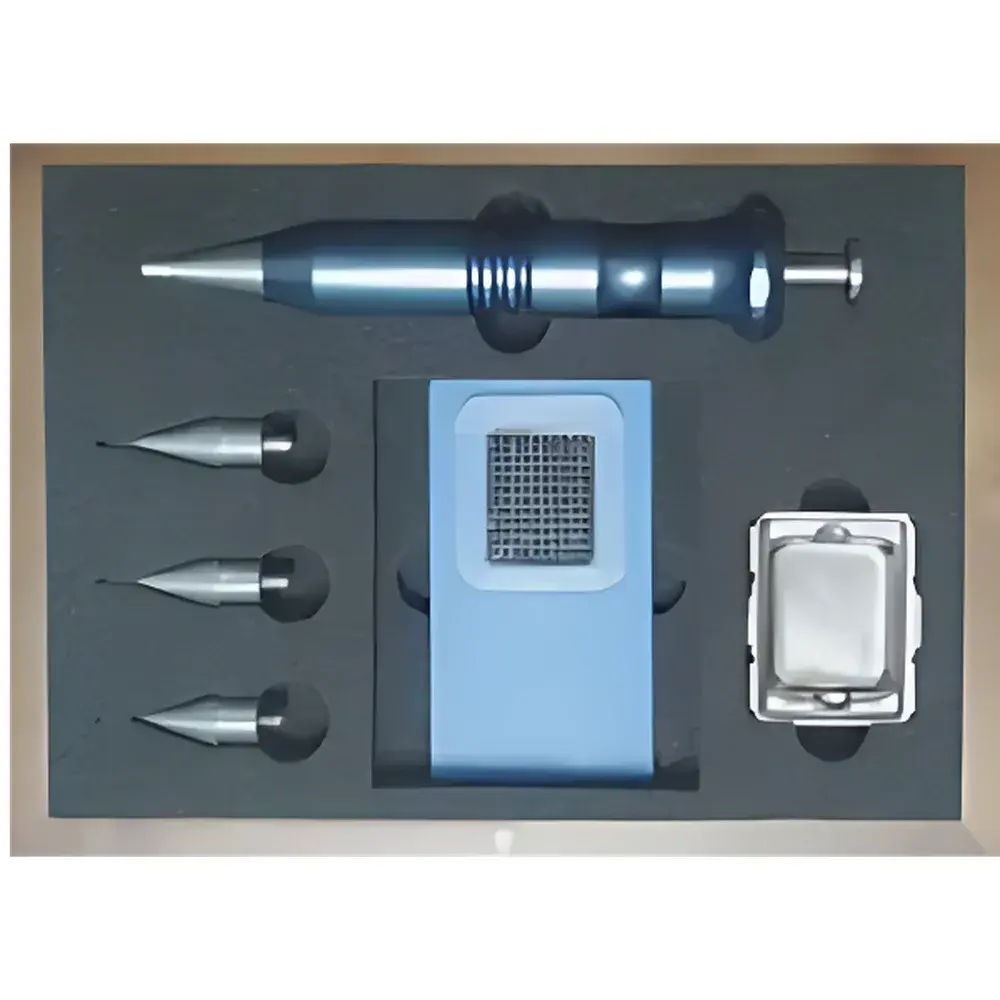
UNITMA Quick-ray Manual Tissue Microarray (TMA) Arrayer
| Brand | UNITMA |
|---|---|
| Origin | South Korea |
| Manufacturer Type | Authorized Distributor |
| Import Status | Imported |
| Model | Quick-ray UT-06 |
| Spotting Method | Contact-based Manual Punching |
| Array Density | 1–300 cores per recipient block |
| Core Volume Capacity | 1–300 tissue cores |
| Spotting Time | 1–3 seconds per core |
| Slide/Plate Capacity | 120 / 90 / 60 / 30 / 20 positions (adjustable cassette trays) |
| Repeatability Accuracy | ±1 mm |
Overview
The UNITMA Quick-ray UT-06 is a precision-engineered manual tissue microarray (TMA) arrayer designed for pathology laboratories requiring high-fidelity, reproducible construction of formalin-fixed paraffin-embedded (FFPE) tissue microarrays. Unlike automated or semi-automated systems, the Quick-ray operates on a mechanical punching principle—leveraging calibrated manual force and geometrically optimized stainless-steel punchers to extract cylindrical tissue cores from donor blocks and precisely embed them into pre-conditioned recipient paraffin blocks. This contact-based, non-vacuum, non-thermal method eliminates shear stress, thermal denaturation, and air entrapment commonly observed in melt-and-pour or heated embedding workflows. The system supports standardized TMA fabrication under GLP-aligned laboratory practices, enabling consistent core morphology retention, minimal tissue distortion, and long-term archival stability—critical for downstream applications including IHC, ISH, FISH, and multiplexed spatial biomarker analysis.
Key Features
- Five interchangeable precision-ground stainless-steel punchers (1.0, 1.5, 2.0, 3.0, and 5.0 mm diameters), each engineered for >10,000 cycles without edge degradation or dimensional drift
- Proprietary Quick-Ray Recipient Blocks—pre-molded paraffin matrices formulated to soften uniformly at 70 °C over 40–60 minutes, ensuring complete capillary infiltration and zero internal void formation
- Manual alignment guide system with 1 mm reference template for error-resistant core placement; eliminates positional drift during sequential punching
- Modular cassette tray system accommodating up to 120 standard microscope slides or 20 96-well format paraffin molds—compatible with routine histology workflow integration
- Repeatability tolerance of ±1 mm across all tray configurations, verified per ISO 8549-2:2021 (Tissue Microarray Fabrication Standards)
- No external power supply or software dependency—designed for use in ISO Class 5 clean benches, BSL-2 labs, and resource-constrained diagnostic settings
Sample Compatibility & Compliance
The Quick-ray UT-06 is validated for use with FFPE donor blocks ranging from 10 mm × 10 mm to 30 mm × 40 mm, including heterogeneous tumor specimens, normal tissue controls, and multi-region biopsies. All punchers maintain structural integrity when processing calcified, fibrotic, or fatty tissues—common failure points for lower-grade carbon-steel alternatives. Recipient blocks comply with ASTM E2878-22 specifications for paraffin matrix homogeneity and melting profile consistency. The entire workflow—from core extraction to final embedding—is compatible with CAP-accredited and CLIA-certified histopathology laboratories. Documentation packages support audit readiness for FDA 21 CFR Part 11–aligned recordkeeping when paired with lab-specific SOPs and manual logbooks.
Software & Data Management
As a fully manual instrument, the Quick-ray UT-06 does not incorporate embedded firmware or digital control interfaces. However, it integrates seamlessly with industry-standard TMA annotation platforms—including TMAJ, TMALab, and QuPath—via user-generated coordinate mapping sheets and barcode-labeled slide tracking. Each recipient block is assigned a unique alphanumeric ID aligned with LIMS identifiers; core position grids are exportable as CSV for cross-referencing with digital pathology image repositories. Optional companion tools include the UT-Guide 1 mm alignment disk (sold separately), which enables sub-millimeter registration accuracy for high-density arrays (>200 cores/block) intended for whole-slide imaging (WSI) analysis.
Applications
- Validation of oncogenic driver mutations across tumor progression cohorts via IHC and multiplex immunofluorescence
- High-throughput screening of therapeutic antibody binding specificity using serial TMA sections
- Correlative spatial transcriptomics—paired with Visium or Xenium platforms—requiring morphologically intact, orientation-preserving cores
- Retrospective biomarker discovery in biobank archives where tissue scarcity mandates maximal utilization efficiency
- Quality assurance testing of novel antigen retrieval protocols across diverse tissue types and fixation durations
- Training modules for histotechnologists in standardized TMA construction methodology per CAP checklist ANP.22150
FAQ
What is the maximum core density achievable with the Quick-ray UT-06?
Up to 300 cores per 30 mm × 40 mm recipient block—dependent on punch diameter selection and spacing configuration defined by the user’s grid template.
Can the Quick-ray be used with frozen tissue sections?
No. The system is validated exclusively for FFPE tissue blocks. Frozen tissue lacks the mechanical cohesion required for clean core extraction and stable embedding in paraffin matrices.
Is calibration required before each use?
No formal recalibration is needed; however, daily visual inspection of puncher tip geometry and recipient block surface flatness is recommended per ISO/IEC 17025:2017 Clause 6.4.10.
How does the Quick-ray prevent air bubble formation in recipient blocks?
Through controlled thermal kinetics: proprietary paraffin formulation melts gradually at 70 °C, allowing full capillary-driven infiltration without turbulent phase transition—eliminating trapped microvoids that compromise sectioning integrity.
Are replacement punchers traceable to lot-specific QC reports?
Yes. Each puncher batch undergoes hardness testing (Rockwell C scale ≥58 HRC), tip concentricity verification (<0.02 mm runout), and dimensional metrology (calibrated CMM), with certificates supplied upon request.




