
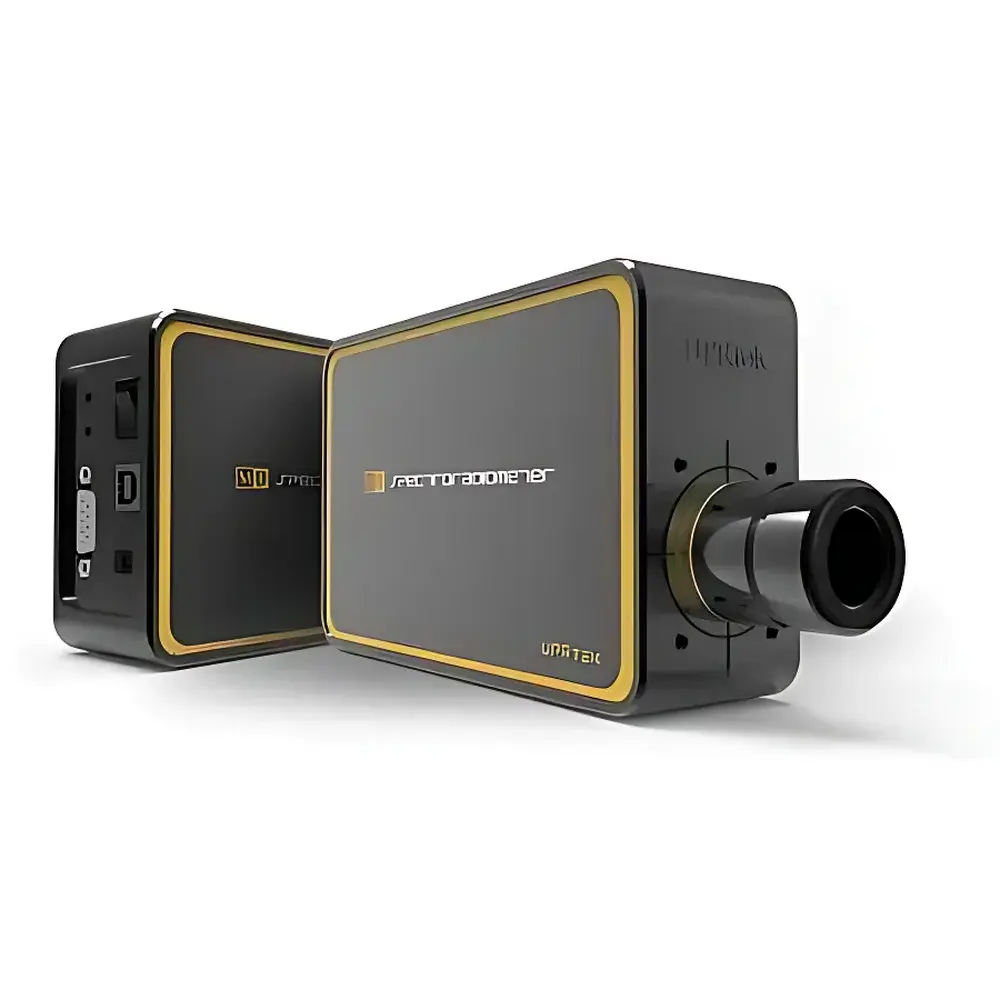
UPRtek MD100N Spectroradiometric Luminance Meter
| Brand | UPRtek |
|---|---|
| Origin | Taiwan |
| Model | MD100N |
| Spectral Range | 380–780 nm |
| Spectral Resolution | 1 nm |
| FWHM | ~12 nm |
| Measurement Area | Ø10 mm |
| Field of View | ±1° |
| Luminance Range | 0.001–5000 cd/m² |
| Luminance Accuracy | ±2% (100–5000 cd/m²), ±3% (0.2–100 cd/m²), ±4% (0.05–0.2 cd/m²) |
| Chromaticity Accuracy | ±0.002 CIE1931 x,y (100–5000 cd/m²), ±0.003 (0.2–100 cd/m²), ±0.005 (0.05–0.2 cd/m²) |
| Stray Light | ≤−25 dB |
| Polarization Error | <2% |
| Integration Time | 100 µs–5000 ms |
| Digital Resolution | 16-bit |
| Flicker Sampling Rate | up to 100 kS/s |
| Dimensions | 204 × 90 × 45 mm |
| Weight | 630 g ±10 g |
Overview
The UPRtek MD100N Spectroradiometric Luminance Meter is a benchtop-grade, CMOS linear array-based spectroradiometer engineered for high-fidelity optical characterization of self-emissive and backlit display technologies. Unlike traditional tristimulus colorimeters—whose spectral mismatch error limits accuracy under non-standard illuminants—the MD100N employs true spectral acquisition across the full visible range (380–780 nm) at 1 nm data intervals, enabling traceable, first-principles photometric and colorimetric computation per CIE S 026/E:2015, ISO/CIE 19898:2022, and IEC 62368-1 Annex G. Its core architecture integrates a precision collimated optical path with ±1° angular acceptance, ensuring minimal cosine error and spatial uniformity compliance for flat-panel emission measurement. Designed specifically for R&D labs, display QA/QC facilities, and AR/VR hardware validation teams, the MD100N delivers calibrated luminance (cd/m²), chromaticity (CIE 1931 xy, CIE 1976 u’v’), correlated color temperature (CCT), spectral power distribution (SPD), and flicker metrics—all traceable to NIST-traceable calibration standards.
Key Features
- True spectral measurement using a linear CMOS sensor with 1 nm spectral sampling resolution and ~12 nm full-width-at-half-maximum (FWHM) bandwidth, eliminating metamerism-related errors inherent in filter-based photometers.
- High dynamic range luminance detection from 0.001 to 5000 cd/m², with tiered accuracy specifications validated per CIE Publication 127:2007 and IEC TR 62778:2014.
- Sub-pixel-level chromaticity repeatability: ≤0.0005 Δxy (2σ) at luminances ≥100 cd/m², meeting requirements for OLED microdisplay qualification and HDR tone-mapping verification.
- Integrated flicker analysis engine compliant with JEITA AP-001, VESA Flicker Standard FPDM2, and IEEE 1789-2015—supporting RMS, percent flicker, flicker index, and frequency-domain spectral decomposition.
- Auto-dark correction, programmable integration time (100 µs–5 s), and polarization-insensitive optics (<2% polarization error) ensure robust operation across diverse panel architectures including MiniLED local dimming zones and microLED arrays.
- 16-bit analog-to-digital conversion and ≤−25 dB stray light rejection enable low-noise spectral acquisition even under high-contrast ambient conditions typical of cleanroom display testing environments.
Sample Compatibility & Compliance
The MD100N is optimized for emissive and transmissive optical sources used in next-generation visual interfaces: LCDs with quantum-dot enhancement films (QDEF), white and RGB OLED panels, MiniLED and microLED microdisplays, AR waveguide combiners, VR pancake lenses, and smart wearable indicators. Its Ø10 mm measurement aperture and ±1° field-of-view align with ISO 13406-2 Annex B and CIE 122:1996 requirements for small-area display uniformity assessment. All photometric outputs—including luminance, CCT, Duv, CRI (Ra and R1–R15), and SPD—are computed using CIE standard observer functions (2° and 10°) and maintained in strict conformance with CIE S 014-1/E:2022 and ISO/CIE 11664-1:2019. Calibration certificates include uncertainty budgets per ISO/IEC 17025:2017, and firmware supports audit-ready logging for GLP/GMP-regulated environments.
Software & Data Management
The MD100N operates natively with UPRtek’s uSpectrum Pro and uFlicker software suites (Windows 10/11), providing full spectral data export in CSV, XML, and industry-standard CIE 15:2018-compliant .cie formats. Users define custom measurement sequences—including multi-point spatial mapping, temporal luminance decay profiling, and automated pass/fail thresholds based on ΔE₀₀, gamma deviation, or flicker index—via drag-and-drop workflow builders. The included SDK enables direct integration into LabVIEW, Python (PyVISA), and MATLAB environments for automated test systems. All raw spectra and metadata are timestamped, instrument-serial-number-tagged, and support FDA 21 CFR Part 11-compliant electronic signatures when deployed with validated IT infrastructure.
Applications
- Display R&D: Characterization of emissive efficiency, viewing angle dependence, and color shift under varying drive currents in OLED and microLED prototypes.
- Manufacturing QA: In-line verification of luminance uniformity, white point stability, and flicker compliance per IEC 62471 and ENERGY STAR Program Requirements v8.0.
- AR/VR Hardware Validation: Quantification of exit pupil luminance, chromatic aberration-induced color fringing, and temporal response artifacts in near-eye displays.
- Lighting & Backlight Unit (BLU) Testing: Spectral analysis of edge-lit LED arrays, phosphor-converted white LEDs, and narrow-band blue/green/red MiniLEDs for backlight modulation fidelity.
- Academic Research: Spectral radiance modeling for human visual system studies, circadian lighting assessments, and metameric failure analysis in high-dynamic-range imaging systems.
FAQ
What spectral calibration standards does the MD100N reference?
The MD100N is factory-calibrated against NIST-traceable tungsten halogen and LED-based standard lamps, with spectral irradiance and radiance transfer functions certified per ISO/IEC 17025-accredited procedures.
Can the MD100N measure pulsed or PWM-driven displays?
Yes—the 100 kS/s maximum sampling rate and adjustable integration time (down to 100 µs) allow precise capture of fast transient emissions, including high-frequency PWM dimming used in AMOLED and microLED drivers.
Is the device compliant with FDA or EU regulatory requirements for medical display validation?
While not a Class II medical device itself, the MD100N meets technical prerequisites for DIN EN 62368-1, IEC 62676-5-1 (video surveillance displays), and DICOM GSDF calibration workflows when paired with appropriate software validation protocols.
How is measurement traceability maintained over time?
UPRtek provides optional annual recalibration services with full uncertainty reporting; users may also perform on-site dark/white reference checks using the integrated auto-dark correction and supplied calibration tile (CIE Standard Illuminant D65).
Does the MD100N support remote operation in automated test benches?
Yes—RS-232 and USB 2.0 interfaces support SCPI command sets, enabling seamless integration into ATE platforms and CI/CD pipelines for continuous display performance monitoring.





