
UPRtek MF250N Handheld Flicker and Spectral Analyzer
| Origin | Taiwan |
|---|---|
| Manufacturer Type | Authorized Distributor |
| Domestic Product Classification | Yes |
| Model | MF250N |
| Price | USD 1,180 (FOB) |
Overview
The UPRtek MF250N is a portable, high-precision flicker and spectral analyzer engineered for objective quantification of temporal light modulation (TLM) and spectral photometric parameters in real-world lighting environments. Unlike conventional lux meters or basic colorimeters, the MF250N integrates dual-path optical detection—simultaneously capturing full spectral irradiance data (380–780 nm) and time-resolved photometric waveforms—with on-device Fast Fourier Transform (FFT) processing to derive industry-standard flicker metrics. Its core measurement principle relies on high-speed CMOS photodetector sampling synchronized with internal timestamping, enabling accurate reconstruction of light output waveforms at up to 20 kHz effective sampling rate. Designed for compliance verification, R&D validation, and field diagnostics, the MF250N supports traceable assessment of flicker-related visual discomfort and stroboscopic effects per IEEE PAR1789, ENERGY STAR V2.0, IEC TR 61547-1, and CIE TN 006:2016.
Key Features
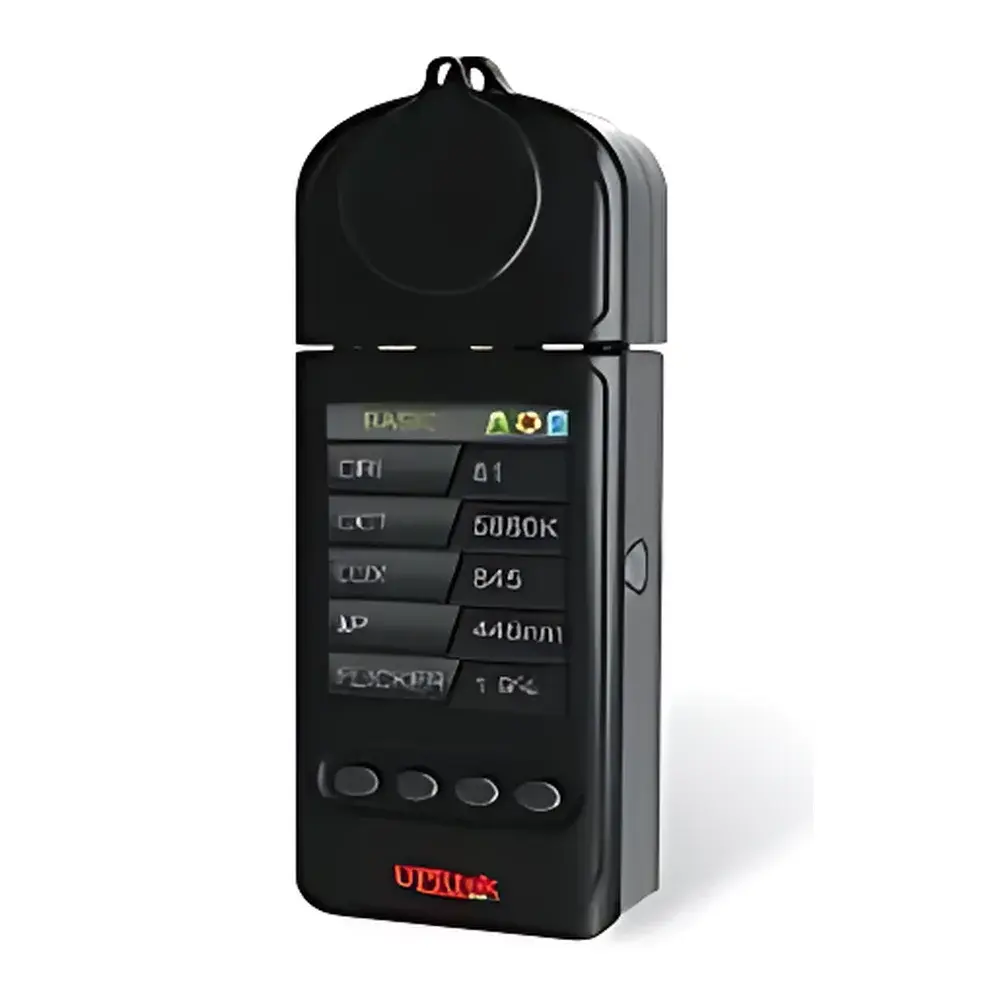
- Simultaneous spectral and temporal analysis: Measures CCT, CRI (Ra), illuminance (lux), peak wavelength (λP), and spectral power distribution (SPD) alongside flicker metrics in a single acquisition.
- Comprehensive flicker parameter calculation: On-device computation of Percent Flicker (%F), Flicker Index (FI), modulation frequency (Hz), and Stroboscopic Visibility Measure (SVM) per CIE/PHILIPS/DOE harmonized methodology.
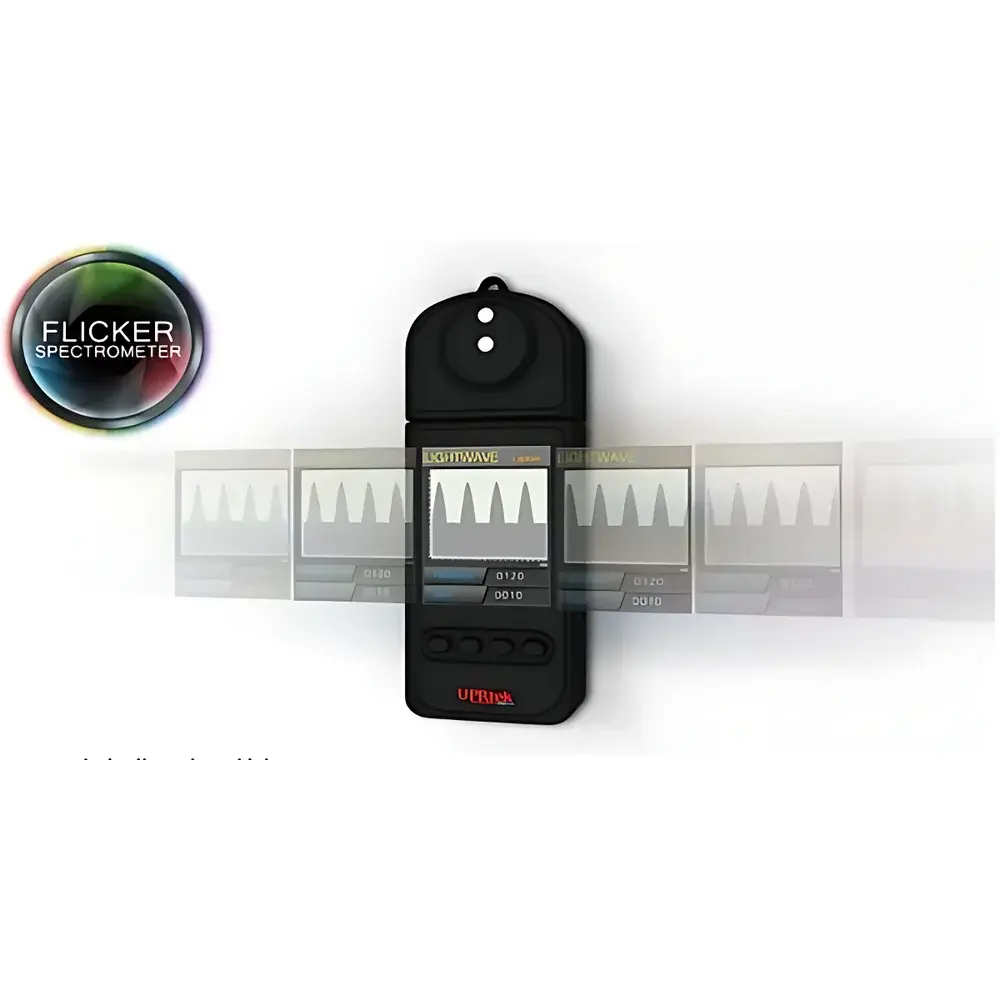
- Four dedicated operational modes: Basic (photometric/spectral snapshot), Spectrum (full SPD display), Flicker (real-time %F/FI/SVM/frequency overlay), and Waveform (oscilloscope-style light intensity vs. time plot with FFT spectrum view).
- Integrated LightWave mode: Visualizes raw photometric waveform with amplitude scaling, enabling direct correlation between driver circuit behavior and emitted light modulation.
- Dark calibration routine: Mandatory pre-measurement dark offset compensation ensures baseline stability; recommended before each session to maintain <±2% repeatability in low-light conditions.
- Rugged handheld form factor: IP52-rated enclosure, 3.5-inch capacitive touchscreen, rechargeable Li-ion battery (8 hrs typical operation), and USB-C data export.
Sample Compatibility & Compliance
The MF250N is compatible with all common electrically powered light sources—including LED modules, fluorescent tubes, HID lamps, OLED panels, and smart lighting systems—regardless of driver topology (TRIAC-dimmable, PWM-controlled, or constant-current). It meets functional requirements for GLP-aligned laboratory use and field audits under ISO/IEC 17025-accredited workflows. While not itself a certified reference standard, its firmware implements algorithms aligned with ASTM E308-19 (for CIE colorimetric computations), IEC 61000-4-15 (flicker emission testing), and CIE S 023/E:2013 (SVM calculation protocol). Traceable calibration services are available annually through UPRtek’s ISO/IEC 17025-certified calibration lab (certificate included).
Software & Data Management
Data acquisition and post-processing are supported via the free PC-based uSpectrum software (v5.0+), which enables batch analysis, comparative reporting, and export to CSV, PDF, or XML formats compliant with FDA 21 CFR Part 11 audit trail requirements (when used with validated system configuration). The device stores up to 1,000 measurement records internally, each tagged with GPS coordinates (optional), timestamp, operator ID, and environmental metadata. Firmware updates are delivered via signed OTA packages to ensure integrity and version control across multi-user deployments.
Applications
- Lighting product development: Validation of driver design against IEEE PAR1789 flicker thresholds during prototyping and qualification.
- Quality assurance labs: Routine screening of production batches for conformance to ENERGY STAR, DLC, or Zhaga Consortium flicker specifications.
- Building commissioning: On-site verification of installed luminaires in healthcare facilities, schools, and offices where stroboscopic effects impact occupant well-being.
- Academic research: Empirical studies on TLM perception thresholds, circadian lighting efficacy, and human-centric lighting performance.
- Regulatory support: Generation of evidentiary reports for CE marking, FCC Part 15B, or RoHS compliance documentation involving photobiological safety and temporal light artefacts.
FAQ
What is the recommended calibration interval for the MF250N?
Annual calibration by an ISO/IEC 17025-accredited laboratory is recommended to maintain measurement uncertainty within published specifications.
Does the MF250N require external triggering or synchronization for accurate flicker analysis?
No. It uses internal high-stability quartz timing and adaptive sampling rate selection to auto-synchronize with the fundamental modulation frequency of the source.
Can SVM be measured for frequencies below 80 Hz?
SVM is mathematically defined only for modulation frequencies ≥ 80 Hz per CIE TN 006:2016; the instrument disables SVM calculation and displays “N/A” for lower frequencies.
Is the spectral resolution sufficient for narrowband LED source characterization?
With 2-nm optical bandwidth and 10-nm data interval across 380–780 nm, it resolves major LED phosphor peaks and provides adequate fidelity for CCT/CRI calculations per CIE 15:2018.
How does the MF250N handle ambient light interference during flicker measurement?
It employs optical bandpass filtering centered at 555 nm (photopic response) and real-time background subtraction using dark-reference frames acquired immediately prior to each measurement cycle.




