
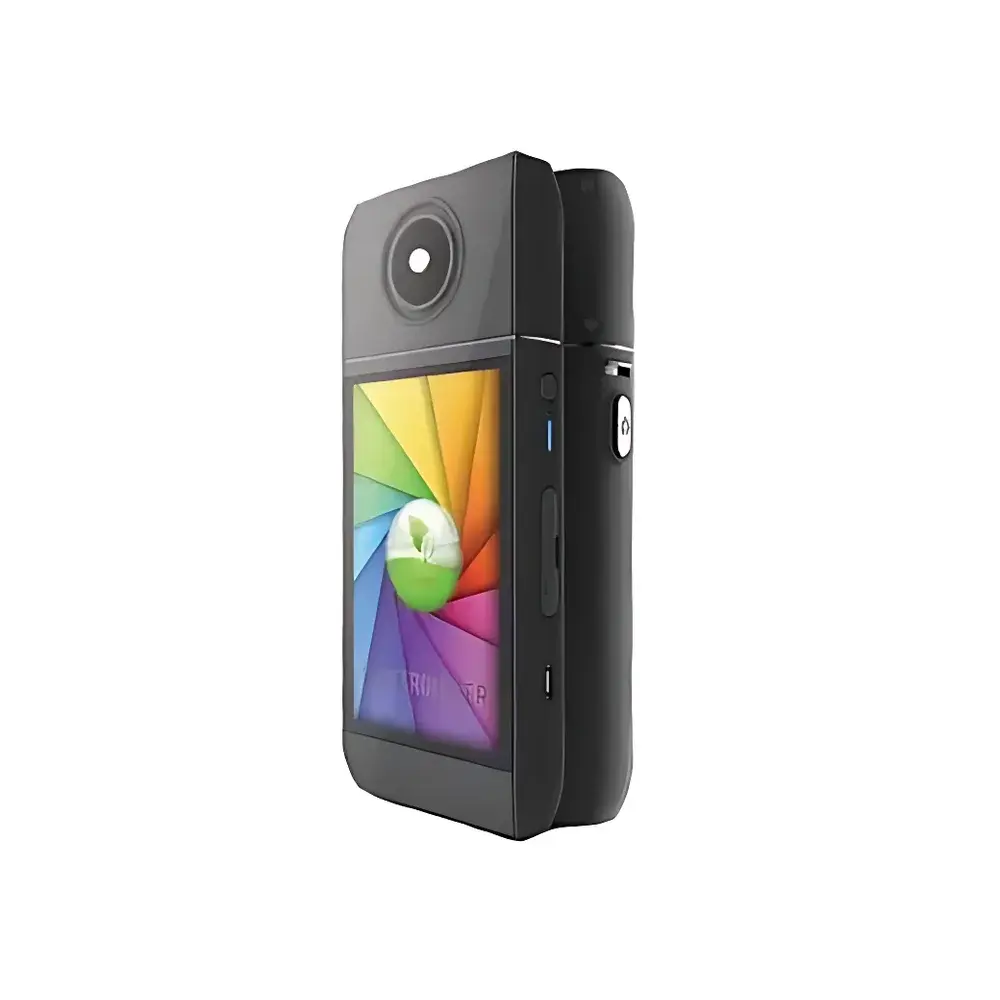
UPRtek PG200N Handheld Plant Lighting Spectroradiometer
| Brand | UPRtek |
|---|---|
| Origin | Taiwan |
| Model | PG200N |
| Spectral Range | 350–800 nm |
| FWHM | ~9 nm |
| Illuminance Accuracy | JIS C 1609-1:2006 Class AA (oblique incidence) |
| Irradiance Accuracy | DIN 5032-7 Class B (oblique incidence) |
| IP Rating | IP66 |
| Measurement Ranges | 70–150,000 lx |
| Exposure Time | 100 µs – 1,000 ms |
| Dimensions | 190 × 81.7 × 29.5 mm (H×W×D) |
| Weight | 280 g ±10 g |
Overview
The UPRtek PG200N Handheld Plant Lighting Spectroradiometer is an engineered field instrument designed for quantitative spectral characterization of horticultural lighting systems. Unlike conventional quantum meters that report only photosynthetic photon flux density (PPFD) as a single integrated value, the PG200N captures full spectral irradiance across the biologically critical 350–800 nm range—including UV-A (350–400 nm), visible (400–700 nm), and far-red (700–800 nm) bands—enabling spectral quality assessment aligned with photobiological response functions such as phytochrome photoequilibrium (Pfr/Ptot), cryptochrome activation, and UV-B signaling pathways. Its core optical architecture employs a grating-based spectroradiometric sensor with ~9 nm full width at half maximum (FWHM) resolution, calibrated traceably to NIST-traceable standards. The device operates on the principle of direct spectral irradiance measurement via linear CCD detection, with real-time conversion to photometric, radiometric, and photosynthetically active radiation (PAR)-weighted metrics. It is purpose-built for controlled-environment agriculture (CEA), greenhouse operations, plant tissue culture labs, and academic photobiology research where spectral fidelity, portability, and environmental robustness are non-negotiable.
Key Features
- Integrated G-sensor for real-time tilt-angle compensation—minimizes cosine error during oblique measurements and enables precise spatial registration of measurement orientation relative to canopy plane.
- IP66-rated optical head and sealed housing—ensures operational reliability in high-humidity greenhouses, outdoor nurseries, and dew-prone growth chambers without degradation in spectral responsivity or calibration stability.
- Dual-mode illumination compliance: meets JIS C 1609-1:2006 Class AA (for illuminance) and DIN 5032-7 Class B (for irradiance) requirements under oblique incidence conditions—critical for accurate readings beneath angled LED arrays or reflective surfaces.
- Simultaneous output of three standardized units: illuminance (lx), irradiance (W/m²), and photosynthetic photon flux density (PPFD, µmol/m²·s)—all derived from the same spectral scan, eliminating inter-conversion uncertainty.
- Adjustable exposure time (100 µs to 1,000 ms) with auto-exposure optimization—ensures high signal-to-noise ratio across low-intensity shade environments and high-output vertical farming fixtures.
- Ergonomic handheld form factor (190 × 81.7 × 29.5 mm; 280 g) with intuitive touchscreen interface and onboard spectral visualization—supports rapid field deployment without external computing devices.
Sample Compatibility & Compliance
The PG200N is compatible with all common horticultural light sources—including narrowband LEDs (e.g., 450 nm blue, 660 nm red, 730 nm far-red), broad-spectrum white LEDs, fluorescent tubes, and supplemental HPS lamps. Its 350–800 nm spectral coverage encompasses key photoreceptor action spectra defined by CIE S 026/E:2018 and ASABE EP471.2, enabling validation against lighting design targets for specific crops (e.g., lettuce, tomato, cannabis). The instrument complies with international photometric standards for field-deployable sensors and supports audit-ready data collection per GLP principles. While not FDA 21 CFR Part 11-certified out-of-the-box, its timestamped, sensor-logged measurement files (CSV and proprietary .upr format) are structured to integrate into validated LIMS or ELN platforms requiring electronic record integrity.
Software & Data Management
UPRtek’s free SpectroPlus PC software (v3.0+) provides post-acquisition analysis including spectral comparison overlays, PPFD mapping across multi-point datasets, custom weighting function application (e.g., McCree curve, CIE PAR, or user-defined phytochrome-weighted integrals), and batch export compliant with ASTM E308-22 spectral data formatting conventions. All measurements include embedded metadata: GPS coordinates (when paired with optional Bluetooth GNSS module), tilt angle, ambient temperature, date/time stamp, and instrument serial number—facilitating traceability in multi-site cultivation trials. Raw spectral data is stored unprocessed, preserving fidelity for third-party reanalysis or machine learning model training.
Applications
- Validation of LED fixture spectral output against horticultural lighting specifications (e.g., DesignLights Consortium Horticultural Qualified Products List).
- Canopy-level PPFD uniformity mapping in vertical farms and tiered grow racks.
- Far-red supplementation efficacy assessment for stem elongation control and flowering induction in photoperiod-sensitive species.
- UV-A dosing verification in disease-suppression protocols and secondary metabolite enhancement studies.
- Longitudinal spectral drift monitoring of aging horticultural lamps to inform replacement schedules.
- Academic research on spectral quality effects on photomorphogenesis, anthocyanin accumulation, and stomatal conductance.
FAQ
Does the PG200N require annual factory recalibration?
Yes. UPRtek recommends traceable recalibration every 12 months against NIST-traceable reference standards to maintain compliance with JIS and DIN accuracy classes.
Can it measure pulsed or modulated LED lighting?
Yes—the adjustable exposure time and internal synchronization logic allow stable spectral capture of PWM-driven fixtures at frequencies ≥1 kHz.
Is spectral data export compatible with MATLAB or Python?
Yes. CSV exports contain wavelength (nm) and spectral irradiance (µW/cm²/nm) columns, directly ingestible via pandas or numpy for custom spectral analysis pipelines.
What is the angular acceptance of the cosine corrector?
The diffuser adheres to f(2) cosine correction error <±2% up to 75° incidence angle, validated per CIE Publication 188:2011.
Does it support wireless data transfer?
Via optional Bluetooth 5.0 dongle (sold separately), enabling real-time telemetry to iOS/Android tablets running UPRtek’s mobile app for live spectral display and geotagged logging.




