
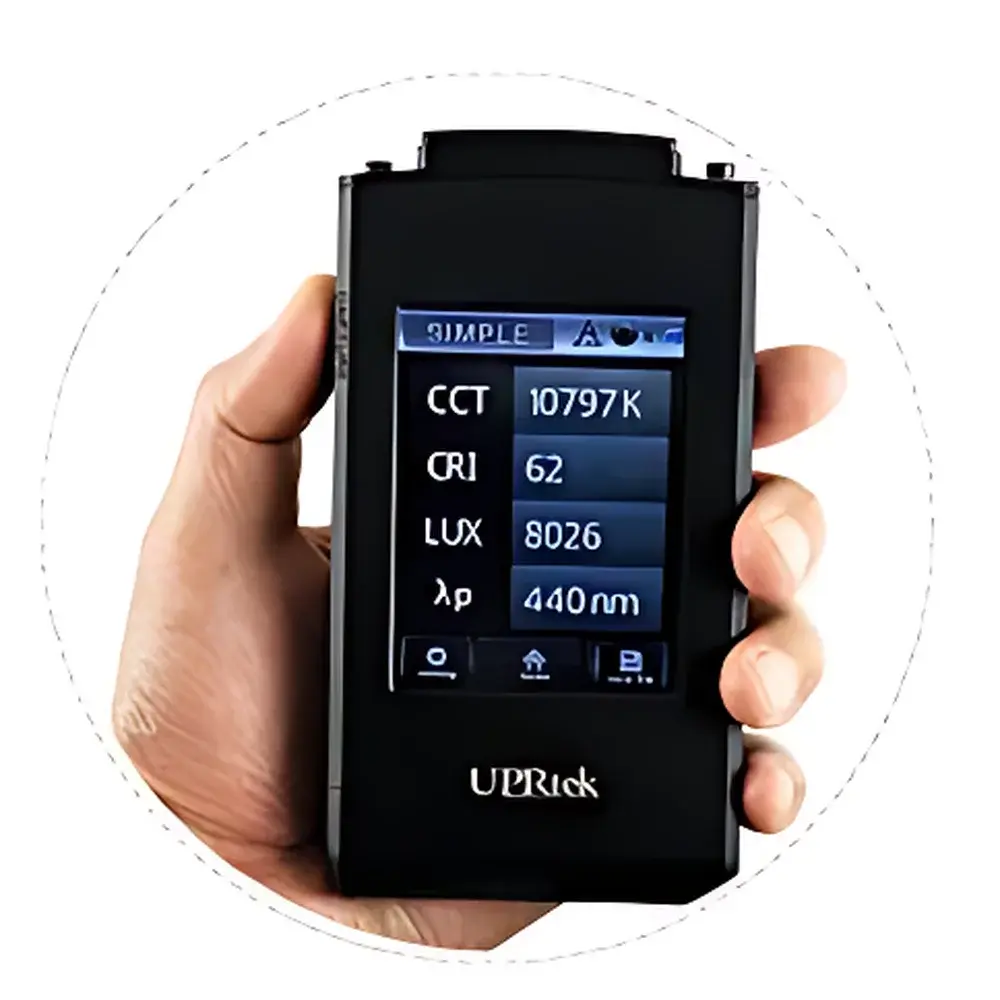
UpTek MK350N Handheld Spectroradiometer
| Brand | UpTek |
|---|---|
| Origin | USA |
| Manufacturer Type | Authorized Distributor |
| Import Status | Imported |
| Model | MK350N |
| Price Range | USD 1,400 – 4,200 (FOB) |
| Display | 3.5″ capacitive touchscreen |
| Connectivity | Bluetooth 4.0 (iOS & Android compatible) |
| Measurement Modes | Single-shot & Continuous (1 Hz update rate) |
| Output Formats | CSV, Excel (.xlsx), BMP |
| Storage | microSD card (1–32 GB) |
| Calibration | NML/CMS-compliant spectral calibration with auto-dark correction routine |
| Spectral Range | 360–780 nm |
| Optical Resolution | ≤ 8 nm (FWHM) |
| Illuminance Range | 0.01–99,999 lx |
| CCT Accuracy | ±50 K (2000–10,000 K) |
| CRI (Ra) Uncertainty | ±1.5 (CIE 13.3–1995) |
| Chromaticity Coordinates | CIE 1931 (x,y) & CIE 1976 (u',v') |
| Peak Wavelength Detection | Yes |
| Spectral Data Export | Full spectrum (1 nm step) |
Overview
The UpTek MK350N Handheld Spectroradiometer is a field-deployable, battery-powered optical measurement instrument engineered for high-fidelity spectral characterization of visible-light sources in situ. Unlike conventional photometers or filtered colorimeters, the MK350N employs a linear CCD array spectrometer with a holographic diffraction grating and thermally stabilized optical path to perform full-spectrum acquisition across 360–780 nm at 1 nm resolution. This enables traceable, physics-based derivation of photometric (illuminance in lux), colorimetric (CIE 1931 xy, CIE 1976 u’v’, correlated color temperature), and radiometric (peak wavelength, spectral power distribution) quantities — all without requiring external computing hardware. Designed for lighting engineers, architectural lighting designers, LED product developers, and theatrical lighting technicians, the MK350N meets the operational demands of real-world environments where portability, immediate feedback, and metrological integrity are critical.
Key Features
- Integrated 3.5″ capacitive touchscreen interface enabling intuitive menu navigation, real-time spectral visualization, and on-device parameter configuration without auxiliary devices.
- Bluetooth 4.0 wireless communication protocol supporting bidirectional data exchange and remote control via UpTek’s official mobile application (iOS and Android).
- Onboard continuous measurement mode delivering synchronized updates of illuminance, CCT, CRI, and chromaticity coordinates at 1 Hz — suitable for dynamic lighting validation and temporal stability assessment.
- NML/CMS-traceable factory calibration with built-in dark-current compensation algorithm; user-initiated dark calibration recommended after power-on and following ambient temperature shifts >5°C.
- MicroSD card slot supporting Class 10 cards (1–32 GB) for long-term unattended logging; data export includes full-spectrum CSV files, Excel-compatible reports (.xlsx), and annotated BMP images of spectral plots and chromaticity diagrams.
- Ruggedized polycarbonate housing rated IP54 for dust and splash resistance, optimized for use in construction sites, stage rigging environments, and manufacturing cleanrooms.
Sample Compatibility & Compliance
The MK350N is validated for quantitative analysis of broadband and narrowband light sources including white LEDs, RGB LED arrays, OLED panels, fluorescent tubes, halogen lamps, and theatrical gel-filtered fixtures. Its spectral response conforms to CIE S 023/E:2013 for spectral irradiance measurement instruments and satisfies the spectral mismatch requirements outlined in IEC 62471 (Photobiological Safety) Annex D. While not certified for regulatory compliance reporting under FDA 21 CFR Part 11 or ISO/IEC 17025, its calibration documentation supports internal quality assurance workflows aligned with ISO 9001 lighting test procedures and GLP-aligned laboratory practices. Device firmware adheres to IEEE 11073-20601 for medical-grade Bluetooth interoperability frameworks.
Software & Data Management
Data acquisition, visualization, and post-processing are supported through UpTek’s proprietary MK350 Series Mobile App (v3.2+), which provides live spectrum overlay, comparative analysis between reference and test spectra, and batch export of time-stamped measurement logs. Raw spectral data is stored in vendor-neutral CSV format with metadata headers specifying integration time, sensor temperature, calibration ID, and GPS-tagged location (if enabled on host device). The instrument does not implement cryptographic signing or audit trail functionality; however, exported Excel reports include embedded timestamps, operator ID fields, and version-controlled calibration certificate references — facilitating traceability in ISO/IEC 17025-accredited laboratories conducting lighting performance verification per LM-79 or EN 13032-4 protocols.
Applications
- Architectural lighting commissioning: Verifying spatial uniformity of CCT and R9 values across façade installations and interior spaces.
- LED product development: Accelerating binning decisions by correlating spectral shape deviations with lumen maintenance predictions.
- Theatrical and broadcast lighting QA: Validating color fidelity of moving lights and LED fresnels against gamut targets (e.g., Rec. 2020, DCI-P3).
- Human-centric lighting (HCL) studies: Quantifying melanopic EDI (Equivalent Daylight Illuminance) using CIE S 026 spectral weighting functions.
- Educational laboratories: Teaching spectral radiometry fundamentals, CIE color space transformations, and photometric unit derivations.
FAQ
Is the MK350N compliant with NIST-traceable calibration standards?
Yes — each unit ships with a calibration certificate referencing NML/CMS (National Measurement Laboratory / Calibration and Measurement Standards) traceability for spectral responsivity and illuminance sensitivity.
Can the device measure pulsed or modulated light sources (e.g., PWM-driven LEDs)?
It supports measurement of quasi-steady-state sources with modulation frequencies below 10 Hz; for higher-frequency flicker analysis, a dedicated flickermeter (e.g., UPRtek MF250N) is required.
Does the MK350N support third-party software integration via API or SDK?
No — UpTek does not provide public APIs or driver-level SDKs; data exchange is limited to Bluetooth HID profile and file-based import/export.
What is the recommended recalibration interval?
Annual recalibration is advised under normal usage conditions; more frequent verification is recommended when used in high-temperature or high-humidity environments (>85% RH, >40°C).
Can spectral data be imported into MATLAB or Python for custom analysis?
Yes — raw CSV outputs contain wavelength (nm) and intensity (µW/cm²/nm) columns, fully compatible with SciPy, Pandas, and MATLAB’s readmatrix() function.




